The Rev. William Blyth had weathered or assimilated the threat of Methodism in the village and also that of the Evangelical Anglicans but the arrival of Catholics in the village caused him increasing stress.
After Martha Hutchison died in 1868 St Mary’s Lodge in the High Street was left to her surviving son William Corston Hutchison. The original Methodist school/chapel built by William Corston had been sold to Mrs Hutchison and a new chapel built in Chapel Lane. Both of her sons, the other was Aeneas Barkly Hutchison ,were Anglican priests and often took services for William Blyth at St Martins when visiting their mother. William was curate of St Endellion in Cornwall but in 1851, as part of the Oxford movement, he converted to Catholicism. He was obviously quite an important and devout convert as he moved to Rome and became private chamberlain to both Pope Leo IX and Pope Benedict XIII and was also tutor to Louis Napoleon. After the death of his mother Martha in 1868 he returned to Fincham with his second wife , Anastasia, and youngest son (who had been born in the Papal States) and Italian nurse to live in St Mary’s Lodge.
Oral history of the village has it that St Mary’s Lodge and what was originally the Wesleyan chapel was once a Roman Catholic chapel and school and nunnery.

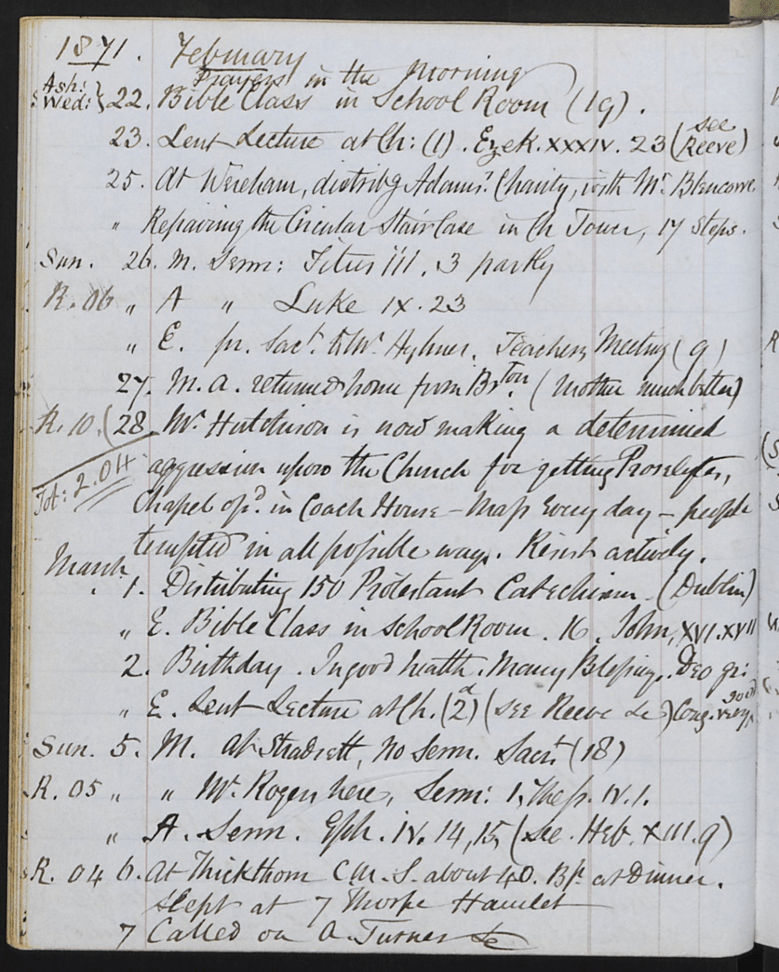
We owe the following information to William Blyth’s diary.
1868 March 23rd With Wm Hutchison arranging for his mother’s funeral which she requested should be a very quiet one but to which he is inviting nearly 100 persons.
1868 March 28th Mrs Hutchison was buried today by the side of her father Her son, grandson, and nephew were chief mourners Canon Longman came.
There were 12 bearers.
60 hat bands were sent out.
112 pairs of gloves
300 cakes for the children
60lbs of tea and sugar and 60 loaves distributed to the poor of the parish.
Not by order of the deceased but by Wm Hutchison.
(Her nephew was Robert Hutchison sometime Mayor of Liverpool. Some of her cousins, the Sadd’s, and the Hopkins’, both Methodists, still lived in the village Cardinal Stephen Longman was the Catholic priest from Oxburgh Hall, Oxborough )
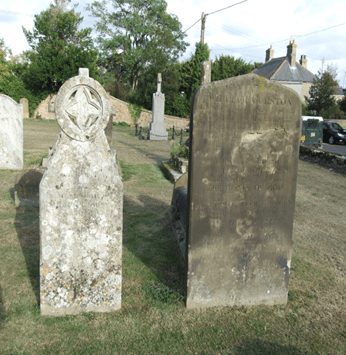
Martha was buried in the churchyard next to her father William Corston. The letters in hoc salus (I.H.S.) appear on the gravestone. (There is safety in this.) This is one of three interpretations of the letters IHS which often appear on Roman Catholic tombstones and monuments.
1869 March 30th Discovered popery insidiously creeping into the parish and must now oppose it in earnest.
School Log book April 5th 1869 Mr Hutchison a Roman Catholic, neither trustee, manager nor subscriber came into the school and claimed the right of remaining. Mr Blyth indignantly denied that he had any such right. (Charles Triggs school master)
1869 April 12th Spoke again against the incursion of popery in Fincham.
1869 April 21st Dropped Mr Hutchison’s acquaintance.
1871 Jan 3rd Mr Hutchison applying for admission to the Institute is objected to.
1871 Feb 28th Mr Hutchison is now making a determined aggression upon the church for getting proselytes. Chapel opened in coach house mass every day. people tempted in all possible ways. (see Blyth diary entry above)
1871 May 16th Romish efforts for the perversion of the religion of the village carried on most unscrupulously by the Hutchisons A Italian priest is now with them.
And then much to William Blyth’s relief
1872 Oct 23rd Sale of St Mary’s Lodge £600 to one Pidgeon
William Hutchison and family moved to London next to St Marys Catholic church in Hampstead.
The second Catholic chapel was started by the daughter of Admiral Noel of Moat House. A private chapel it eventually moved to Downham to become the present Catholic church.
According to the history of the Catholic Church in Downham the Parish Priest of Swaffham, Father Vendé records in the Swaffham Parish Mission Book that Mass was celebrated at Fincham in 1914. He writes:
“In December of that same year (1914) Miss Noel expressed the desire of opening an Oratory in her house, called “The Moats”. With the permission of Admiral and Lady Noel, a small place, formerly the painting studio of Miss Noel, was chosen as a temporary chapel.
“I consented every Sunday with the Bishop’s approval to say Mass in Fincham, and I did so until the time of the opening of the Downham Market Mission. The number of Catholics in Fincham was two at the time, but a good few refugees were stationed in Downham and the neighbourhood.”
Downham Market Catholic Church
An entry in the Swaffham Parish Mission Book for 1915 reads: “The principal event recorded for this year was the opening of the Church at Downham Market. By permission of the Bishop, and the generosity of Miss Noel, the principal benefactress, together with Mrs Wayman, a local resident, and recent convert, a stable was provided to be used as a Chapel. On 19th March (1915) I said the FIRST MASS SINCE THE REFORMATION IN DOWNHAM MARKET, in the presence of a few stray Catholics and in the evening, I gave Benediction, at which many non-Catholics assisted. Mrs Winter, and the nuns of Swaffham were present, with the pupils, to form a choir.”
.
 Fincham Local History Society