In the centuries before the advent of modern record keeping it is only the church registers that give us a fragmentary view of the diseases that swept the village on a regular basis. The parish church records convey an idea of the magnitude of the death toll but not the number of parishioners that may have survived such epidemics. Throughout the 18th Century outbreaks of Smallpox would strike the village on a regular basis resulting in programs of inoculation on two occasions.
This loathsome disease was very prevalent at this time, and was increased and propagated by the practice of inoculation. Some of the parishioners still hold to the old sentiments of their forefathers very pertinaciously on this subject, and it is probable that a hundred years will intervene between the discovery of vaccination and its universal adoption, with legislative sanction on its side, and a £10 penalty against a contrary practice.
- 1696. Six persons of one family named Sutton were buried in five months, having died probably from small pox.
- 1746. All those with this mark X before then, dyed of the small pox (about 12) when upwards of 90 had it in the town, as witness my hand, W. Harvey.
- 1748. A Further Outbreak kills possibly 26.
- 1754. This year there were many deaths (13) from small pox, and amongst its victims was “Lebèurfeverèlla daughter of Thomas and Lebèurfeverèlla Lock,” a very outlandish name truly, of the origin of which I am ignorant.
- 1761. A Further Outbreak kills possibly 21.
- 1788. This year small pox had gained such an alarming ascendancy (10 dead) that a vestry was summoned, whose collective wisdom resolved that no one in the parish should escape. “It was agreed unanimously to inoculate the poor inhabitants of this parish at the “public expense” and Mr. Bayfield was forthwith employed, and his bill was £14 14s. for spreading a filthy disease and plague in the village.
- 1802. The same thing was done again this year, and the sum of £21 15s. 6d. paid for like results, with many deaths.
In 1863 Revd William Blyth wrote: “Let the striking contrast presented by our own times have its proper influence in the cause of health and medical science. Inoculation is illegal, and vaccination compulsory, effected by the overwhelming evidence in favor of Jenner’s great discovery in 1770, and fatal cases of small pox are comparatively rare. Just eight years more will complete the centenary of experimental vaccination, and we trust that by that time we may be permitted to see, in God’s Providence, its complete triumph.”
Smallpox vaccination was made compulsory in 1853
Tragically, in the year that William Blyth wrote of the improvements in medical science he would lose his own daughter Ellen to an equally deadly disease that struck the very young, the symptoms of which have a resonance with our own recent pandemic.
Diphtheria
- Initial symptoms of diphtheria present about three to five days after exposure to someone else with the germ. Transmission generally occurs by inhaling the droplets of an infected person’s fluids. One’s presence around a person with diphtheria who is sneezing or coughing is usually enough to contract the disease.
- Symptoms at first include fever and sore throat. One of the most dangerous aspects of the illness is the formation of a membrane over the throat, the nose, and into the bronchial tubes, which can significantly impact breathing. Swollen glands under the throat worsen breathing problems. Those with diphtheria often have a croup-like cough which cannot be resolved by exposure to night air.
- As the membrane thickens over the throat, physicians may need to perform an a tracheotomy to maintain an airway. People with diphtheria usually require hospitalization and administration of intravenous antibiotics in order to recover. To complicate matters, diphtheria may also affect the heart and cause serious cardiac damage. Diphtheria must also be treated with a medication called diphtheria anti-toxin to prevent such damage.
From a register
This book contains the burials of half a century, and the average is exactly 16 per annum. This book (containing 800 entries) was finished under very melancholy circumstances. A fatal epidemic, diphtheria, in all its various forms, has prevailed for about 12 months in the parish, and still continues its unsparing ravages. Hereby the number of deaths, according to the annual averages, are already exactly doubled, no less than 23 or 24 having occurred from this disease alone.
William Blyth
In 1863 Diphtheria extracted a cruel toll on some of the families of Fincham.
- The twins Frederick and Arthur Addison were buried on March 25th and April 8th 1863.
- The Family of Robert Lemmon Farmer (farming 225 acres employing 7 labourers & 5 boys) living at Shrublands on High Street lost 5 children
- Laura Lemmon Sep 3 1863 Aged 11
- Robert Lemmon Sep 9 1863 Aged 5
- Charles J Lemmon Sep 11 1863 Aged 7
- Annie Lemmon Sep 16 1863 Aged 9
- Harriet Lemmon Sep 18 1863 Aged 4
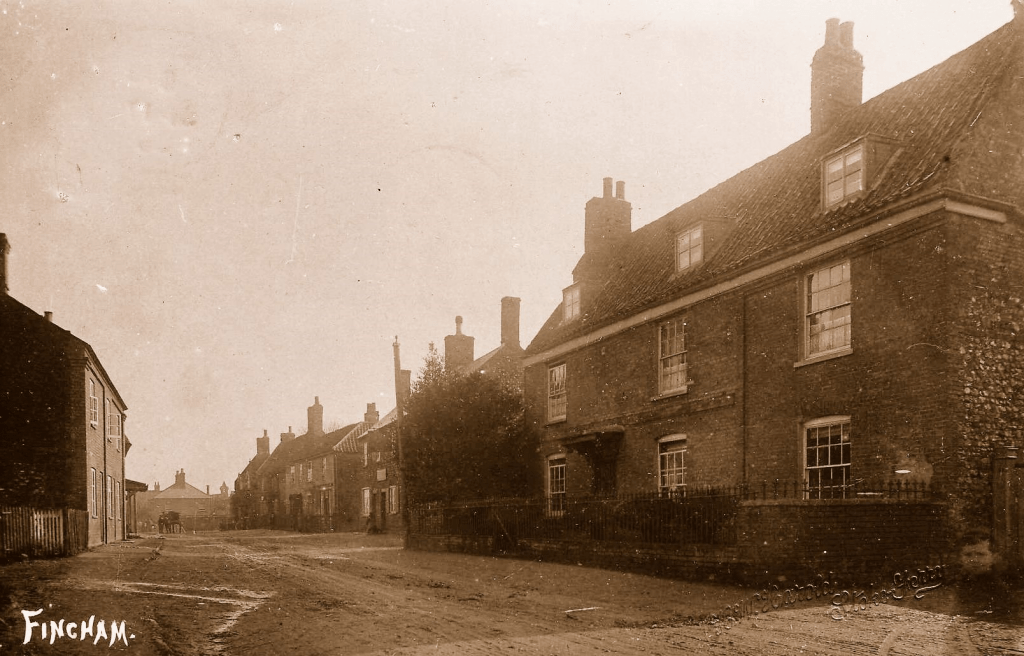
- The burials were all performed by the Rev William Blyth, except:
W.F. Welch, Vicar of Stradsett, officiated for
Sarah Claydon, buried Dec 3 1862
Frederick John Rumball, buried May 21 1863
Martha Ann Rixx, buried Aug 13 1863
Dorothy Porter buried Aug 18 1863
A. Thurtell, Rector of Oxburgh, officiated for
Ellen Blyth, buried Apr 30 1863
John Holley (of Barton Bendish), officiated for
Daniel William Waters, buried Oct 6 1863
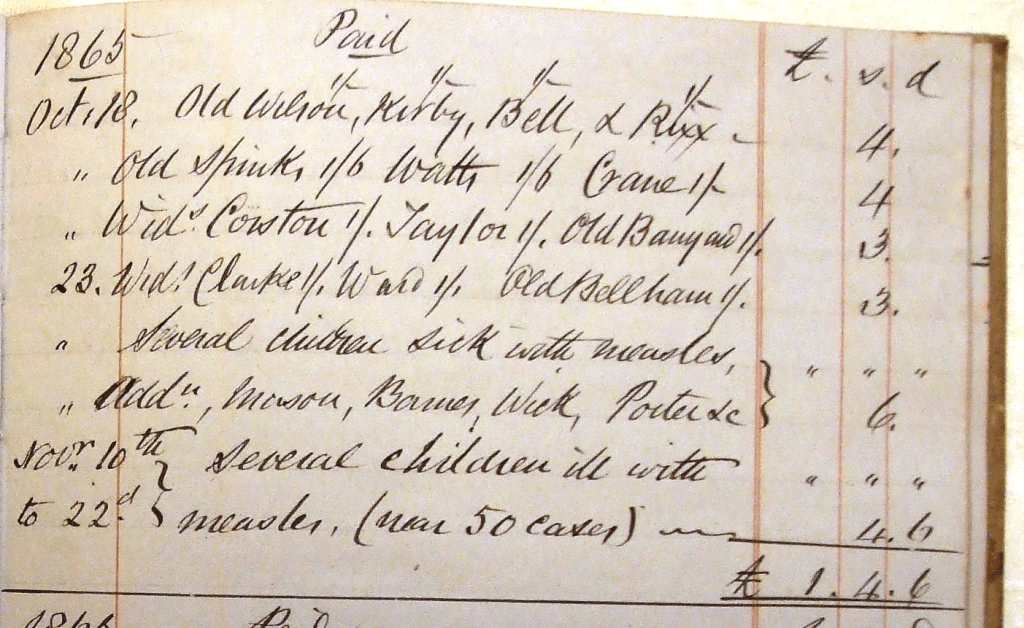
In November 1865 the parish accounts show an outbreak of 50 cases of Measles in the village and although the disease could be deadly there is nothing in the burial records to suggest there was an increase in the mortality rate at this time.
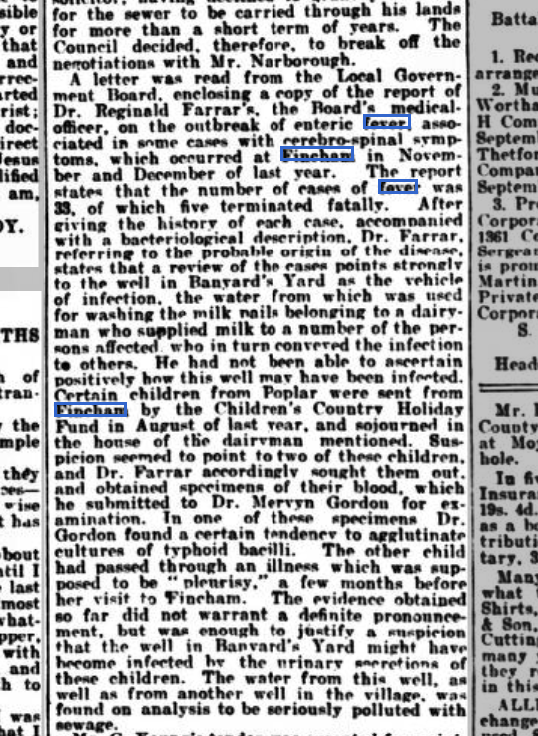
In November and December 1905 there was an outbreak of spotted Fever in Fincham. Spotted fever or cerebrospinal meningitis was a generally fatal disease. The source of the outbreak was traced to a poisoned well in Banyard’s Yard. In September 1906 a report on the outbreak found there to have been 33 cases in the village of which five were fatal including the school manager, T H Barker and a local shopkeeper.
Doctors,
Whilst 19th Century medicine was not always effective, Fincham did at least have it fairly close at hand. There were no doctors in the neighbouring villages of Shouldham, Marham, or Barton Bendish.
- Benjamin Bayfield Apothecary apprenticed to Henry Edgar surgeon at Downham Market. On 4th April 1774 a Vestry meeting appoints him apothecary and surgeon to the poor of the parish for the year ensuing.
- Frederick Gent Australia House (practicing 1836 -1851) Born 1789 In 1839 he was a Surgeon living in Australia House High Street he died on Dec 31st 1851 aged 62 and his headstone may be found in the churchyard of St Martins Church.
- Edward Arthey of Ivy House (practicing 1836-1871) Born 1797 at Isleham Cambridgeshire Member of the College of Surgeons and a Licentiate of the Apothecaries Hall and General practitioner owner and occupier of 2 acres of land. 1835 Surgeon living ‘near the Church’ 1863 Living in Ivy House Shown in 1871 Census with Wife Martha Arthy, born 1797 Caister, Norfolk. and his daughter Harriet Arthy born 1831 Fincham.
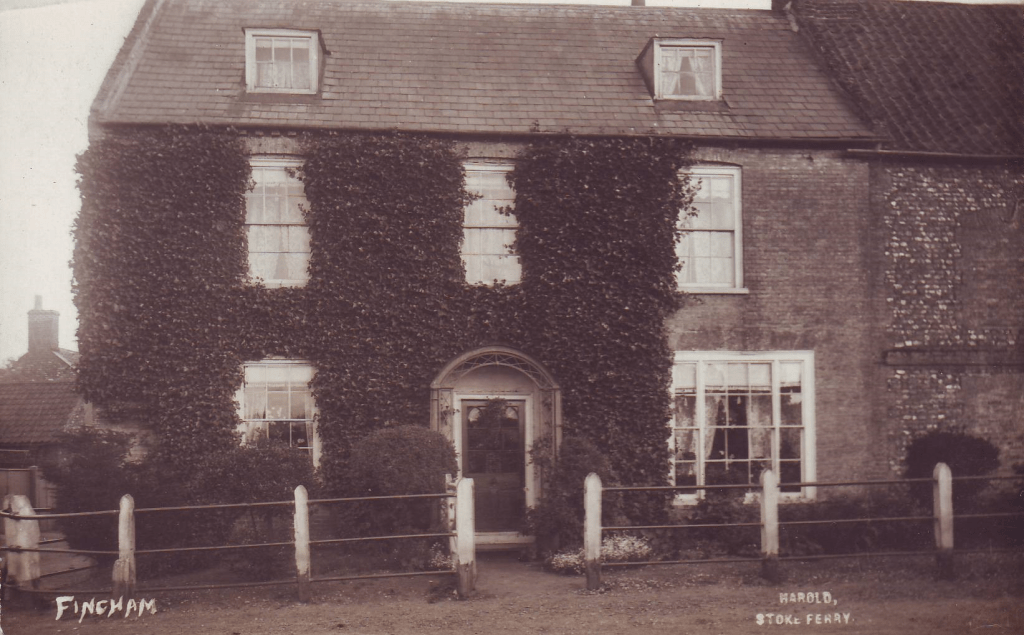
- William Cater of Holly House (practicing 1856-1894) Born in Norwich in 1824 Married Francis Aylmer in 1853, 1 x Son William Aylmer Cater. Moved into Holly House, High Street in 1856, 42 Years Surgeon to the Parish. In 1863 son William died of Diphtheria and in 1879 wife Frances died. On 18th Oct 1880 Dr Cater married Mary Moore Hill. William Cater died in 1894 aged 70 and he is buried in the churchyard of St Martin’s Church.
- In November 1870 William Blyth’s diary notes a program of vaccinations being conducted by the village doctor. Dr William Cater vaccinated at his own house (Holly House) on the 1st 2nd and 3rd Monday of each month at 10 a.m. And inspects cases on the 4th at the same house.
- George Blake Masson of Holly House (practicing 1897-1920) – Born in Dargeeling India in 1859. Author of Prolapsus Uteri – British Medical Journal 1889. Dissolved practice in Ramsgate on 6thMay1897 and moves to Fincham. In 1906 he extends Holly House. In 1899 he was appointed Surgeon Lt to 3 Vol Bn Royal Norfolk Regiment and in 1908 Surgeon Captain to 2nd East Anglian Field Ambulance. In 1914 he was appointed Lt Col Officer Commanding 2nd East Anglian Field Ambulance. Called up in 1914 aged 54 he asked to be considered for active service but he was refused. In 1918 he was located at 25 General Hospital British Expeditionary Force France as Lt Col. 1919 – British Army of the Rhine – Officer Commanding 47 Casualty Clearing Station Bruhl. In 1920 he Returned to Kirk Brampton Doncaster 1920 and marries Erina Cecilia Rolfe(28) in the same year. In 1921 he moved to Eastbourne as Medical Officer to Bromley Convalescent Home Ramsgate. He died in Alfriston Sussex on 8th Oct 1932.
- Leslie Steven Med Officer Downham 1916
- Frederick Unwin of Holly House (practicing1920-1969) Born 1890. In 1912 he trained at Westminster Hospital 1915 – University School Guys Hospital Medical Officer and Public vaccination Officer No 3 District Downham Union, Medical referee Prudential and other assurance companies. Member of the BMA and Collage of Preceptors London. 1915-1917 – Lecturer in Chemistry and Biology Victoria College London 1918 – Senior Medical Officer POW Camp Maidstone. In 1922 Dr Unwin moves to Fincham and later organises District Medical Facilities during World War II. He also becomes Area Medical Officer for West Norfolk. Died 3rd Nov 1969 aged 79 buried in the churchyard of St, Martin’s church.
 Fincham Local History Society