One of the earliest mentions of education in Fincham is of a grammar school.
1432 “The bishops of Norwich appointed a number of grammar schools, not otherwise known of, at Fincham in 1432, Harleston in 1433…”.
The schools of medieval England by AF Leach.pg 168
William Blyth in his book Historical Notices and Records of the parish of Fincham (1863) mentions
1575 With regard to educational charities, there are evidences of some kind of instruction having been given to the poor from very early times. In the survey of 1575 occurs this :-
“Quarantena cxxv. Villatica tenet oriente domum vocatum a schole house. Ecclesia sancti Martini est oriente ibidem.”
1636 We know that in the survey of 1636 there was a school attached to St Martin’s church in a building in the SW corner of the churchyard:
“The towne hath a litle house and curtilage, at the south west corner of “the churche yard, having formerlie been part of the tenement following, “and now used for a school house, 0a. 0r. 6p.”
A later school was held in a room above the vestry in the church. Schoolmasters had to be licenced by the Bishop and we have records of three masters and Edward Dookes (maybe Deekes, who figures in many of the church records at the time)
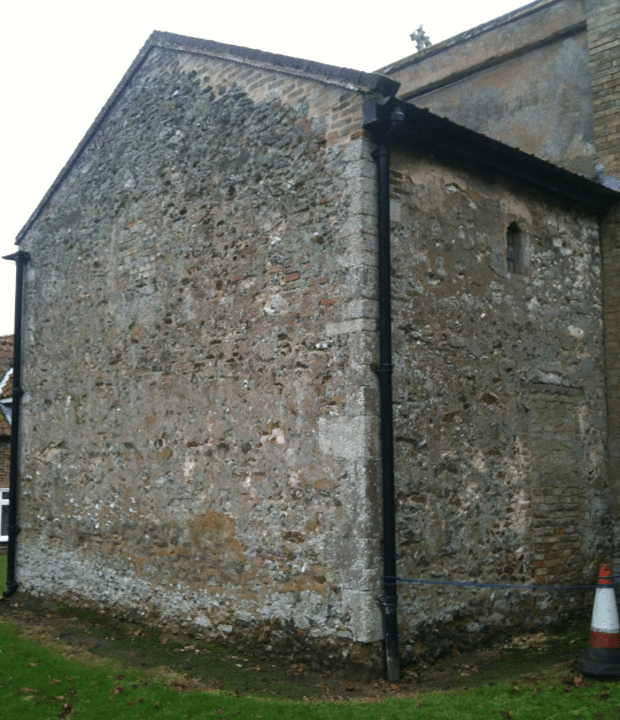
The school was held in the upper storey, where there is evidence of a blocked window
1736 September 7th Edward Dookes schoolmaster is mentioned on the marriage licence of Francis Hardy to Mary Wortly at St Michaels’ Church Fincham
1740 July 5th Thomas Locke
1771. December 26th , William England.
1784. June 19th , John Tibbenham. “licensed to teach reading, writing and arithmetic in the parish of Fincham. Signed with his mark X
We find out why he signed with his mark at the bottom of the page.
“ Mr Tibenham having this day had a fall from his horse by which his right hand and arm was greatly grieved he was not able to write his name so only made his mark as above”
Norfolk Records Office DN/SUB/B/2 Subscription Book
1802 A school of Industry was set up in Fincham by William Corston for the education of children of that and the adjoining parishes. It combined education with manufacturing straw plait. Unfortunately by 1806 it appears to have closed.
“They are instructed twice a day in reading and eight of them in writing. In addition to the advantage of education, they receive pay according to the amount of their respective earnings. The school is very frequently visited by the Rev. Mr Forby, the Vicar of Fincham. He very kindly allows himself to be referred to as a kind of judge or arbitrator, upon any matter arising in the school; and, in case any of the children have been neglectful or inattentive, he makes use of his influence to amend and improve them, and to prevent a repetition of the cause of cause of complaint.”
Extract from the Society for Bettering the Condition of the Poor 1805
1809 In his book, A brief Sketch of the Life of Joseph Lancaster (1840), William Corston mentions how he eventually succeeded in building his own day school in Fincham.
In the year 1809, with assistance of Friends and a handsome contribution of ten pounds byt the Duke of Bedford and a liberal contribution of £5 each from my five co-trustees, the wish of my heart was gratified, and, the blessing of God, the institution still subsists, bearing the same inscription,- “To the Glory of God and the benefit of Poor Children”
The opening was attended by amongst other, Joseph Lancaster and Joseph Fox
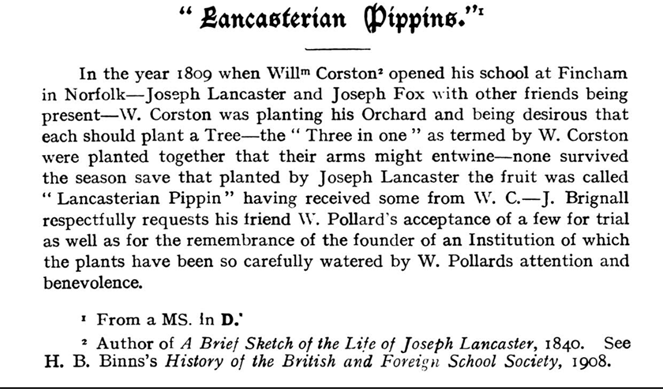
The co-trustees were the trustees of the British and Foreign School Society. By 1822 the building was also used as a Wesleyan Methodist chapel.
When he died in 1843 he mentions in his will
To John Mason and Gowers for their attention to my school , one pound and ten shillings each.
1810 Meanwhile in the Vestry minutes – maybe in response to William Corston’s school
Resolved to erect a new house on the parish land for a school-“master.
Unfortunately, this didn’t appear.
1819 Rev Forby writes : Fincham population- 601
Particulars relating to the education of youth : none Other institutions : 2 Sunday schools entirely supported by voluntary contributions containing 50 children. Observations : The poor have not sufficient means of instructions but the minister hopes soon to introduce the national system into the Sunday schools. Digest of returns to the circular letter from the select committee on education of the poor. (in the Local Studies Library at the Forum)
1833 Rev Loftus write: Fincham population – 756
Two daily schools in one whereof 6 males and 24 females and in the other (commenced 1824) 22 males and 18 females are instructed at the expense of their parents. Two Sunday Schools one of which (held in the church) has 60 children, and is supported by subscription from the Rector and three other inhabitants, at a salary of 8L per annum: it commenced in 1827: the other school (held in a Methodist chapel), consists of 70 children who are instructed by gratuitous teachers.
Abstract of Education Returns : 1833 pg. 619
1848 William Blyth founded the National School on glebe land.
1870 The Primitive Methodist chapel on Downham Road set up its own day school in opposition to the National School.
A Connextional day school was opened in Fincham with one teacher and 30 scholars. It was funded by the profits of a tea meeting, a public collection, and subscriptions from different friends. The number of scholars increased to 40 in 1875 The school was supported by the children’s weekly fees. Details from “Affable and Humane by WF Samsom 1998
1869 Post Office Directory the National School master is Charles Triggs and the mistress at the Primitive Methodist school is Harriet C Balls.
1874 Kellys Directory National School Charles Triggs, master. There is also a small mixed school for children.
1870 Rev Blyth’s Diary 25th October notes that
My school passed as sufficient (in conjunction with the Primitives) for the parish. Shouldham and Marham schools passed under review.
1870s Village oral history has it that the chapel at St Mary’s Lodge was once a Catholic chapel and school. This was probably when Martha Hutchison died and her son, William Corston Hutchison, came to live in the village. He had been a Church of England curate who converted to Catholicism in 1851 and had invited nuns and a Catholic priest to live at St Mary’s Lodge (for more details see the page on non-conformity. The school would have been short-lived as the next owners probably used it as rooms for the Fincham curate Rev Toomis and then as a stable or storage.
IN 1870 Rev Blyth writes, (probably in preparation for the 1870 Education Act)
Collecting the names of all the children in the parish between 5 and 13 for educational purposes there being 142 (excluding well to do children)
.However, there are mention of other schools and other school teachers
The baptism of his son, Thomas Negus Rose’s occupation is given as schoolmaster. Probably the same Thomas Negus Rose who later became Master of the workhouse at Downham Market. Joseph Matthews occupation is given as teacher in the 1841 census but not in the 1851 census. Also in the 1841 census Susan Cook occupation School Keeper, Emma Rose, School Keeper, Maria Able, School Keeper. ( a school keeper was usually one who kept a small private school in their own home)
In 1851 the National School teacher is Joseph Richards, but Judith Vare is also living in Fincham occupation, school mistress.
In the 1845 White’s directory Vare Indah (actually Judith Vare) is given as mistress. In the 1856 directory she appears as Vare Indah schoolmaster (!) As she is living in a cottage owned by Mrs Hutchison it is possible that she was connected with the school founded by William Corston, Mrs Hutchison’s father, or a school connected to the Wesleyan Methodist chapel.
1857 Mary Parker a schoolmistress died in Fincham
1869 Post Office Directory mentions Miss Mary Anne Hubbard seminary, 1871 census Mary Anne Hubbard, Elementary Teacher (by 1881 working for mother as clerk to the postmistress at the Post Office)
At the moment it is difficult to tell with any certainty whether these teachers were Sunday School teachers, from the BFSS school, the Primitive Methodist school or were Dames schools held in their own homes.
 Fincham Local History Society