
The last public execution in Norwich was on Monday August 26 at 8.00 a.m. The young man hanged was Hubbard Lingley, a Fincham resident. He was hanged for killing his uncle, Benjamin Black of Barton Bendish.
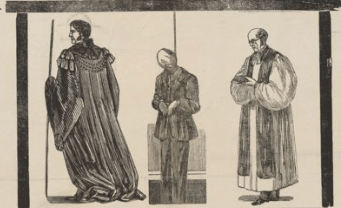
Hubbard Lingley was born in Hampshire in 1845 but both his parents, George Lingley and Mary Black, were from Barton Bendish. In 1851 at the age of 6 he was back living at Barton with his grandparents, Jacob Black and Elizabeth, and his mother and brother. In the same year in the space of just two months he lost both his grandmother and mother. His grandfather soon remarried a spinster from Fincham called Elizabeth Ward.
He began his working life as an agricultural worker on the farm owned by Hanson Berney. His grandfather Jacob died in 1862 and he hoped he might take over his job as head woodman. This job however went to Jacob’s son, Benjamin. He became Hubbard’s boss and this soon caused many problems and arguments between uncle and nephew. Hubbard often complained to his neighbours that one day he would kill his b——- foreman.
In May 1865 he married Mary Ann Ward from Fincham. Within two years they were the parents of two daughters. At this time they were living in Fincham near the Oak public house,
These are the facts leading up to the killing of Benjamin Black on May 17 1867:
On Tuesday May 14th Hubbard goes to the shop in Fincham and buys shot from Henry Scott the owner. He asks for large shot and chooses no.2 shot which is wrapped in grey paper. He returns two days later for a double charge.
On Friday May 17th he leaves home at 3.00 a.m. and makes his way to Barton Leys. He said he had agreed to go poaching with two friends. Pheasant eggs were taken, rabbits snared and one rabbit was shot. It is this shot that wakes his uncle.
According to Lingley’s testimony his uncle arrives on the scene, accuses him of poaching and claims he had suspected him of this for a long time. They row and a companion of Lingley shouts out ‘Shoot the —–. If you don’t I will.’ Hubbard then shoots his uncle, his companions take money from the dead man’s body and give it to Lingley. He later spends the money on tobacco, beer, groceries and drapery.
A group on men on their way to work find the dead body at 6.15 a.m. and go to fetch PC Balls. He discovers that Black has been shot in the face and an attempt had been made to take the deceased’s pocket watch. Lingley has been found and told of his uncle’s death and he says that money has been taken from the dead man.
The following day PC Balls goes to Lingley to ask him where his gun is. Lingley takes him to the home of his uncle, Henry Black, and points to a gun being used by Henry’s son. His uncle says ‘You know that’s not yours. What’s the use of bringing these men here on a foolish errand?’ Lingley finally takes PC Balls to where he has hidden his gun. They see it has been used and a powder flask is found hidden in a tree.He is taken to Downham Market courthouse and then taken to Swaffham Bridewell.
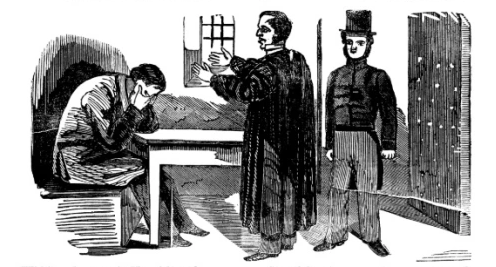
The trial begins on August 8 1867 at Norwich. The prosecution state the motive was the desire of the prisoner to take his uncle’s place. He had uttered ‘Strong oaths’ to this effect. Also Lingley had been the first to notice money had been taken from the body. Very little was offered by Lingley in defence for his actions. He admitted the killing and said he’d lost his temper and acted out of passion and under the influence of drink. The jury took 25 minutes to find him guilty.
On August 26 1867 the execution was carried out by William Calcraft at 8.00 a.m. The body was cut down an hour later. A crowd of twelve to fifteen thousand people had arrived to witness the event, the last public execution in Norfolk.
 Fincham Local History Society