We are grateful to Jesus College Cambridge for permission to reproduce the article below.
INTRODUCTION
The following article was published by Jesus College Cambridge and is based on archives they have relating to certain matters concerning people from Fincham. Maria Parish accused John Henry Arthy, an undergraduate at Jesus, of being the father of her child, of being in love with her and promising to marry her. She wrote to the Master at Jesus to help her as John Henry had gone back on his, alleged, word. There followed a second letter from her, a letter from her mother, Mary, and one from the Rev Robert Forby who felt compelled to get involved.
The Parish family
James and Mary Parish had five children, all born in Fincham, between 1781 and 1796. The last was Maria Elizabeth. On July 20th 1797 James was contracted at a Vestry meeting for the ‘maintenance, clothing and management of the Poor of the Parish’ at the rate of £160 per annum. This was for a House of Industry, or Workhouse, started by the village twenty years previously. Details of the contract can be seen in the page about the Workhouse. His contract was extended beyond the initial three years so James must have discharged his duties well enough and be considered a reliable parishioner. James died in Fincham in 1822 aged 67. Maria had the baby in 1822 and named her Catherine. She was baptised on 15th August and died soon after, as she was buried on 22nd September, with Rev Forby officiating. Mary Parish, the mother, died in 1837, aged 80, and was buried at Fincham.
The Arthy family
Joseph Arthy was born in about 1754 in Snailswell Cambridgeshire and died in Fincham in 1827 aged 73. He married Catharine Scott in 1792.
The family moved to Ivy House in Fincham in 1822 . The Parishes had a house next door but it is not known if it was what is now known as the West Wing of Ivy House or the next house going west.
We know of three sons.
John Henry Arthy was born in 1800 in Isleham Cambs. He is the son who Maria Parish accuses. He was ordained and eventually became Rector of Caister St.Edmunds where he died in 1881, aged 81. In 1832 he married Mary Louisa Warren.
Edward Arthur Arthy born c. 1798 was the son who became a doctor and lived in Ivy House until his death in 1876. In 1828 he married Martha Warren in Caister St. Edmund where his brother eventually became Rector. Unless a huge coincidence in name, he married the sister of his brother’s wife. In the 1851 census he says he is ‘Member of the College of Surgeons and a Licentiate of the Apothecaries Hall and now a General Practitioner and the owner and occupier of two acres of land.’ He was the doctor who had to give evidence in the trial of Rev Arthur Loftus.
Nathaniel Hopper Arthy who was born c 1795 and ordained. In 1832 he married Anna Maria Jenkins Ruxton. She died aged 91 in 1889. Nathaniel was involved in an astonishing court case where a doctor was accused of forcibly operating on a fifteen year old youth despite the youth’s protests. Nathaniel helped restrain the youth. It was called the Brenchley Workhouse Case. Nathaniel died in 1876.
Maria’s letters are very animated and full of passion as is her mother’s. Robert Forby’s is more measured. The Rev. William Blyth, writing in 1863, says that he (Forby) was ‘especially remembered by his surviving parishioners’ and ‘was a man of letters, strong mind and brusque manners, a ‘’clergyman of the old school’’. Does this judgement support Maria or John Henry?
Archive of the month: “Low Wench” or “Suffering Child”?
Included within the personal papers of William French, Master of Jesus 1820-1849, are numerous letters marked as ‘private’.
Some of these are bills addressed directly to French, including those from Spode for china bought for the Master’s Lodge, requests for references from former students and correspondence with friends. One set of letters included in this folder are an excellent reminder as to the importance of appreciating that not all information contained within a set of documents can necessarily be taken at face value nor be combined to create a single narrative.
The first is a letter from Maria Parish, a woman from the village of Fincham in Norfolk. Her letter recounts how following numerous declarations of commitment and a promise of marriage from John Henry Arthy (admitted to Jesus College, 8th February 1820) she “forfeited my honour and happiness” resulting an unexpected pregnancy. Following this announcement, Maria claimed Arthy cut all ties with her and so she decided to write to the Master in the hope that he might be able to convince Arthy to acknowledge his responsibilities and return to Maria. Through Mr. Burleigh of Barnwell, a family friend of the Parish’s, Maria and her mother were admitted to see William Hustler who was, at the time, Arthy’s tutor. Initially, as Maria acknowledges in a second letter to the Master, her “wretched case” was initially received “very warmly” by French, with his agreement that Arthy “certainly deserved punishment”. She is also very clear to highlight her family’s “respectability” and that such a case had brought great shame upon them.
.First letter of Maria Parish to the Master of Jesus College
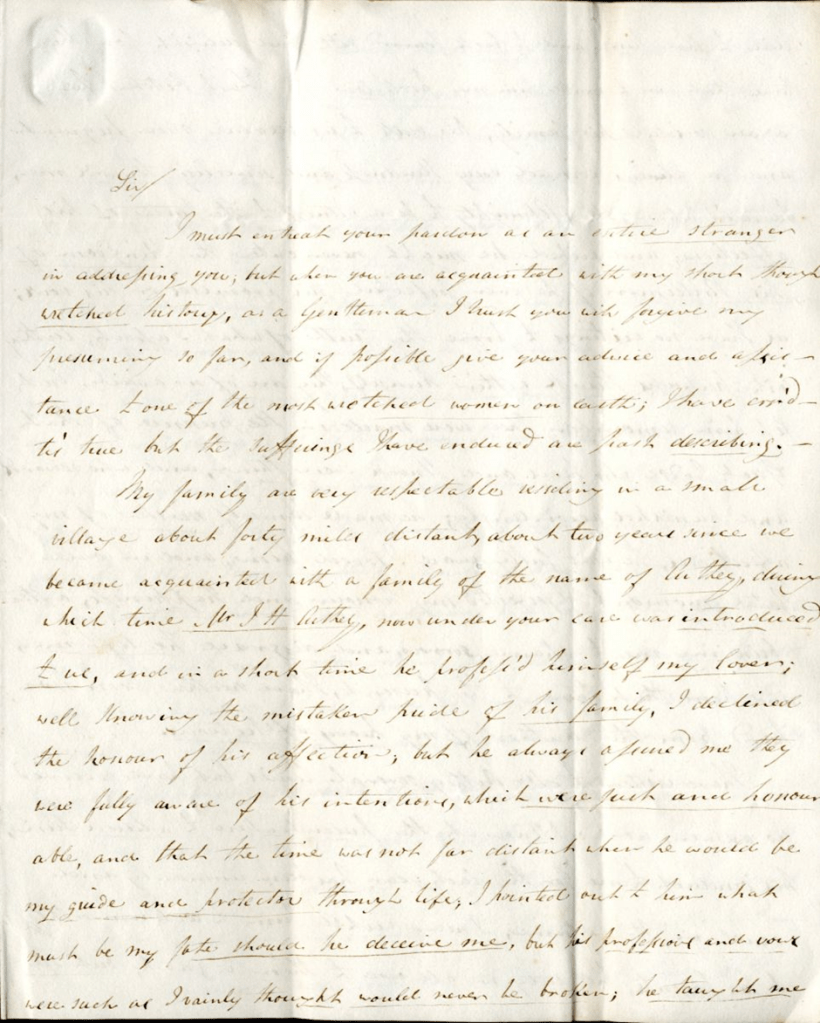
Transcription
Sir
I must entreat your pardon as an entire stranger
in addressing you; but when you are acquainted with my short though
wretched history , as a gentleman I think you will forgive my
presuming so far, and if possible give your advice and assis
tance to one of the most wretched women on earth; I have err’d
tis true but the sufferings I have endured are past describing.
My family are very respectable residing in a small
village about forty miles distant about two years since we
became acquainted with a family of the name of Arthey, during
which time Mr J H Arthey, now under your care was introduced
to me, and in a short time he profess’d himself my lover;
well knowing the mistaken pride of his family, I declined
the honour of his affection; but he always assured me they
were fully aware of his intentions, which were just and honour
able, and that the time was not far distant when he would be
my guide and protector through life; I pointed out to him what
must be my fate should he deceive me, but his professions and vows
were such as vainly thought would never be broken; he taught me
daily to love him; and to look forward with fond delight for the
time that was to make him my protector. Last October he
again visited his family, his visits to us became more frequent
and he always evinced every kindness and sincerity towards me.
He call’d upon the Almighty to be a witness to the truth of his
affection; and wished he might never enter the Kingdom of
his Redeemer if he ever forfeited his promises of his vows.
As I have no writings to prove the truth of what I assert Arthey
will perhaps think within himself; they are of no avail, but let him remember they were made in the presence of that
Great Judge who hears and knows everything, and who rewards
and punishes accordingly. He made himself master of my
affections, he was fully aware I loved him, and in one
fatal moment, I forfeited my honour and happiness. After
bringing me to shame, sorrow and disgrace he left me,
and from that time to the present, I have neither seen nor
heard from the Author of my heavy affliction.
I have written to Mr Arthey several times but have received
no answer; nor do I know at the present where to address him,
his conduct to me for the last year has been unmanly and
cruel in the extreme. II never wished him to act unworthy
to his parents, the duty we all owe to them is great; but he
ought to have considered likewise the duty of a father, and if after
bringing me to the needs and scorns of an unfeeling world, his affection
was turn’d to such implacable hatred, he might have new and loved
his child; I could have forgiven him all had he done this but instead of which he left me and my helpless innocent to perish in misery
and want. Since I saw Mr A – I have had the heartrending sorrow
of losing a beloved parent, grief for the shame his wretched child brought upon
herself prey’d so heavy on his mind that he sunk under it. He could
not bear to see the finger of scorn held up at one who was always
the pride and delight of his life, sorrow for me at last bereft him
of his reason; and he left me and my unborn infant to a merci less world; had it pleased the Almighty to have spared my
venerated father, I might with his Kindness have been restored
to comparative health and happiness, but losing him added a still
greater burden to my breaking heart; if my health and spirits
would have permitted, I should have beg’d an interview with you trusting
you would not have turn’d away unpitied and unheard the sorrow of a wretched
being, who has indeed drank deeply of the cup of affliction.
May I beg of you kindness in speaking to Mr Arthey for me, le
May I beg of you kindness in speaking to Mr Arthey for me, let
him remember he has deprived me of a tender parent happiness
and health, what can have induced him to act as he has done I am
at a loss to imagine; surely long we this he must have sett
the stings of a guilty conscience; his conduct is offensive to his
Mother; will he dare to preach against those crimes which he
have practised towards me and yet feel no remorse; he should
call to mind in the midst of life we are in death, and will
he still continue to act towards me in the unjust and unnatural
way he has done, when he may in the course of a few moments
be call’d with the presence of that Great Judge to give an ac
count of his actions whether they be good or bad.
I must entreat your kindness and forgiveness but I am
part sinking to the grave; my sorrows and trials have been
great, they have so shatter’d my constitution, that death to
me will be I think a blessing; I have done wrong but I am I hope,
a penitent; I have call’d upon my maker fervently to forgive
me my errors, and I pray most heartily pray he will hear me.
My last remaining Parent is nearly distracted at the
thoughts of losing me, as she looks upon me as her only
solace in her declining years; she is incapable of attending
to any business on account of a fall she received about four
years since which occasions her to need the use of crutches.
I must again beg you will pardon me for addressing you at such length.
If you will exact what power you have in pointing out to Mr A the
cruelty of his conduct, and can prevail upon him to act as becomes him
the prayers of a helpless widow a deserted and broken hearted woman shall ever attend you.
This was followed by a letter from Maria’s mother Mary, dated 6th January 1823 and also written from Fincham to the Master. Mary wrote to express her “feelings of a wretched mother, who is pleading for her suffering child” following “the destruction of my family”. In this, Mary is referring to both the unrealised proposal of marriage apparently made to her daughter and the pregnancy which caused many problems for the family. As can be seen in the transcription of the letter, despite initial polite neighbourly exchanges following the Arthy family’s move to Fincham into a property neighbouring that of the Parish family, hostilities between the two families grew following the relationship between Maria and John. Mary’s husband, John Parish, is shown in parish registers to have died aged 67, being buried on 30th May 1822, although the reason she gives for his death in her letter is that “he died of grief” for the shame of his daughter’s predicament. The parish burial register shows that Mr. Parish’s funeral service was conducted by Rev. Robert Forby, the parish vicar.
Mary Parish letter to Master of Jesus College
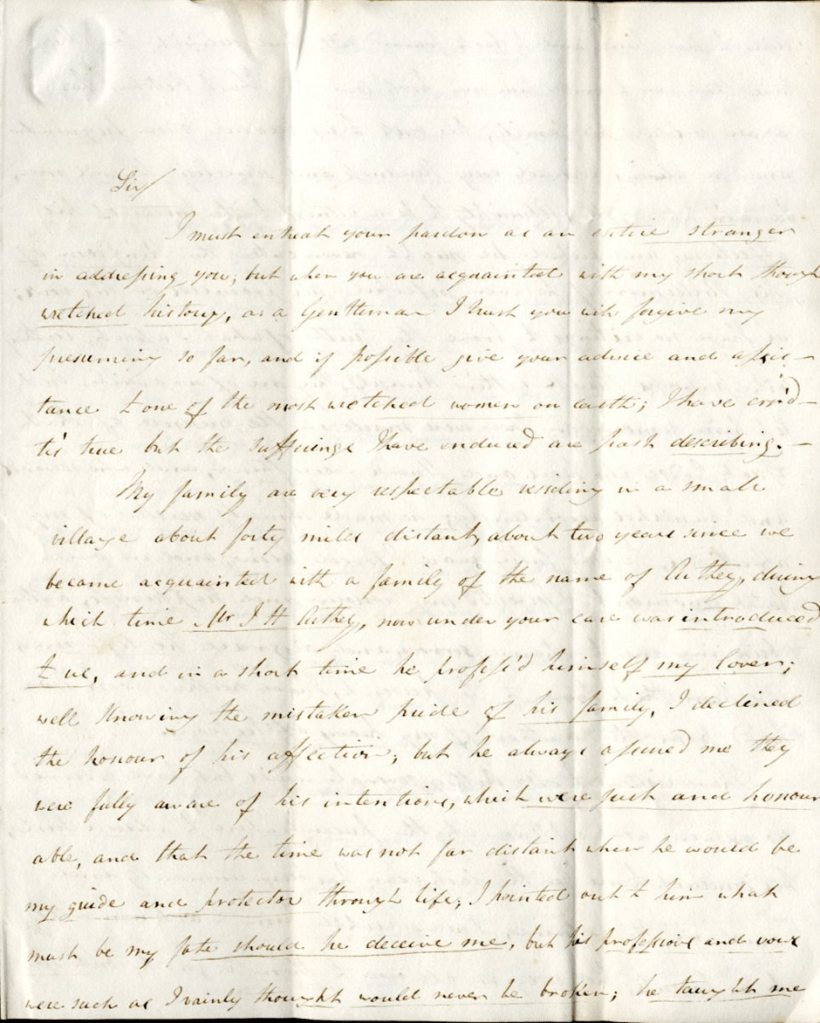
Transcription
Fincham January 6th 1823
Sir,
I most humbly entreat your pardon
in addressing you; but hope you will forgive the
feelings of a wretched mother, who is pleading for her
suffering child; Mr J H Arthy who has been the destruction
of my family is again returned to his home after a
twelve months absence. You are I believe acquainted
with the sad history of my daughter; who a short time
since addressed a letter to you; without a signature,
being the first time our name ever as disgraced.
She has erred it is true but is the author of all her sorrows
to go unpunished; as he has totally abandoned her and
his family have and still do cruelly persecute her.
Our family have been brought up with credit and
respectability; and till this unfortunate affair the name
never had a stain cast upon it. We have resided in the
same house 42 years; the unhappy subject of this letter
in the youngest of 5 children and looked upon by her
lamented father and myself as the last prop to our
declining years; her father end idolized her and the dis
grace she so unguardedly heaped upon herself was too
much for him he died of grief. The family
of Arthy three years since purchased an estate next
door to us; and being entire strangers in the Neighbour
hood; what information they needed my dear Husband
readily gave them; they expressed themselves much
obliged and professed to be agreeable neighbours. During
this time my unhappy child without the knowledge
of her father or myself; formed an attachment with
Mr J H Arthy. My daughter has I believed explained to
you part of this unfortunate affair; they have in order to
halt the unjust conduct of themselves and son,
circulated the most wicked falsehoods. Had Mr A returned
to college at the proper time in November 22 my family
would have been spared this mortifying disgrace;
when he found his time was expired he wrote to his
Brother requesting him to write to the college to say
he was confined by sickness, which was entirely by false;
as during the time he was with his family not a day
passed but he visited mine. never should I
have solicited assistance from them for my dear
Girl and her infant but from the sudden death
of her beloved father; which left her nearly destitute
as my eldest son claimed all and he, though
a good man, has had a numerous family and his
thoughts are naturally turned to them.
The health of my daughter is in a very delicate
and precarious state, in deed she is incapable
of attending to any business; and is at present
confined to her room by sickness brought
on entirely by grief; the disgraceful manner
Mr A has conducted himself to her, and the low
infamous reports; which his family daily circulate
press heavily on her wounded mind.
They took him from college last March as he was likely
to be called upon soon after that time on account of
the affair of my unhappy daughters; since which
time till last Dec they report here that he has been
in France and Wales; for the recovery of his health
but whether he really has or not is unknown to me.
Will you Sir have the goodness to advise me how to act.
I know no one so near to refer you to, as to our character
as Mr Burleigh of Barnwell; who knew us in our better
days; and when my daughter saw him he thought it
best for her to see you but her health and spirits would not
permit. She can if required protest upon oath
anything that she has assented; although she has no
written promises of his she has several letters, copies
of what she has written to him but he never had the
humanity to answer one of them; could they be read
they would prove his deceit to her .
Since Arthy has been at College this last time his brother
from Bath has been to the Bishop of Norwich to get him
ordained as they fear he will not pass his examination
and the Bishop being advanced in years they think
he will not be so particular.
Before I closed this I thought it right to call upon
the family. I did so where we had been in the habit
of visiting much their betters; the whole of them
retired from the parlour by a back door this
was the first time I attempted to see any of them;
after waiting some time Mr J Arthy appeared
who not only behaved in an unmanly Manner
but I must add also Brutal. Your kindness in
attending to this will greatly oblige yours respectfully
Mary Parish.
So far, so consistent. However, the Master received a letter nearly two months later from Robert Forby who was asked by Arthy to write to the Master on his behalf to recount his side of the story, presumably following conversations he had had with both the Master and his tutor. In this letter, dated 24th February 1823, Forby paints a very different picture of the situation. He suggests that Maria Parish and her family were not of such high standing in the local community, and goes so far as to describe Maria as “shameless”, of “great and notorious looseness of conduct” and of having “exclusive intimacy with low wenches of the most depraved and public characters”. He further describes occasions on which the Parish family supposedly behaved inappropriately in public and, on one occasion, on a Sunday “as my congregation was assembling”.
Robert Forby letter to Master of Jesus College
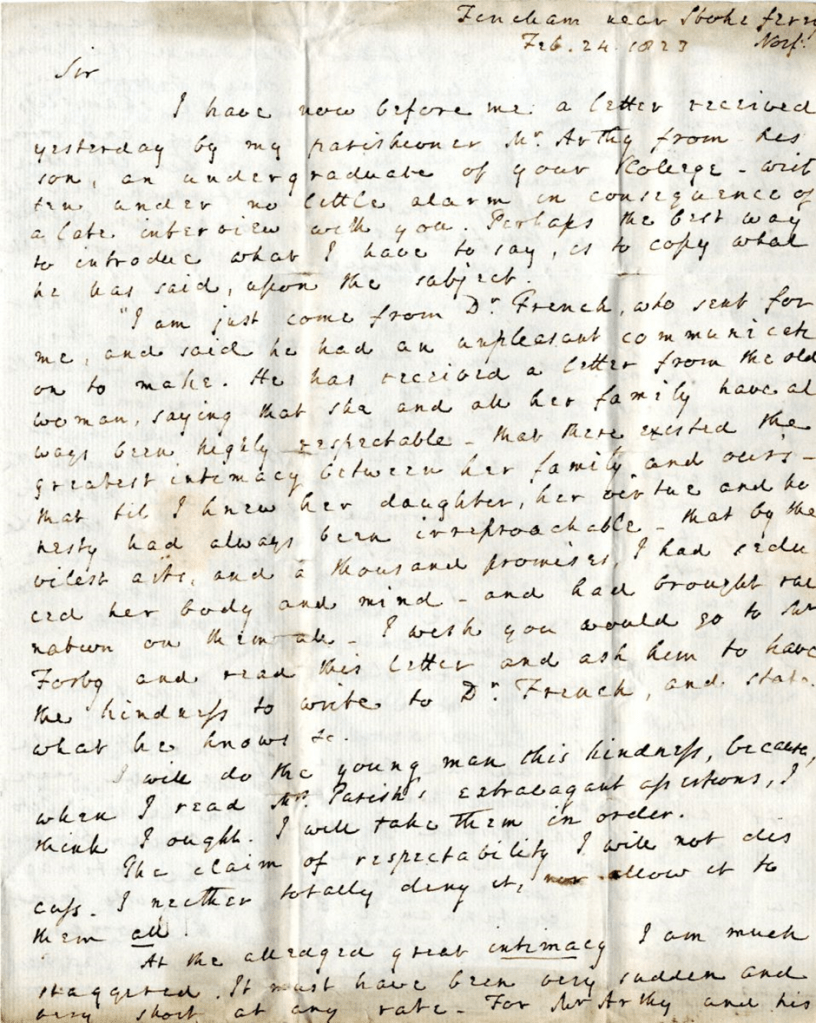
Transcription
Fincham near Stoke Ferry
Feb 24 1823 Norf[olk]
Sir,
I have now before me: a letter received
yesterday by my parishioner Mr Arthy from his
son, an undergraduate of your College – writ
ten under no little alarm in consequence of
a late interview with you. Perhaps the best way
to introduce what I have to say, is to copy what
he has said, upon the subject
“I am just come from Dr. French, who sent for
me, and said he had an unpleasant communicati
on to make. He has received a letter from the old
woman, saying that she and all her family have al
ways been highly respectable – that there excited the
greatest intimacy between her family and ours –
that til I knew her daughter, her virtue and ho
nesty had always been irreproachable – that by the
vilest acts, and a thousand promises, I had sedu
ced her body and mind – and had brought rai
naturn? on them all – I wish you would go to Mr
Forby and read this letter and ask him to have
the kindness to write to Dr. French, and state
what he knows etc”
I will do the young man this kindness, because
when I read Mrs Parish’s extravagant assertions, I
think I ought. I will take them in order.
The claim of respectability I will not dis
cuss. I neither totally deny it, nor allow it to
them all.
At the alleged great intimacy I am much
staggered. It must have been very sudden and
very short at any rate. For Mr Arthy and his
family came into this parish perfect strangers
late on the month of October 1821 – and the young
man returned to College some days before the
division of term. Before Christmas the shameless
young woman declared her pregnancy, and osten
tatiously announced the father of her expected
infant. This must of course have terminated all
intimacy – but the fact is, that none ever existed
beyond the casual civilities of next-door neigh
bours in a village.
How far this eager haste to proclaim her
own shame, is consistent with the character
of virtue and honesty always irreproachable.
I must leave you to judge. Certainly as one in
the parish or neighbourhood believes it. It
is inconceivable that the mother can, though she
aperts it. The young woman’s great and notori
ous looseness of conduct for many years past (she
is now in her 28th year) and her almost unre
parable and exclusive intimacy with low wenches
of the most depraved and public characters,
make it totally incredible.
If this young man be a practiced seducer,
he must be so in a very extraordinary degree
not having at all the aspect of one. His vile
acts and thousand promises must have been
very rapidly successful indeed – On the 10 of Octo
ber he came, and on the 8th of November went
away – and it is not denied that the intimacy
was of some continuance! Every body who knows
the parties, is fully persuaded, that the woman
was the seducer – and moreover, that the lad must
have been very inexperienced in matters of galle
try, to have been so very foolishly entrap’d
As to the ruination, it is true enough, but
was certain, if not publicly known, before the
Arthy family came and was notoriously caused
by one of the sons – the other strenuously endea
vouring to retrieve it, and to support his mother
and sister, notwithstanding their ingratitude and
unkindness.
The young man and his family have sufferd
And are still suffering severly for that mis conduct
They are perpetually pestered, both by mother and
daughter, with abusive letters, and the most
extravagant and absurd demands of compruca
tion – though the infant lived but a very few
days, and its mother has for ought any body knows
as good a reputation as she had before.
The general remark on hearing
of her misfortune, being, that
she had been very fortunate
to escape so long. Mrs Arthy
has even been assailed in the village street by
the old woman with the most opprobrious lan
guage – and this, even happened on a Sunday
as my congregation was assembling – and was
repeated, when they dispersed. I was obliged to
interpose, and to threaten to bind her to the
good behaviour, and to commit in default of
sureties, which she had little chance of finding
after such outrageous conduct.
I am afraid I have been very tedious – all
I know not how I could have conveyed in fear
er words, the full view I wish to give you.
The young man, I find, has told you that I am
soon to be in Cambridge – and last that you
expressed a wish to see me. It is true I ex
p4
pect to be there on Tuesd[ay] Mar[ch] 4 – but I shall come
from Ely that morning to take the Telegraph – so
that a call at Jesus Lodge will be impossible. I
expect to be there again on Sat[urday] Mar[ch] 15 – but I shall
have two young ladies in charge, whom I must
immediately put into a post chaise and convey
to Ely. It is not improbable that I may be there
again in Easterweek – and in that case I will
wait upon you. In the mean time I am ready
to answer any questions you may have to propose –
I am D[ear] Sir – Y[ou]r obed[ient] serv[an]t Robert Forby
Finally, Maria sent a second letter to the Master, acknowledging she was at fault, but insists that Arthy made a vow to marry her. This letter is also partly a defence against Forby’s statement which she refers to as “that letter”. Maria says that Forby “is where he pleases a most warm and steady friend but the most bitter enemy a person can meet” preceding this by saying Forby’s “malice and tyranny show no bounds”. Maria also highlights that Forby refused to say any prayers for her when she was ill following the birth of the child, that he also refused to Christen it “thereby denying it a christian burial” following its death. She also suggests that Forby encouraged owners of property in the area not to take them on as tenants follow the loss of their rented house following the death of Maria’s father, leading them to be homeless for a month with “our furniture standing in the Street”.
Second letter from Maria Parish to Master of Jesus College
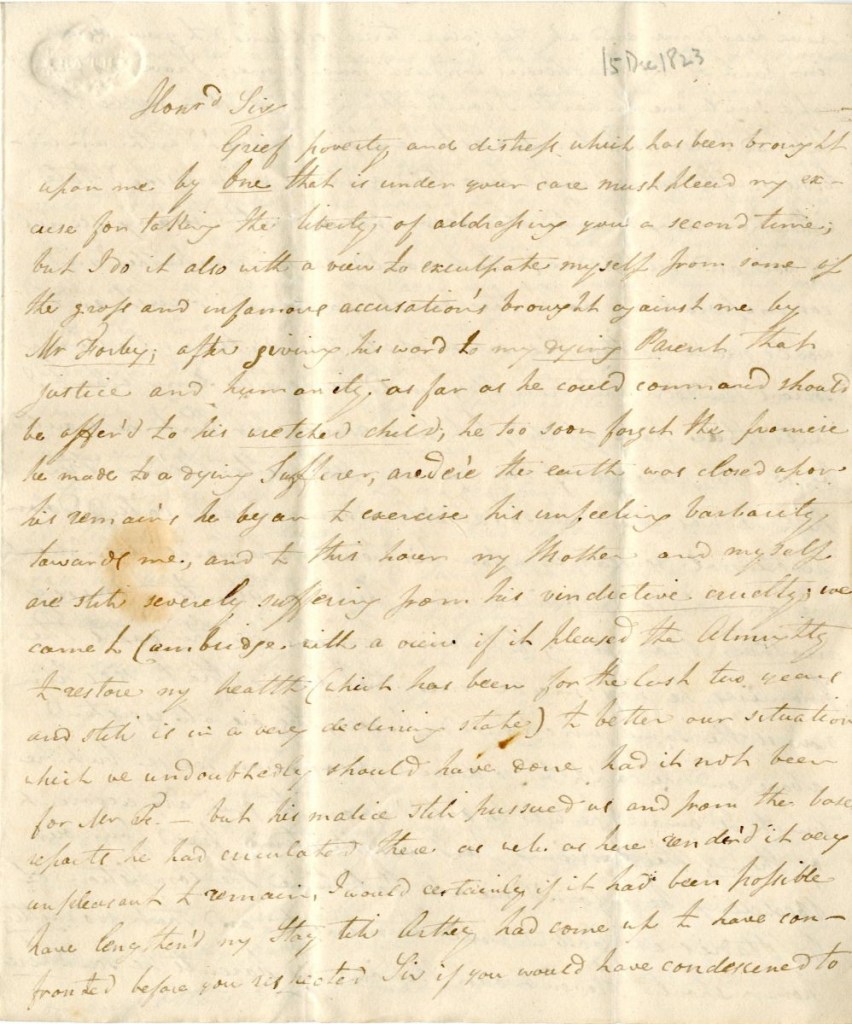
Transcription
Honoured Sir
Grief poverty and distress which has been brought
upon me by One that is under your care must pleed my ex
cuse for taking the liberty of addressing you a second time;
but I do it with a view to exculpate myself from some of
the gross and infamous accusations brought against me by
Mr Forby; after giving his word to my dying Parents that
justice and humanity as far as he could command should
be offer’d to his wretched child; he too soon forgot the promise
he made to a dying sufferer, and er’e the earth was closed upon
his remains he began to exercise his unfeeling barbarity
towards me, and to this hour my Mother and myself
are still severely suffering from his vindictive cruelty; we
came to Cambridge with a view if it pleased the Almighty
to restore my health (which has been for the last two years
and still is in a very declining state) to better our situation
which we undoubtedly should have done had it not been
reports he had circulated there as well as here render’d it
unpleasant to remain, I would certainly if it had been possible
have lengthen’d my stay till Arthey had come up to have con
fronted before you respected Sir if you would have condescended to
have heard me and at the same time explained to you before
him part of his treacherous conduct towards me; I have no friend
not a single one on earth I could apply to to speak on my behalf
but had I been so fortunate as to have been honour’d with an
interview with you; I could have told a plain unvainsided state
without a single untruth accompanied with many scenes
of woe and wretchedness that would raise sympathy and
commiseration from the most hardened breast, and
would make Arthey that cause of all the author of all my
sorrow shudder and tremble. Would he dare to deny what I
could there have asserted, let him remember that he would
be in the presence of the same Almighty, Being then
that he was when he so sacredly promised and called down
his eternal vengeance upon his head if he would ever reject
me or even be prevailed upon by his Parents to marry
another woman; let him remember the oaths the
promises he has made me the being that sees him
now is the same unchanged Judge, they are all register’d
above and he can’t be so devoid of common sense but he
must be aware he will be call’d upon to give an account
of them; the ensuing January was the time fixed four our
wedding. He inform’d me at that time the completion of
his studies at Coll[ege] would terminate and that no earthly
power should prevent our Union; his parents he said were
aware what his intentions was and that if he acted dishonour
able to me he wished he might never enter the Kingdom
of his Redeemer and that eternal punishments might be
his portion; to him I will apply to know how far he has
acted towards me as we was bound to do; for tho’ he is no
stranger to the distress sickness and want which I have suffered
he has neither written or seen me now more than two years
since the time he so basely deserted me.
Through the kind interference of Mr Burleigh I had the
honour of calling twice upon Mr Hustler, but owing to
his indisposition he was unable to converse much
with me; he gave me to understand that you respect
ed Sir and another Gent had taken my wretched
case up very warmly and said that Arthey certainly
deserved punishment; but after that a letter had
been received which had quite changed the affair
by laying the entire blame upon me and report’d
such things of my character as were unfit to read;
I wish’d very much to have been admitted to your
presence as I could have confuted all the infamy
contained in that letter; had I not been clear of those
vile reports which Mr Forby has accused me of; I
should never have dared to appear before Mr Hustler
or any other Gent; I was inform’d by Mr Burleigh
that your time was very much taken up by business
and that it was not likely I could be honour’d with
an interview; and we were obliged to return again fearing
that if we stay’d we should incur debts we should have
been unable to discharge; I most humbly beg your
pardon in the passing so long upon your time; but I do
it with a vein to render myself, though unknown to you,
less infamous in the eyes of you and the other Gents.
Till this unfortunate affair with myself our family
were always respectable much more so then the
Arthey’s, in their living they are very disreputable
Mr & Mrs A never being together but at table, and
the sons living very adulterous lives; and till my acquaint
tence commenced with Arthey scarcely noticed and
thought nothing at all of by Mr Forby.
I fear Respected Sire that you will think some
blame must be attached to me, as Mr Forby’s
character standing so high as it does in the circle
of his friends would cause a stranger to think there
must be something; but in my case I assure
you there is not, the Arthey family assisted by
him have done every thing and likewise said all
that was baseand wicked in order to excuse their
son and re-instate him again in College, as he said
himself when he came here last Summer that
but for Mr Forby’s writing, to the head of the College
he could not have return’d, which Mr F now denies
by saying he never wrote to any Gent there but
had I have reason to believe spoken very disrespectful
of my Mother whose character was ever unspotted
but be her’s on any one’s even so fair if Mr Forby
takes against a person even without giving offence
which is certainly the case in this instance, his ma
lice and tyranny show no bounds; he is certainly
where he pleases a most warm and steady friend
but the most bitter enemy a person can meet
with; in our present deplorable situation we must
submit to it, but had we either friends or proper
ty he certainly should be call’d upon to give an ac
count of his unjust conduct to the Widow and Daugh
ter of what he always styled him his most respected
friend; every insult every degradation which it is
possible to shew me he has done; at the time I was
so very ill and confined to my bed for three months
my recovery being pronounced very doubtful
her refused prayers both public and private;
but the unfeeling insults which I felt most was
his peremptorily refusing to name my beloved and
fatherless infant at the time it was very bad. there
by denying it a christian burial; you Respected
Sir and any other Gent possessed of humanity
will I am sure feel for my present past and help
less situation, after our return home we were
for a Month without a house and our furni
ture standing in the Street as every where we
apply’d Mr F desired the owners not to admit
us; we have at last succeeded and are now placed
in a small cottage with two rooms attended with
every inconvenience and so unlike what I have
been accustomed to during the life of my beloved
Parent that I am ready to sink under my mis
fortune’s; there must be a time when Arthey
must have his reflection’s severe and keen they
must be, at the time he just knew me I lived
in a most respectable manner with Parents that
resided forty three years in one house with charac
ter’s fair and unspotted; I was their youngest and
beloved child; he knows full well how they idolized
by them; and by attending to his deceitful villainy.
I brought wretchedness upon them; and for myself
know that will never have an end; at what I have
and am doomn’d to suffer I look upon as punish
ments inflicted by the Almighty for disobedience
to the best of Parents; I fervently hope in have
my punishment here; but Great God let the
author of all my sorrows reflect er’e it is too
late; what must his punishments be hereafter
if he is call’d suddenly away without time for
repentence. I know not how to apo
logize to you Hon[ou]r[e]d Sir for the liberty I have
taken in writing so long a letter but think
you will impute it to the right cause a
conviction of my innocence.
I beg leave to subscribe myself
Most Humbly Yours
Maria E. Parish
Finch[a]m
Dec[embe]r 15
1823
If Maria’s account of Forby’s character is correct, it does make one wonder why Forby should take such extreme measures against her and her family. Venn’s Alumni Cantabrigiensis shows that Forby was the son of Thomas Forby, a grocer, in Stoke Ferry, a village four miles from Fincham. Might the families have known each other for a long time, and might there have been some sort of long standing feud to which Forby took advantage in blaming the Parish family solely for their situation? There is inference in both Maria’s letters and the letter of Mr. Forby that the cutting of ties by Arthy might have been at the instance of his parents which might possibly hint at an intervention beyond the control of Arthy himself. Or maybe Forby’s account was true and the Parish’s were trying to get some sort of compensation from an unsuspecting John Arthy and his family?
As to the physical nature of the documents, this can also suggest things about the individuals who wrote the letters. Maria’s second letter to the Master, for example, is sealed with black sealing wax which was often used by individuals in mourning, in Maria’s case in mourning at the loss of her child and possibly her father. This shows she was probably aware of the social etiquette involved with writing letters and, in addition to her very neat handwriting and good vocabulary, suggests she was probably fairly well educated for the time.
The postmark on Forby’s letter to the Master shows he posted it in Stoke Ferry although he would have lived in Fincham following an inheritance from his uncle, Rev. Joseph Forby. Perhaps with his family connection to Stoke Ferry, he still visited regularly? Although family crests and initials were far more common, Forby’s wax seal is the profile of a man. This profile, however, bears a fairly strong resemblance to a portrait of Mr. Forby held by the Norfolk Museums Service. It could be possible that Forby, being from a family background that would not warrant the use of a crest, decided to have a matrix made in his own image to use as his seal.
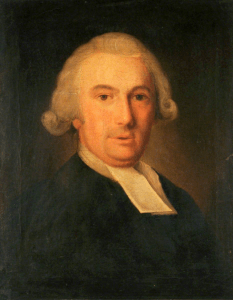
So with three different writers and certainly two very differing accounts of the situation, it is difficult to know who to believe or which elements of the stories may or may not be true. Who do you think was telling the truth?
************************************************************************************************************
 Fincham Local History Society