We would be grateful for any further information, photographs, or corrections on this topic.
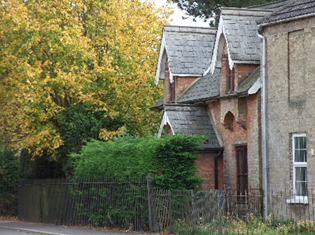
The Wesleyan chapel, the High Street, now a private house.

Wesleyan Methodist chapel , Chapel Lane. Now a private house.
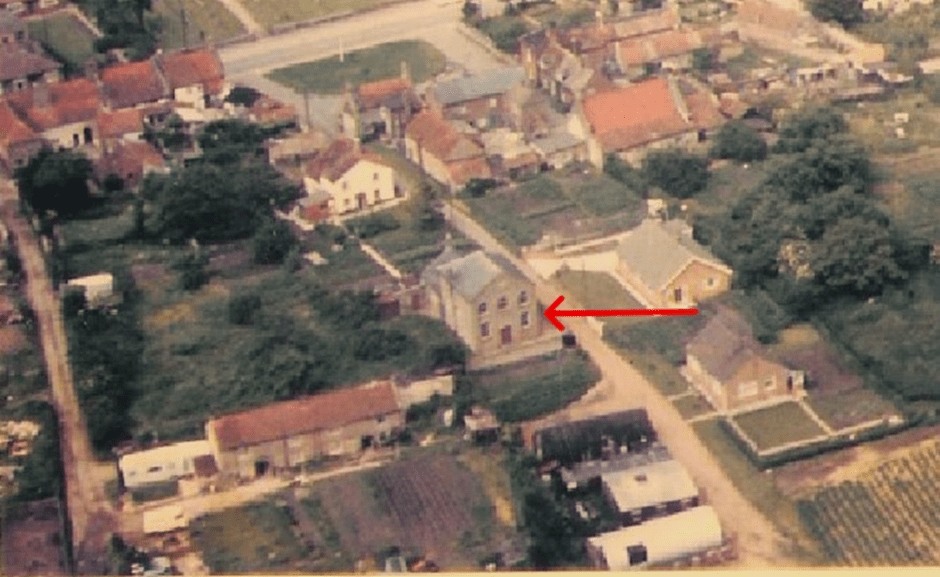
Wesleyan Methodist chapel , Chapel Lane from an aerial photograph
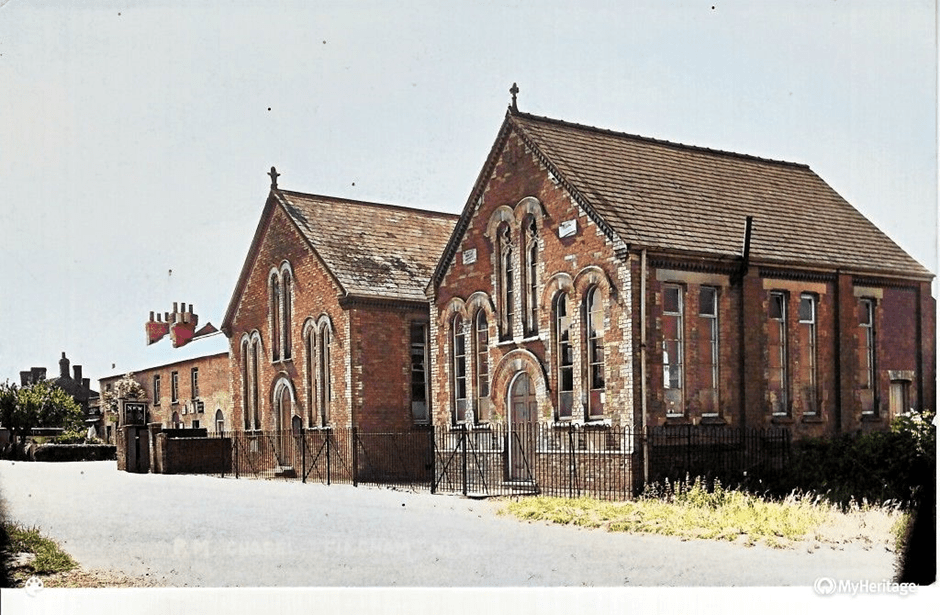
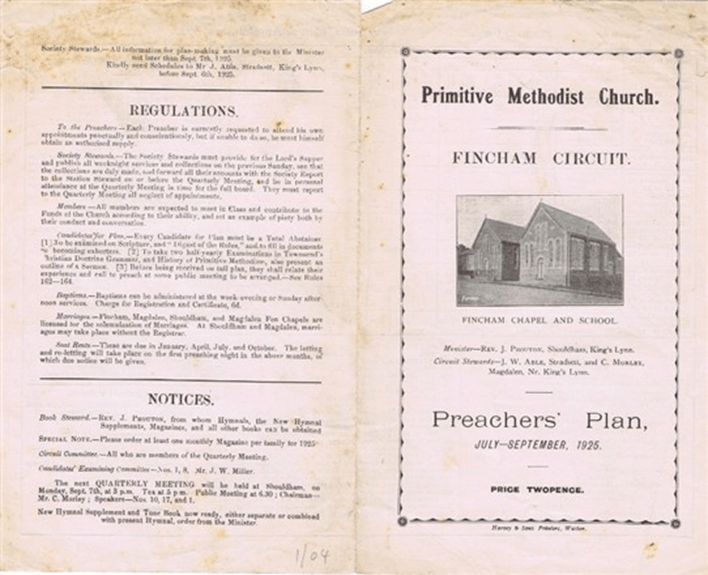
Primitive Methodist Chapel and Schoolroom, Downham Road post 1904
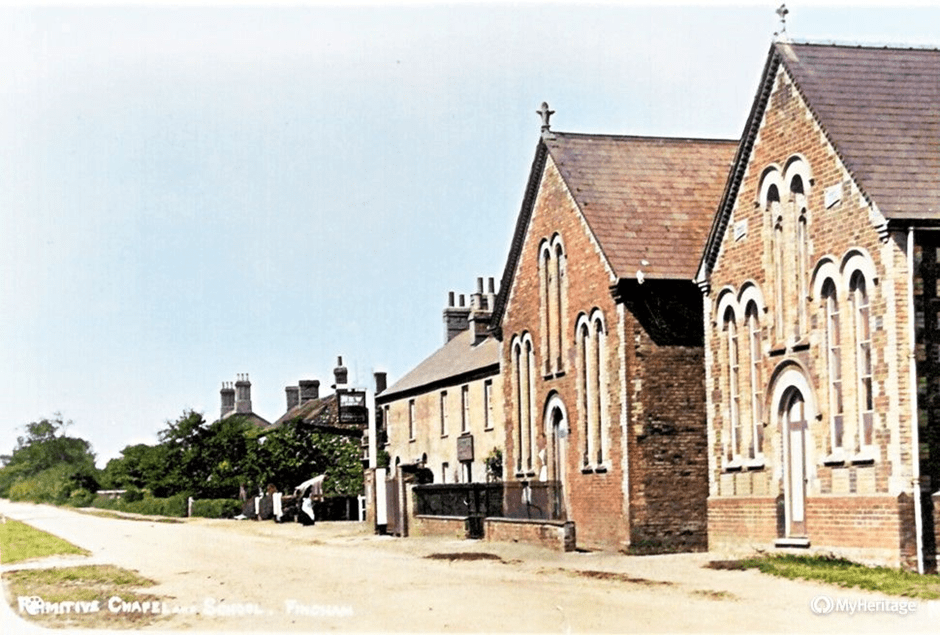
Primitive Methodist Chapel and Schoolroom, post 1904 Downham Road
(note proximity to the New Inn)
What was Non-conformity?
Nonconformists or Dissenters were any member of a religious body who had separated from the Established (Anglican) (state) church and who did not “conform” or agree with the established church, (the Church of England –Anglican Church). By the 19th century not all religious life in the village was centred on the parish church and, especially in Norfolk, non-conformists equalled or outnumbered members of the church of England.
Census and statistics
The 1851 Census of Religion, taken in the same year as the 1851 census, showed that in Norfolk there were more Nonconformists than there were Anglicans.
Older dissenter chapels such as Baptist, Quakers and Unitarians could often be found in towns such as Kings Lynn, Swaffham, Downham Market and Wisbech. The newer nonconformist chapels such as the Methodists in the villages. The majority of the village parishes in the Clackclose Hundred had both Wesleyan and Primitive Methodists chapels and Fincham was no exception.
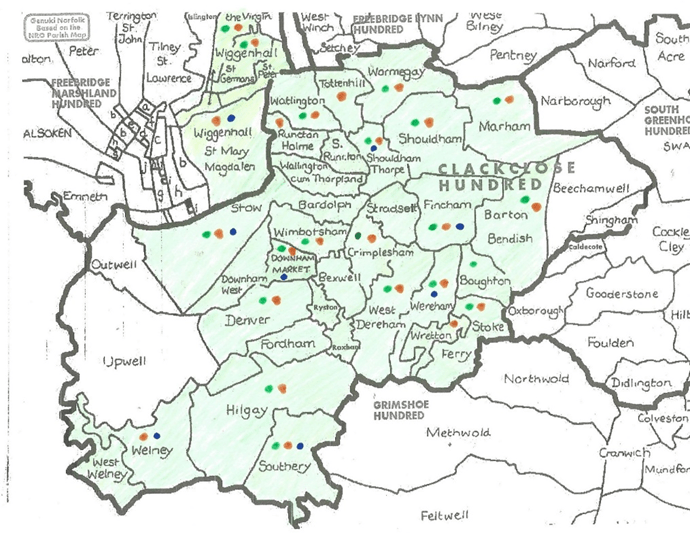
n.b. Beechamwell, Upwell and Outwell were previously part of the Clackclose Hundred but became part of the Downham Poor Law Union after the 1837 reorganisation.
Key
Green dots = Wesleyan Methodist chapel
Orange dots = Primitive Methodist chapel
Blue dots = Other nonconformist denominations In Fincham’s case the short-lived Catholic chapel.
We can see the records for Fincham in the 1851 Census of Religion (see the Norfolk Record Society Vol LXII) but William Blyth, the inveterate recorder, also took a census of church attendees in 1866 and in 1874 and noted them in his diary. (However, it should be remembered that like is not being compared with like as for instance Fincham St Martin’s did not hold an evening service and the totals did not account for those attending twice or even three services on a Sunday or even some villagers attending both church and chapel.)
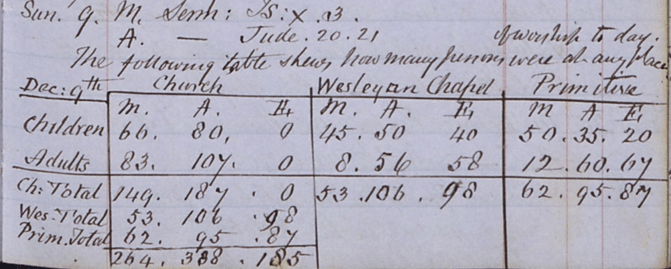
1866 diary entry

1874 diary entry
At first many meetings were held in people’s houses or in the open air but to hold chapel meetings even in people’s houses originally needed the permission as there was a requirement from 1689 onwards to register meeting houses with the authorities. Until the mid-19th century licences were issued by county and borough councils or by the Bishop’s or Archdeacon’s registries. The Protestant Dissenters Act of 1852 later transferred the responsibility to the Registrar General.
Chapels were organised not by parish as the Anglican churches were but in districts or circuits . These circuits might change to be amalgamated with other circuits or to become a circuit of their own. The number of different circuits that combined or reformed is explained on the section of the Norfolk Records Office online catalogues under Records of the Downham Market Methodist Circuit.
The Anglican church still remained important in parishioners’ lives. For instance, Non-conformists could be baptised where they chose but they might find it more difficult to get parish relief is they were not baptised in the church of England.
Any parishioner had the right to be buried in a church of England churchyard whether they were confirmed or not but what they didn’t have was the right to a burial service before 1880. Their children not being baptised might be refused burial.
“This is the first burial by a dissenter one Smith from Lynn. Quite orderly and Christian service. No bell requested” .
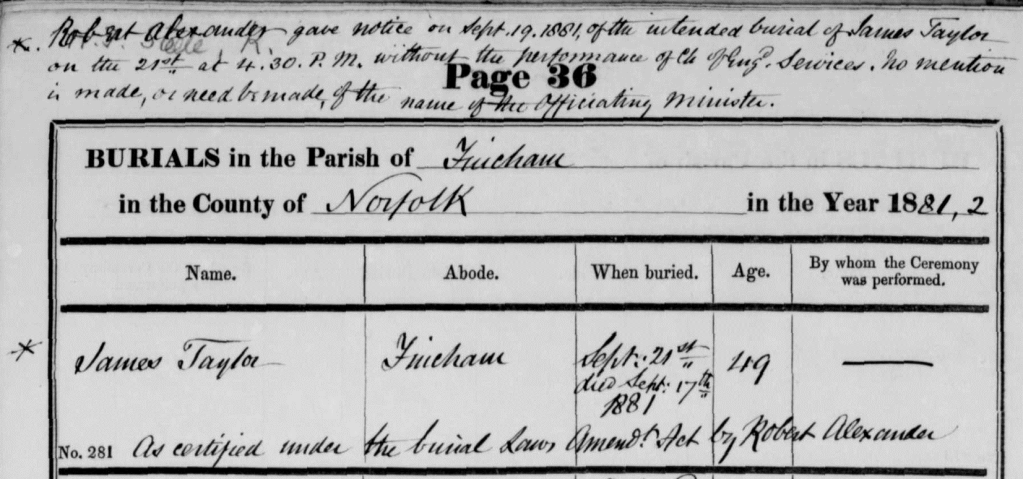
“Robert Alexander gave notice on September 19th of the intended burial of James Taylor on the 21st at 4.30 pm without the performance of” church ?” services. No mention is made or needs to be made of the officiating minister”
A growing emphasis on money for the upkeep of the chapels , both Wesleyan Methodist and Primitive Methodist, meant increased fundraising and we have copies of many newspaper articles about chapel fundraisers and social life.
“According to a long-established custom the members and friends of the Primitive Methodist Society met together on Good Friday at a public tea and meeting. About fifty partook of the friendly cup and after the removal of the tables Mr F Barker was elected to preside and addresses were delivered by Messrs W Bowen, E Thompson, J Green, R Green, and T Barker to a large and attentive congregation.”
Norwich Mercury – Saturday 31 March 1883
For many the chapels were their social life in a way that it was often impossible for them to find in the more middle-class Anglican church. There were still those who would attend both Church and Chapel.
Wesleyan Methodism in Fincham
The first Wesleyan chapel was built by William Corston in the grounds of his house, St Mary’s Lodge. A philanthropist and straw hat manufacture he was born in Fincham and moved to London where he lived and sold hats in Ludgate Hill. A Moravian by religion he later seems to have joined the Methodists after moving back to Fincham, leaving money in his will to his Methodist relations.
William Corston’s Will dated 9th June 1838 (died 1843)
Most of his money and property he left to his daughter Martha and his grandsons and granddaughter. In a codicil dated 1842 “and I bequeath to my nephew and niece William Sadd and his wife Elizabeth £10.00 and to their son William Corston Sadd my silver watch and seal(?)To my nephew and niece Henry Corston and Mary his wife £10.00 to my nephew and niece James Hopkins and Ann his wife £10,00…… to the two ministers in the Methodist connection (?) who happen to be on the Downham circuit at the time of my decease £1.00 each………..to my nephews Henry Corston and William Sadd before mentioned to be equally divided between them all my wearing apparel.”
The chapel was first built as a school in 1809 along the lines of the British and Foreign Schools Society (William Corston was a friend and the first biographer of Joseph Lancaster ) It is believed that Judith Vare the school teacher in the 1845 Whites directory may have been a teacher at this school. It became a Wesleyan Methodist chapel in 1822.
The 1841 tithe map shows the school/chapel as belonging to the Methodist Society (no .31 on the Tithe map) on land shown previously belonging to William Corston’s father on the 1775 enclosure map.
White’s Norfolk Directory 1845 reports that The Wesleyans have a chapel here, built in 1809.
In the response to the 1851 Census of Religion survey James Hopkins William Corston nephew wrote….
Wesleyan Methodist erected 1809 as a Day and Sunday school, 1823 for a chapel. Separate and entire. Yes. Exclusiveand Sunday school Yes. Sittings free 96 other 60
Divine services have not been held in the last 5 months in consequence of the Wesleyan division. Signed 31st march James Hopkin Trustee Fincham.
William Blyth notes in his diary April 9th, 1855, that the Methodist Chapel was sold to Mrs Hutchison (William Corston’s daughter who owned St Mary’s Lodge) for £122. Presumable there was land that went with it.
Opening of a new chapel site
It’s uncertain whether the congregation returned to the High Street premises after the Methodist division or if they attended chapel in another village. In 1862 the Wesleyans bought land in Chapel Lane from George Aylmer
Mr George Aylmer to Mr Charles Lemmon, James Scott, and others. Conveyance of a plot of freehold land at Fincham for the purpose of erecting a Wesleyan Chapel thereon.
and in 1863 The new Wesleyan chapel was opened. The deeds give a number of Fincham residents as the trustees together with other Wesleyan residents of the circuit.
LOn Thursday, the 16th inst. A neat and commodious Wesleyan chapel was dedicated to the worship and service of God in this pleasant and respectable village. The Rev. Dr. Osborn of London preached on the occasion to the delight of two large congregations. The site for this chapel was provided by G. Aylmer of Mote (sic) House, who on its settlement to the Wesleyan connexion, most liberally returned the purchase money as well as a contribution of £5 towards the erection.
On the following Sunday the Rev J Hearnshaw of Lynn conducted the two closing services, much to the pleasure and profit of large gathering in furtherance of the long-desired object.”
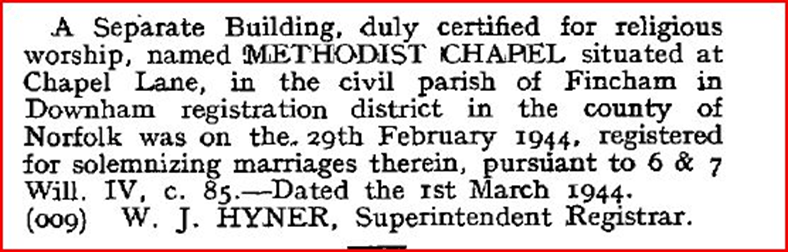
Marriage ceremonies held in Methodist chapels were legalized in 1837 (but the chapel had to be registered for ceremonies to take place) The Wesleyan chapel seems to have been registered in 1944.
After the Wesleyans and Primitive Methodists reunited and became one Methodist church the two Fincham chapels remained open until the chapel in Chapel Lane and land were sold to Fred Barker the landlord of the Swan and services continued in the chapel on Downham Road. The top storey of the chapel was removed, and it became a private house.
Primitive Methodism in Fincham
The Primitive Methodists were an early breakaway group from Wesleyan Methodism .The first Primitive Methodist chapels would have been open air meetings or meetings held in people’s homes.
The first Primitive Methodists in Fincham had a society which varied between 78 and 62 members. It was built in 1835/1836 on land along Downham Road, on Bywater’s land (Maybe John Bywater). In the 1841 tithe apportionment it is shown as both being occupied and belonging to the Primitive Methodist (no, 198 on the tithe map) It was very close to the New Inn, one of 3 beer houses in Fincham , which was later built on Bywater land. At that time beer houses were not allowed to sell strong liquor and there was no irony in a beer house being next to a chapel.
The 1851 Returns for Census of Religion shows Primitive Methodist sittings free seventy-two other seventy-one, signed James Bywater trustee Fincham.
The chapel was enlarged in 1858 on the site of the original chapel, at a cost of £50 by adding 12 feet to its length. At the same time a new gallery across one end was installed with four new windows and new pews below. It re-opened on September 5th, 1858, with services and a public tea in W Bywater’s field. Preachers included R Howchin, T Lincoln, J Ogden, W Cork, J Lyndoe, E Hewing, E Carter, T Howell, JD Digby, and J Harpley.
Trustees in 1860 were Thomas Bywater , Everard Pank, and Richard Steele and in 1863 a piece of land was sold by William Bywater for £500 in 1863 for a schoolroom. The purchasers were John Able butcher, James William Shelton wheelwright, Caleb Everett thatcher, Richard Saunder bricklayer, James Taylor shepherd and George Towler, George Shinfield, James Walden, and William Easter labourers all of Fincham.
In 1846 there were 5 teachers and 28 scholars in the Sunday School which rose to 11 teachers and 67 scholars in 1865. In 1871 there were 10 teachers and 60 scholars and in 1900 6 teachers and 43 scholars. The secretary in 1898 was C Woods. (W. F. Samson Affable and Humane)
The circuit recommended to the Trust to engage Miss Crisp, a teacher, at a salary of £5 per year and the ‘children’s pence’ The Trustees did not follow up the suggestion and the circuit committee had to write to Miss Crisp with apologies.
WF Samson in his book Affable and Humane (1998) gives us some snippets of chapel life.
Page 22 1846. Camp meetings were planned at Fincham (amongst others ), but trouble may have occurred because five years later the committee agreed “that two policemen be sought for the purpose of protecting the camp meetings”.
Page 28 A Connexional Day School was opened in Fincham in 1870 with one teacher and 30 scholars. Receipts for the year were £8.0.91/2d It was funded by the pence of the children, the profits of a tea meeting a public collection and subscriptions from different friends.
Page 31 and 32 lists how stewards in the Lynn circuit allowed £3 in the first quarter of 1894 to provide conveyances on ten Sundays to carry preachers to Fincham and Massingham.
The Primitive Methodist school opened in 1870 but in closed fairly soon. The first school mistress being Harriet Balls daughter of the Fincham district policeman.
1869 Post Office Directory
The National School master is Charles Triggs and the mistress at the Primitive Methodist school is Harriet C Balls.
William Blyth’s Diary October 24th 1870
Collecting the names of all the children in the parish between 5 and 13 for educational purpose. There being 142 (excluding well to do children).
William Blyth’s Diary October 25th 1870
My school passed as sufficient (in conjunction with the Primitives) for the parish. Shouldham and Marham schools passed under review.

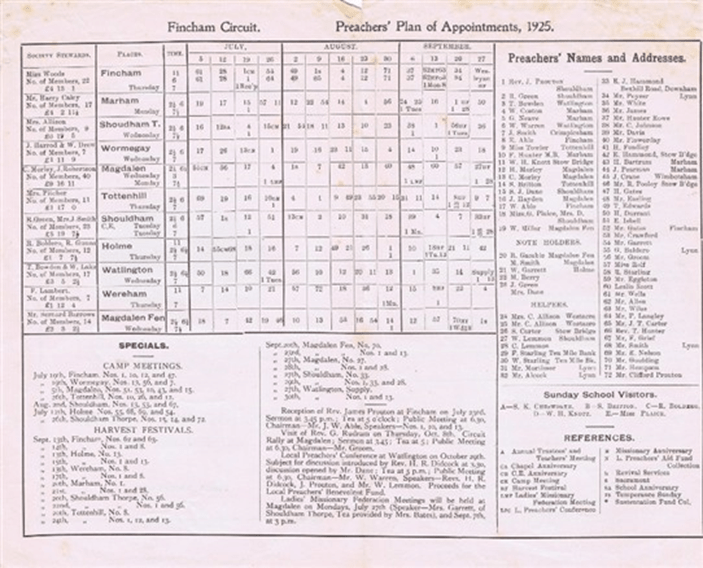
Fincham formed a separate circuit from Lynn on 28th and 29th June 1904 (Primitive Methodists)
The members of the society decided to build a new larger chapel, probably on the foundations of the old. A new chapel foundation stone was laid on 22nd April by William Lift who arranged payment for the builders (the money was paid before the chapel was opened. It had palisading and a boundary wall included in the price. Seats were to be let at 9d each. The building was insured for £200 (W F Samson) A new Sunday School was built in 1903. The chapel was again altered in 1904.
In his book Nonconformist Chapels and Meeting Houses in Eastern England Christopher Stell describes the chapel as
Gabled front with three windows having paired arched lights dated 1878. Sunday school in similar style by John Whitmore of Lynn in 1904

1900
Architects coloured plans, elevations, and sections of proposed Methodist school building. NRO FC63/24
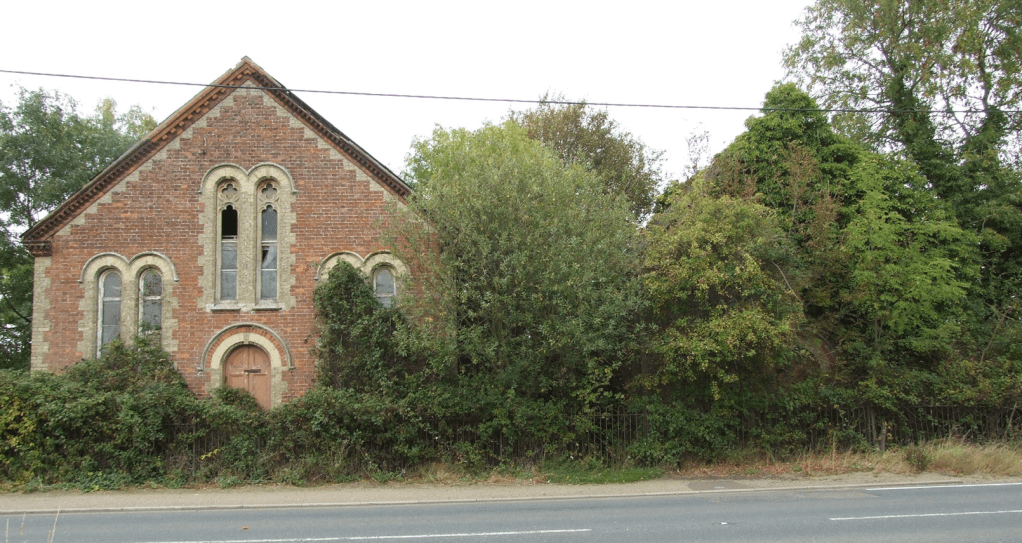
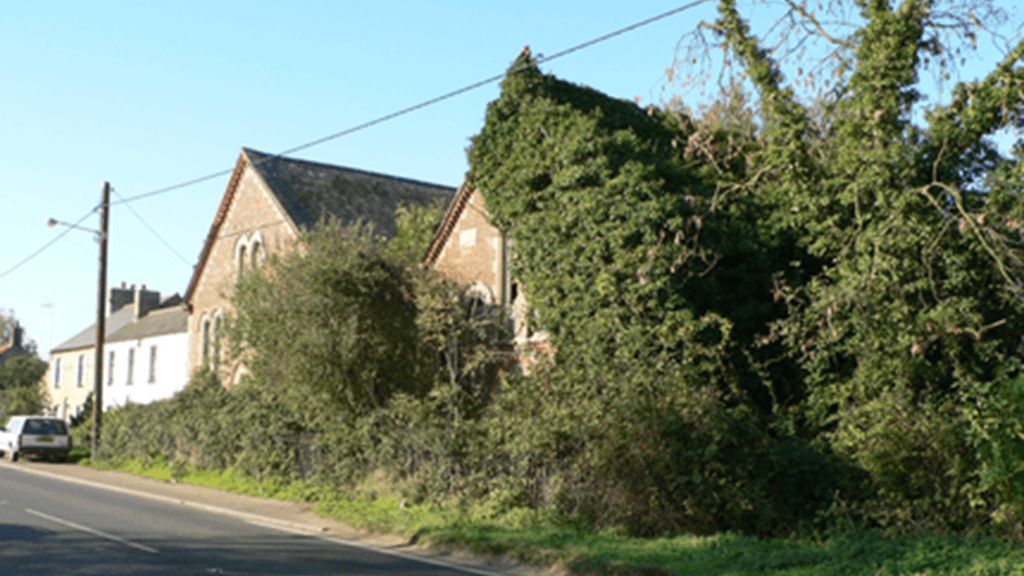
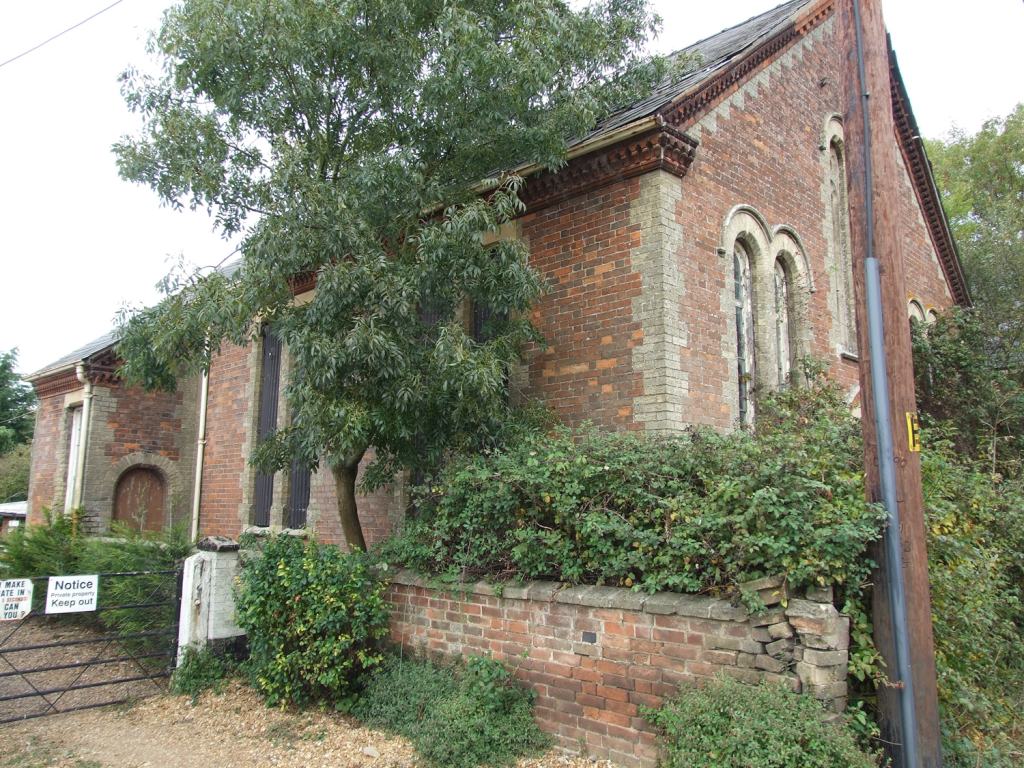
The Primitive Methodists and Wesleyan Methodists reunited in 1932 and after the closure of the Wesleyan Methodist chapel in Chapel Lane, the Downham Road chapel was in use by the Fincham Methodists until it itself closed in the 1980s.
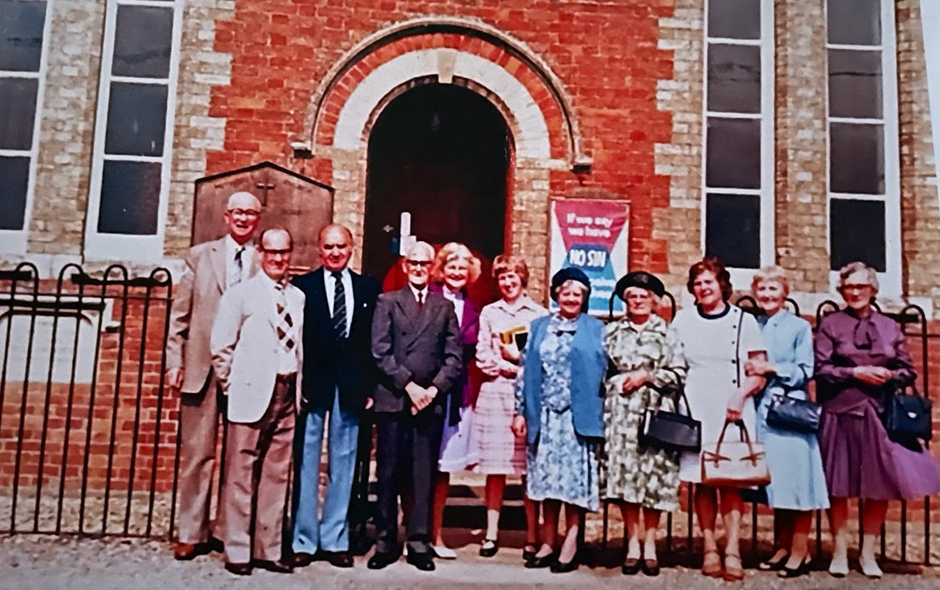
Chapel closed on August 30th, 1981 (Local History Society)
Heather Mills (centre holding the books) preached at the last service.
It was then sold and used as a furniture repository but has recently been sold at auction.
 Fincham Local History Society