From the church register
‘1860 February 29th (Leap year)
On this day there occurred a most tremendous Gale which for about three hours exceeded anything remembered by any person living in the parish.
The lead on the Church porch (new in 1852) was torn off in one mass and blown over into the Church Yard, and one of the pinnacles blown down.
At the Rectory the large Chimney over the dining room fell upon the roof. Two very fine elms in front of the house succumbed to the gale. They were 82 feet high and the largest of them contained 114 feet of timber (including bark), and from the number of circular marks it appeared that it was about 90 years old. The dock ends of these timbers were taken round into the garden with a view to making rustic chairs of them.‘
A note some years later
‘Decayed and burnt in 1871.’
++++++++++++++++++++++++++++++++++++++++++++++++++
From Rev Blyth’s Diary
Feb 28th 1860
A most fearful Gale occurred today. Wind due West. Its effects here were such that none living remember. At the Church the lead on the porch roof was all carried away, and crumpled up like paper. Its weight was nearly a ton and a half.
At the Rectory the fine old elm trees, for a century the pride of the Village were, two of them, blown down and the other two shattered. The height of the tallest was 82 feet and its circumference 6 feet from the ground, 9 ft.
The chimney over the dining room fell upon the roof and the pots went over on the leads. Considerable other damage was caused all over village. In the neighbourhood the fall of trees was such as was never before heard of. 2000 down at Beechamwell, 4000 on the Stow estate. Some hundreds at Stradsett. Several Churches greatly injured.
This is a significant event given that the trees would hardly have been in leaf. It seems as bad as the 1987 storm. There is a discrepancy in the above dates but it is likely to have been the 28th as he starts the day’s entry with a meeting he attended at Downham and continues ‘A most fearful storm….’
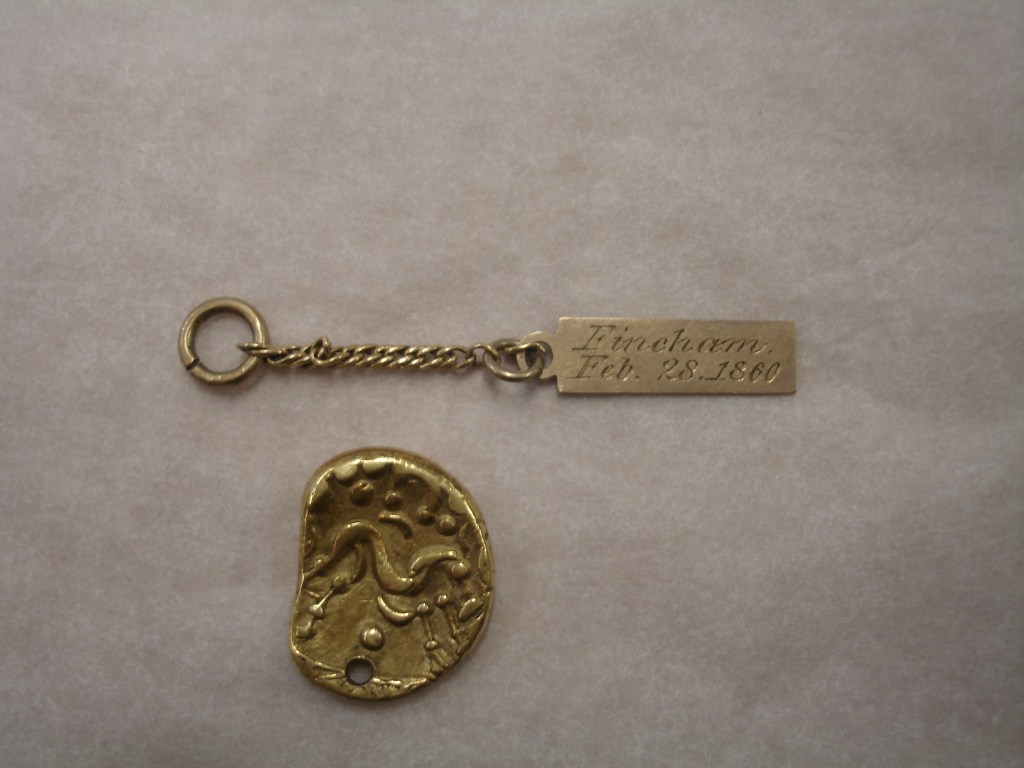
In his book Blyth says ‘A valuable gold coin was discovered at the roots of one of large elms blown down in the very severe gale of February 28th 1860, which is worthy of special notice. It has been compared with those of its class in the British Museum, and pronounced to be of the time of Julius Caesar, and probably coined in France. The obverse is blank. A skeleton like figure of a horse occupies the reverse.’
 Fincham Local History Society