Rectors and Vicars
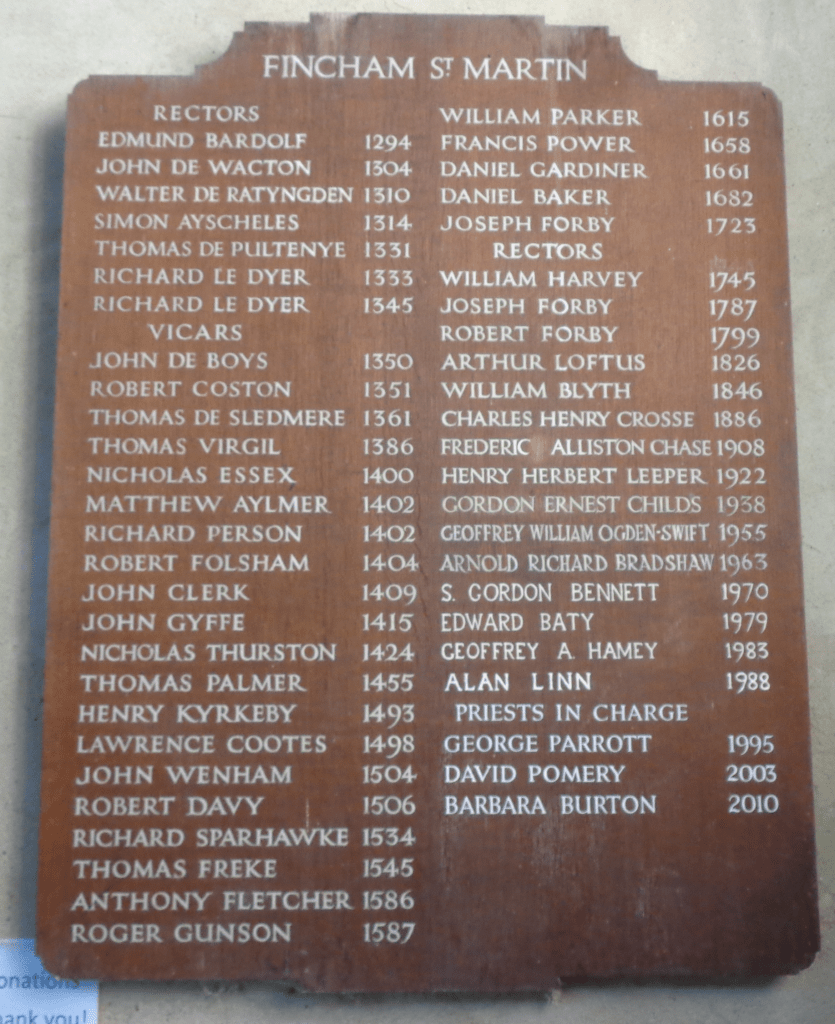
From 1995 sadly Rectors are no more. If they are priests in charge they can be moved around making amalgamations possible.
If anyone has any photos or information on the following we would love to know.
Rev Chase 1908-22 Rev Leeper 1922-38 Rev Childs 1938-55 Rev Bradshaw 1963-70
**********************************************************************************************************
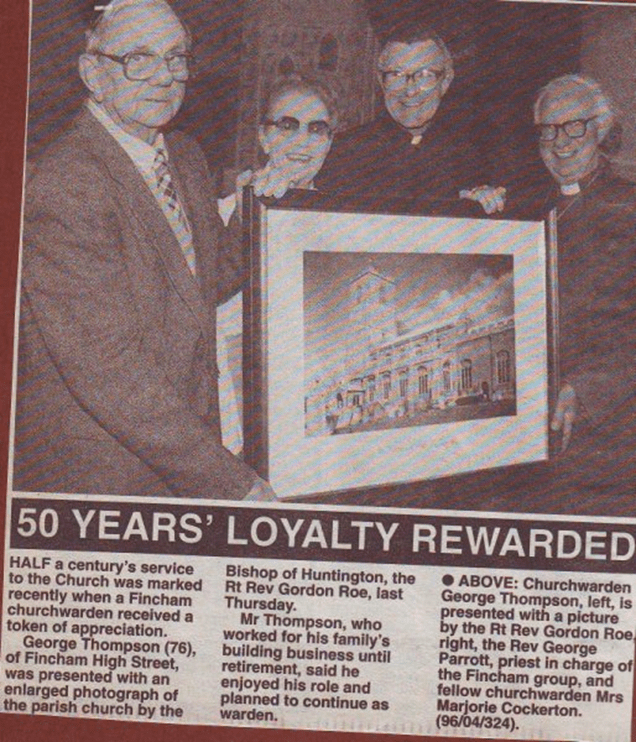
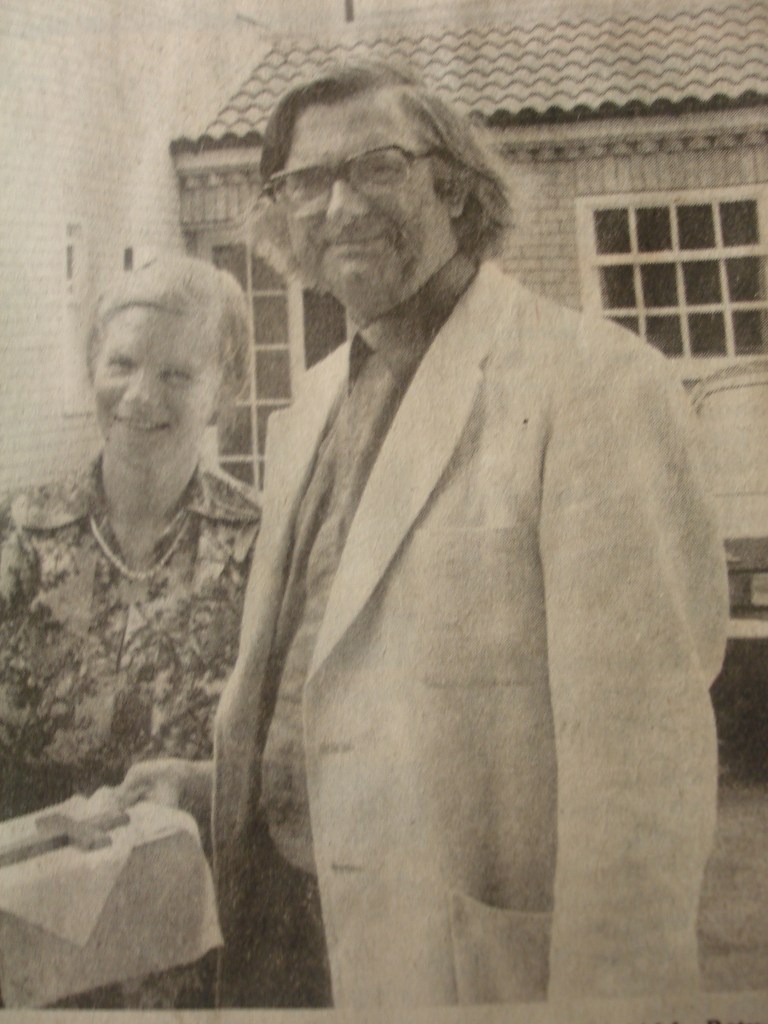
Presentation to Churchwarden George Thompson. He and Marjorie Cockerton (also pictured here) were very long serving Churchwardens.
************************************************************************************************************
************************************************************************************************************
************************************************************************************************************
This is the obituary notice for Rev Baty who died in August 2014
BATY. – On 23 August, the Revd Dr Edward Baty: Succentor of Chelmsford Cathedral (1964-67); Vicar of St Cedd’s, Becontree (1967-71); Rector of Hope Bowdler with Eaton-under-Heywood (1971-79); Rushbury (1971-79); Curate-in-Charge of Cardington (1971-79); Team Rector of Fincham (1979-82); Rector of Long Stanton with St Michael (1982-94); Priest-in-Charge of Lolworth (1985-88); Voluntary Chaplain to the Forces (1986-95); aged 84.
************************************************************************************************************
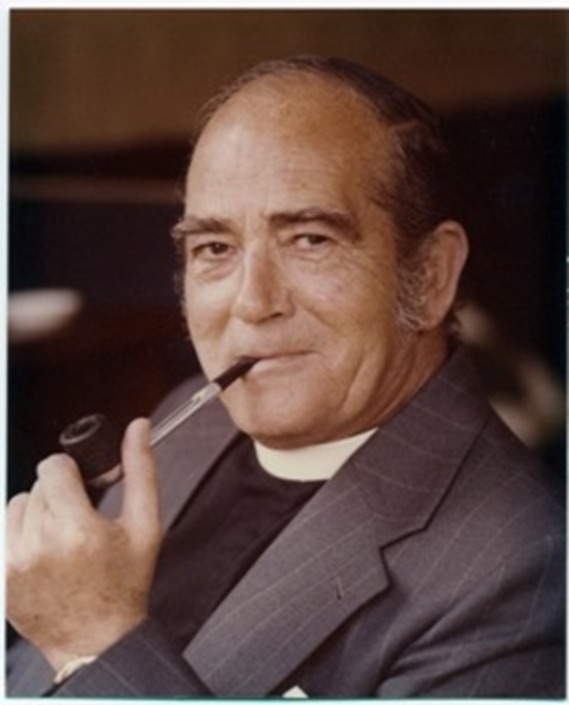
Rev Stanley Gordon Bennett 1970-1978
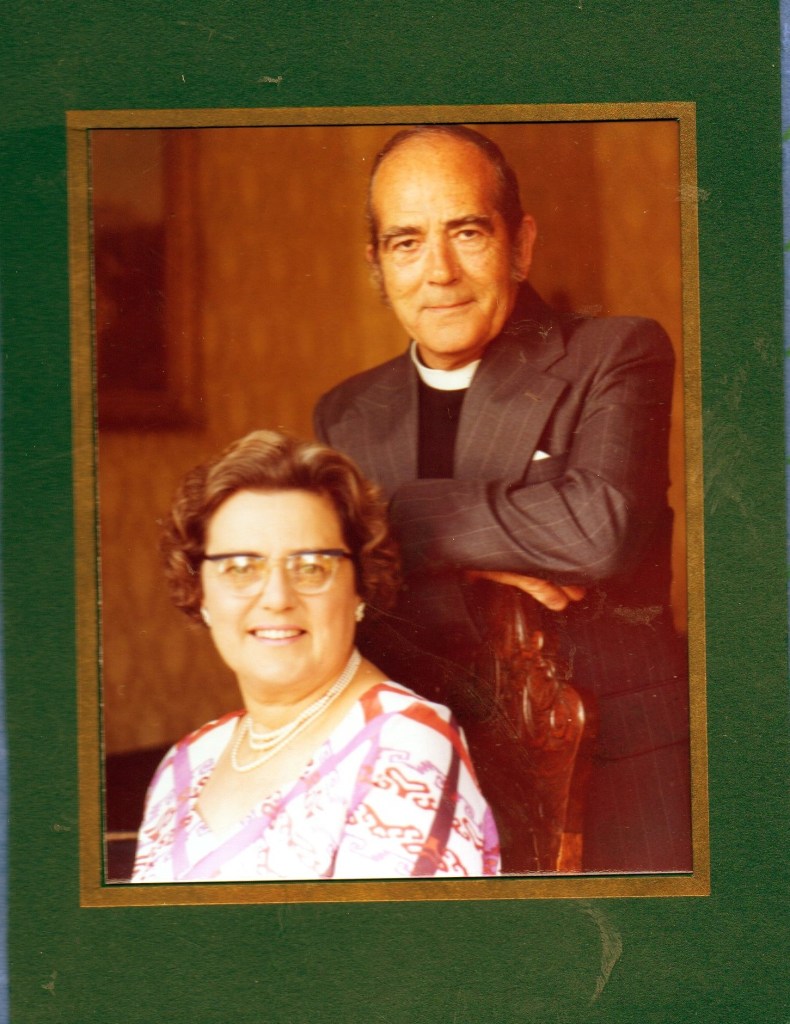
Stanley Gordon Bennett was born in 1915 in Handsworth.
He went to University to study bio-chemistry but in 1939 went to the London College of Divinity to train for the priesthood. Stanley was ordained deacon in Holy Trinity, Coventry, in 1939, and then priest in the Cathedral on Trinity Sunday of 1940 – the last ordination service before the firebombs of the autumn wrecked the building irrevocably. His wife Jeanne whom he married in 1941 told a tale of an act of quiet heroism by Stanley. He must have been on fire-watch on an occasion when a firebomb had rolled down into the doorway of an air raid shelter. Donning his brand new leather gloves as protection, Stanley picked up the bomb and removed it to a place where it could cause less damage; in the process he ruined the gloves – a gift from Jeanne.
In 1947 Stanley joined the RAF. He became a Squadron Leader and in 1962 Wing Commander. Padre Bennett was very well liked and served in many places, including Christmas Island. He was talented as an entertainer and here is an old photo of him from his army days.
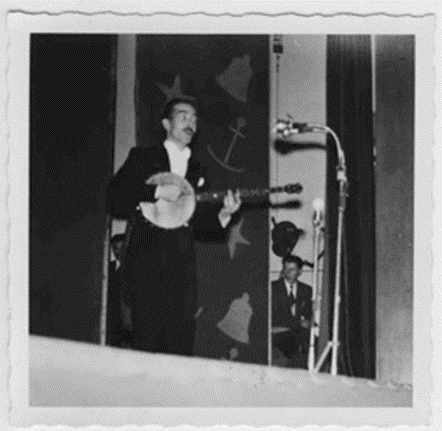
In 1970 he retired from the Army and was asked to form the Priory Cross Group in West Norfolk. He moved into Fincham Rectory in 1970. Many years later he was remembered with affection in the area.
In 1973, Ely Cathedral celebrated its thirteenth centenary, with a series of events. They had a notional “beating of the bounds” of the diocese, whereby the bishops visited all the boundary parishes, and met with the people there – visiting schools and suchlike, and being entertained. For the set of events in the Fincham area, he asked Stanley to be his chaplain (i.e. a kind of P.A.). Stanley decided to wear his Spanish wide-brimmed hat. The Bishop asked why, but was completely convinced by his explanation: Stanley was not tall, and would be a be-cassocked figure amongst lots of be-cassocked figures; if the Bishop needed to find him, he would have only to look for the hat!
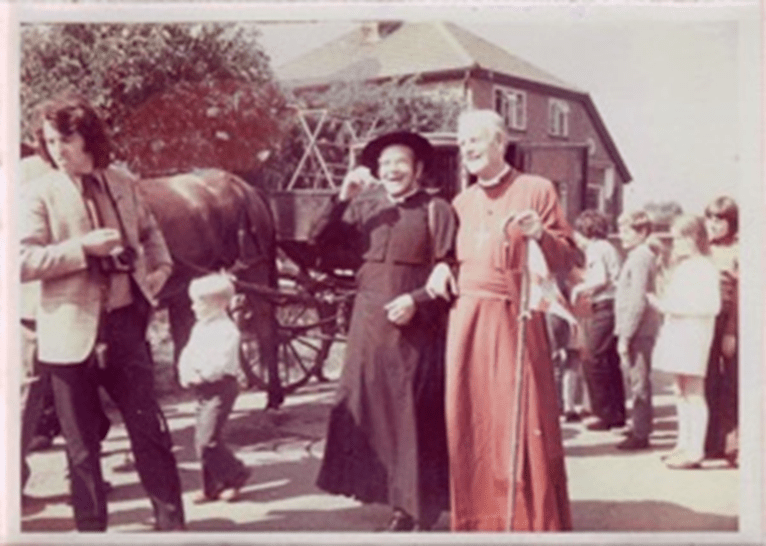
In 1978 he moved to the Parish of Gamston in Nottinghamshire. Sadly he died two years later in 1980. Towards the end of June 1980 a service of thanksgiving for his life and ministry was held at St Martin’s, Fincham. Many people came along, even though it was already a couple of years since he’d left. Hubert Ward, Headmaster of King’s School, Ely, gave the address.
************************************************************************************************************

+++++++++++++++++++++++++++++++++++++++++++++++++++++++++++++
Rev Gordon Ernest Childs 1938-55
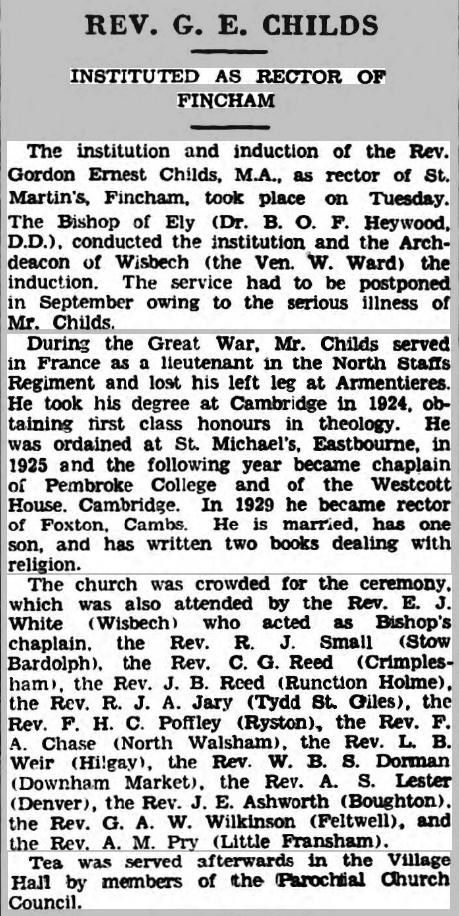
Rev Childs was married to Margery. He died in Cornwall in 1966.
+++++++++++++++++++++++++++++++++++++++++++++++++++++
Frederick Allison Chase 1908-1922
****************************************************************************************
Herbert Henry Leeper 1922-1938
****************************************************************************************
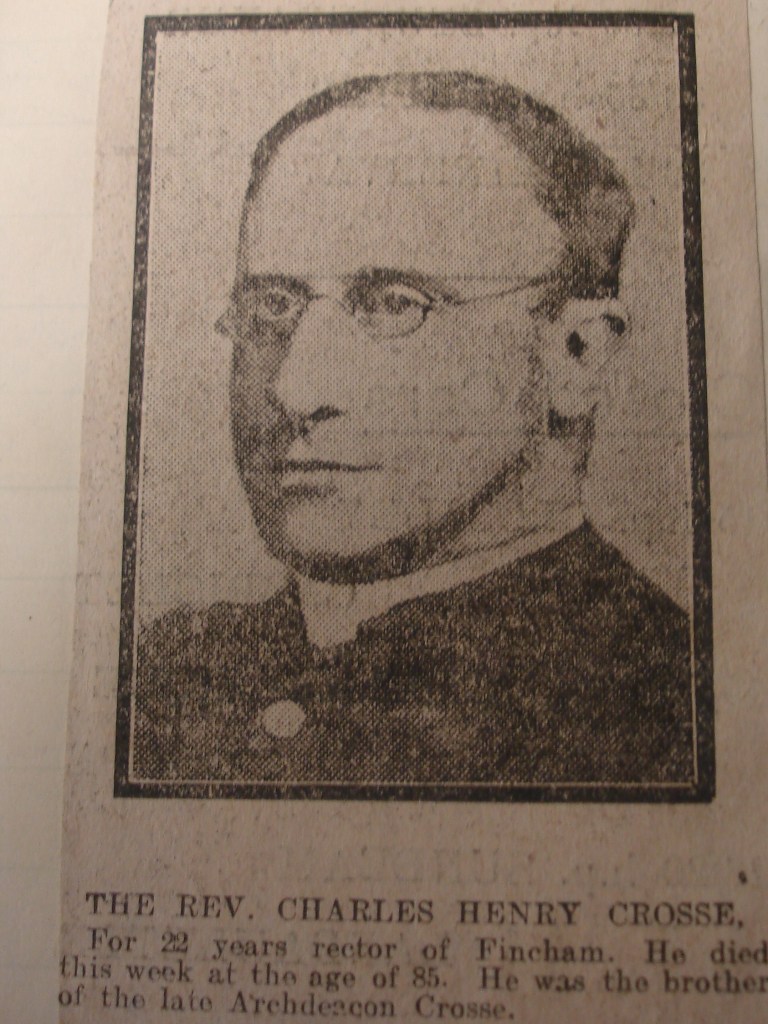
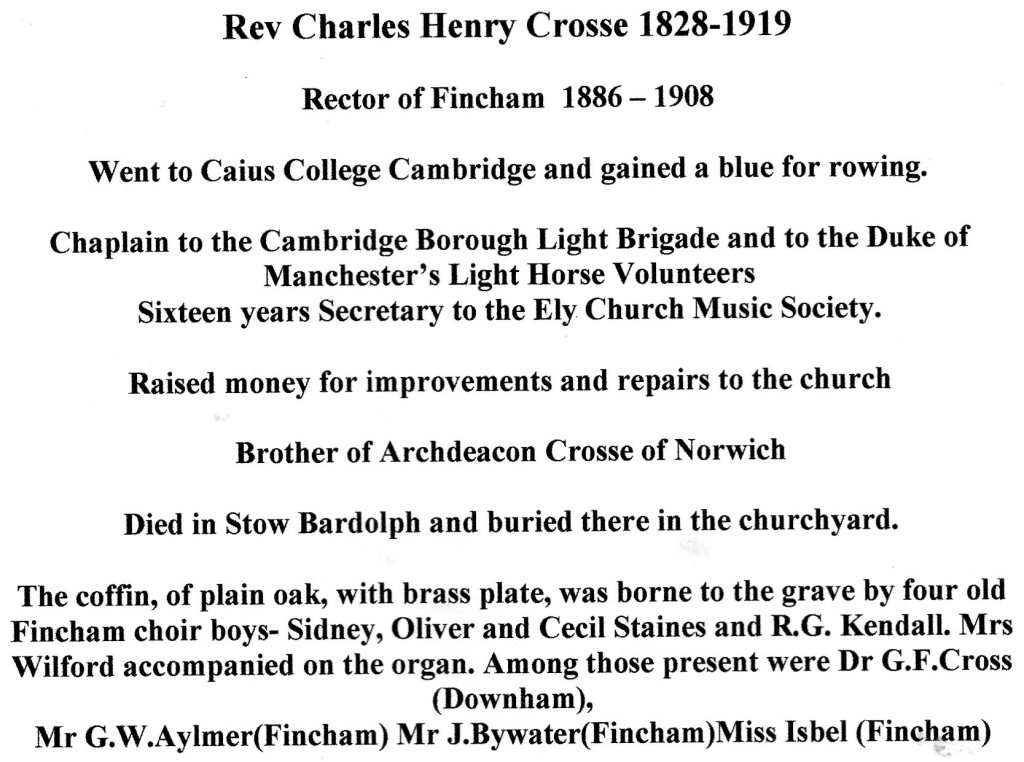
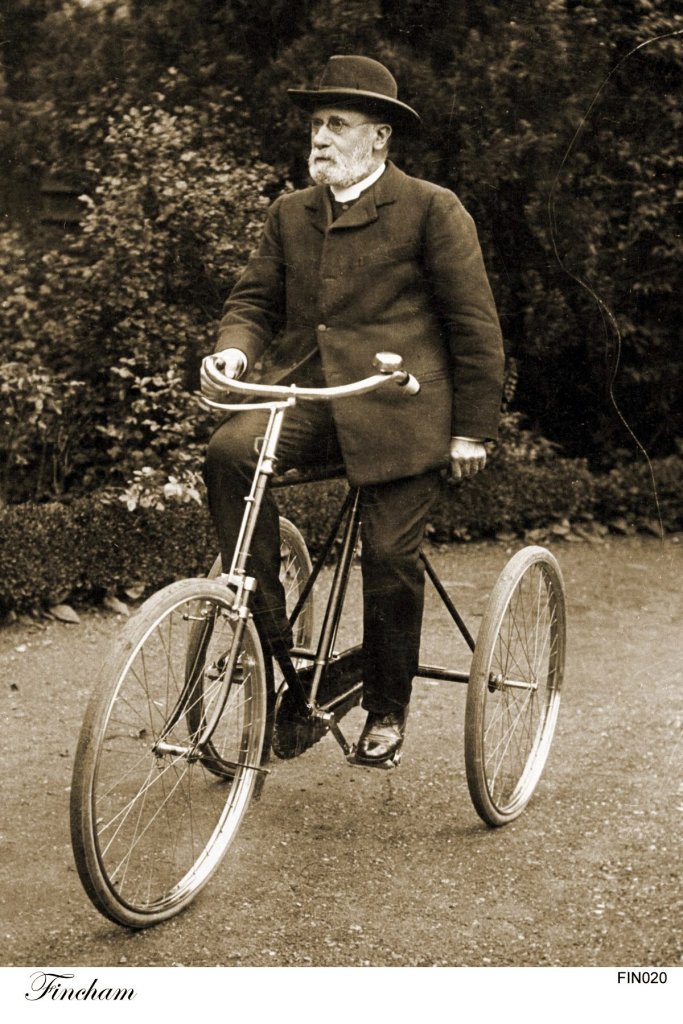
Newspaper Cutting (Eastern Daily Press) 24/12/1913: ‘Death Of The Rev. C.H. Crosse. “One of the best known ecclesiastics of the county passed away on Monday in the person of the Rev. Charles Henry Crosse, M.A., M.L., who was for twenty-two years rector of Fincham. His last days, since July, have been spent at Stow Vicarage, the residence of his niece (Mrs C.E.H. Wilford, wife of the vicar of Stow), and the end came on Monday as the result of senile decay after about a month’s illness. He was 85 years of age. The rev. gentleman was appointed to the rectorship of Fincham by the Lord Chancellor in 1886, succeeding the late Canon Blyth, and after doing excellent service towards the restoration of the fabric of the church and the revival of public worship, retired some five years ago. He was a brother of the late Archdeacon Crosse, and leaves a daughter, Mrs Cecil Tennant.
. The funeral will take place at Stow Churchyard to-day (Wednesday), when the Rev. C.E.H. Wilford and the Rural Dean (the Rev. E.W. Bayly) will officiate. Other clergy of the Deanery will be present, and the body will be borne to the grave by four old Fincham choir boys – Oliver Staines, Cecil Staines, Sidney Staines, and R.G. Kendall.”
Rev. Cross was educated at Gonville and Caius College Cambridge where he gained a rowing blue. He was a curate in several livings around Cambridge which needed attention. He raised funds and repaired and improved churches as well as increasing attendance at church and school. His legacy at Fincham is similar in that a major renovation was made to the church in Edwardian times. (for details see Sir Gerard Noel in People.)
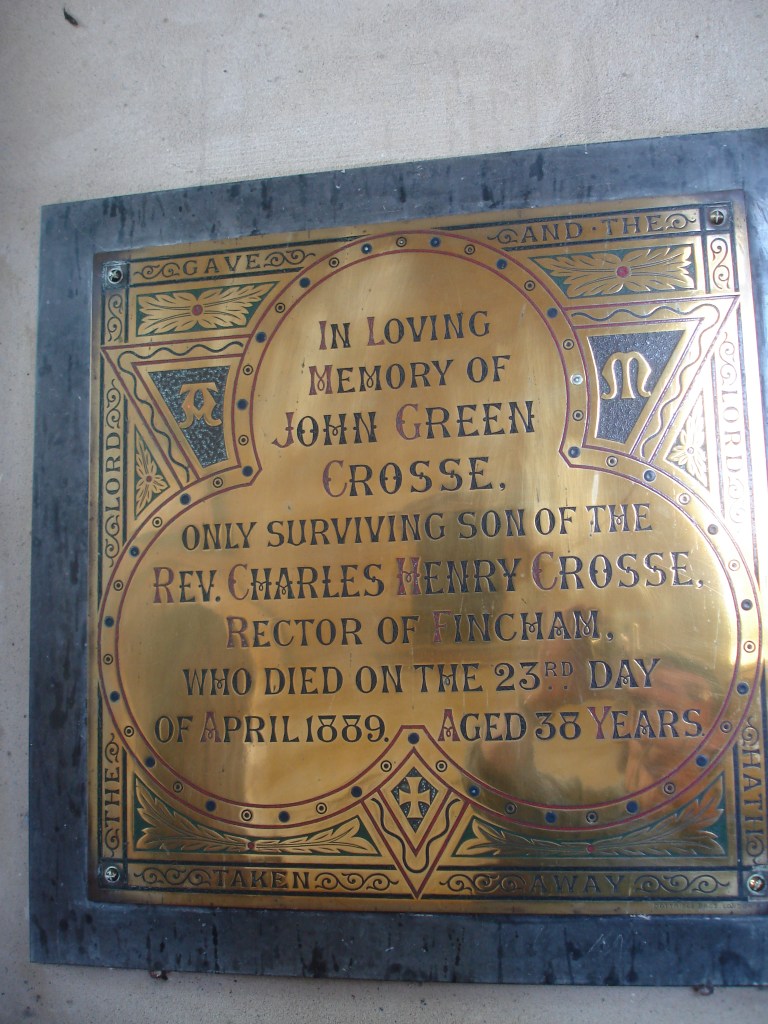
A family tragedy for Rev Crosse.
*************************************************************************************
William Blyth 1846-1886
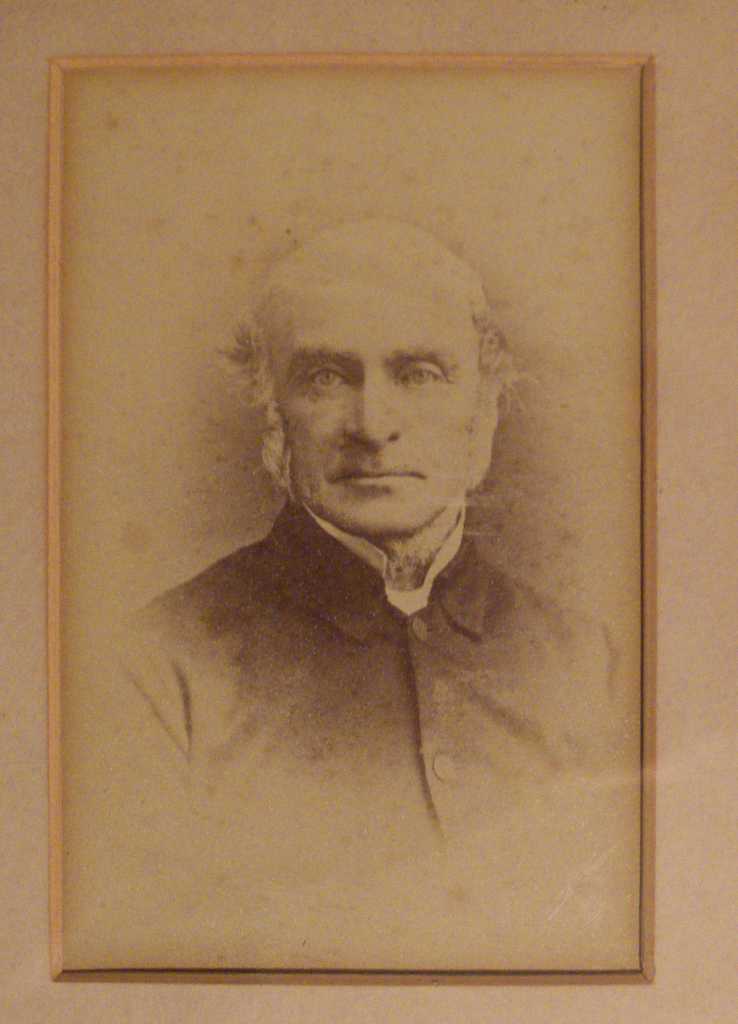
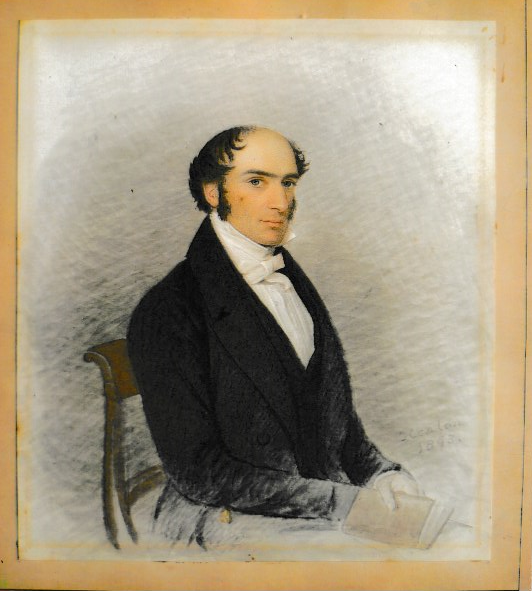


Mary Ann Blyth 1820-1879
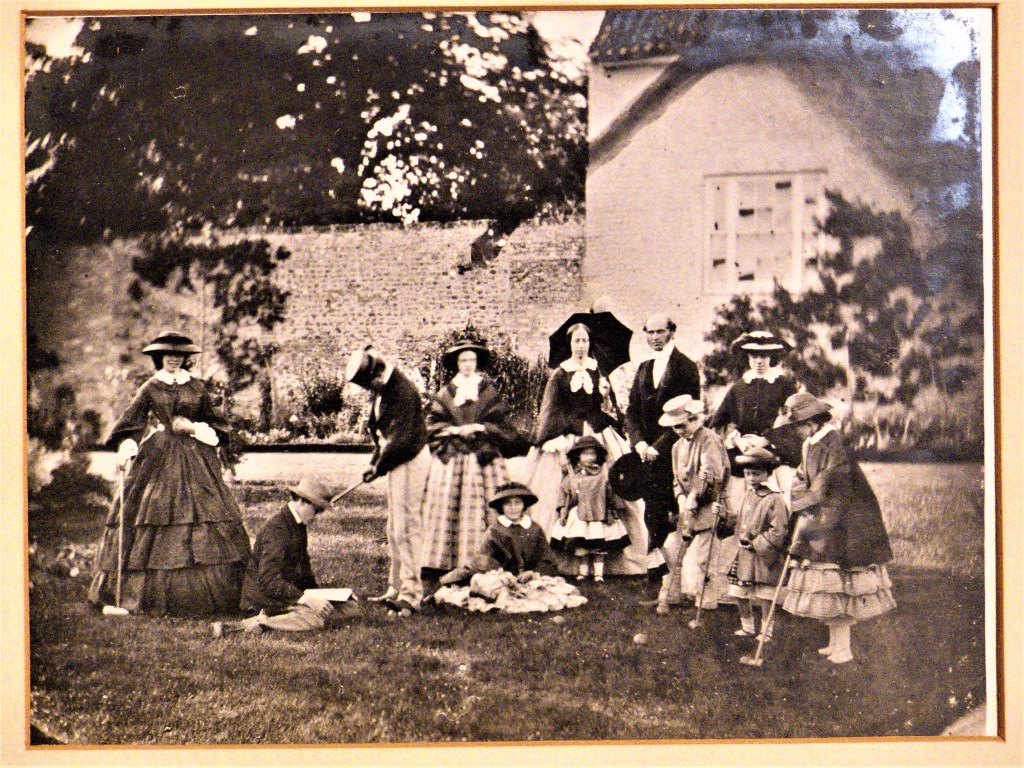
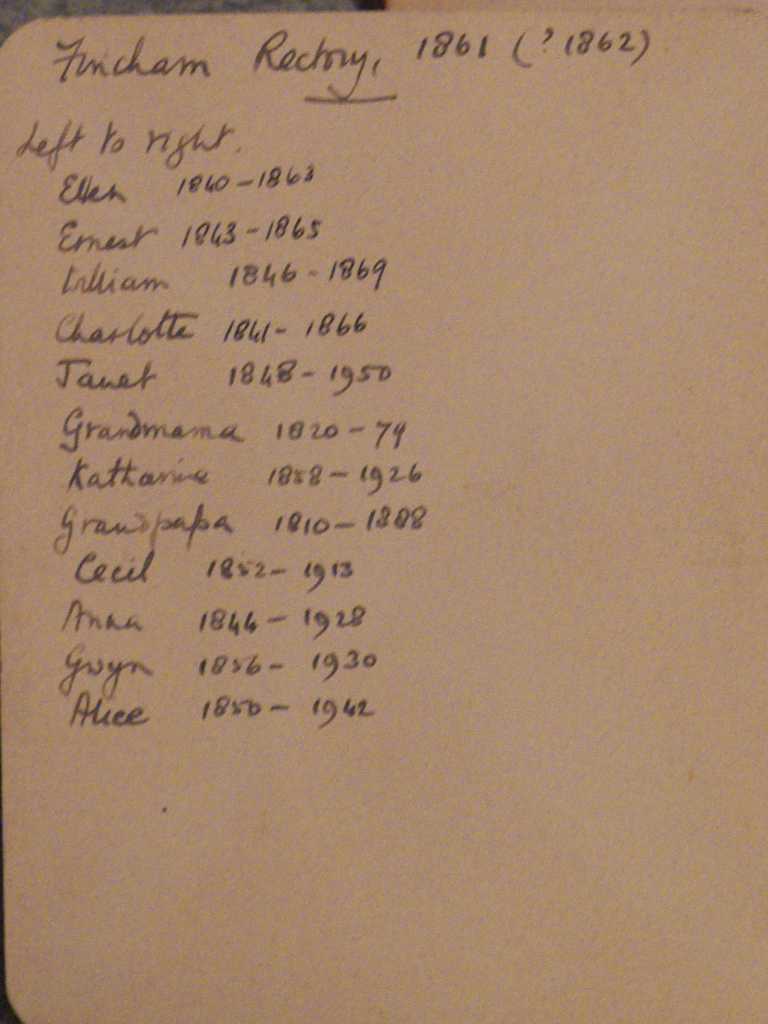
William Blyth came to Fincham in 1846. He was thirty six and his wife Mary Ann twenty seven. His father was a farmer and landowner, Henry Blyth, who ws a neighbour of the pioneering agriculturist Thomas Coke of Holkham. Henry owned Sussex Farm near Burnham Market. He is mentioned in almost the same breath as Coke in agricultural reports of the time. He had a large number of children who benefitted from his largesse. He bought the advowson of Fincham St. Michael’s and St. Martin’s for £3000, a huge sum in the early 19th century. So William came into the wealthy living at Fincham when the village must have been in considerable turmoil. The previous Rector, Arthur Loftus, had been deprived of the living after a trial in the Consistory Court which detailed some scandalous events that surely left villagers feeling almost without a church.
The Rev Blyth was certainly quite equal to the task. Within a year or two he had improved the poorly kept interior of the church, gaining funding from several wealthy villagers, and started the building of a new National School. He soon became Rural Dean, showing the high regard he was held in. The villagers must have been so pleased that here was a man who was well organised, hard working and genuinely disposed to be a good Rector.
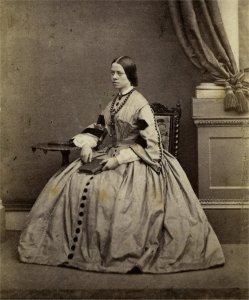
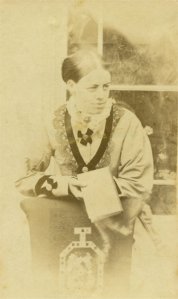
There will be many references to him on this website. The sources are a book he published in 1863 on the history of Fincham, his private diaries kindly shown to us by a descendant, church registers of births marriages and deaths, the school log books, church wardens accounts and miscellaneous items. The photograph above taken in the Rectory garden is the earliest Fincham photograph we know of.
++++++++++++++
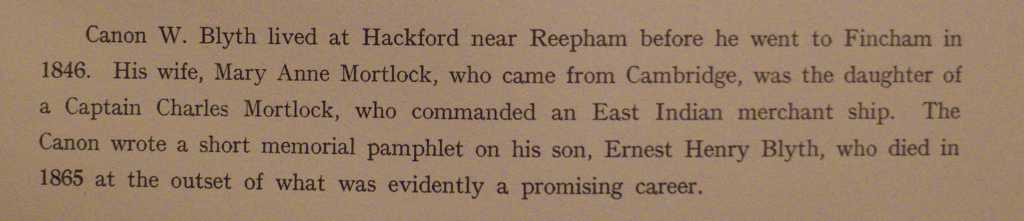
The following notes were written by Rev Blyth in spare pages in a Parish register
They are very useful in identifying and dating various objects still in the church, and for other events such as the building of the new school and the widening of the road and improvements to the pond.
Memoranda
1847 During the summer of this year extensive repairs and improvements were effected in the church. The nave entirely re-seated with open seats, floors re-laid, new reading desk, pulpit, new south door etc. etc.
The total cost was £321,14,10, of which nearly all was subscribed in the parish. One old brass was found and placed in the central passage of the Nave
William Blyth Rector
John Barsham
George Aylmer Churchwardens
1848 During this year the Vestry was well repaired and refitted. The pulpit sounding board afforded a good table. There is the following inscription on the old board. “Gregory Watson made this at his own charge anno domini 1604.”
Also during this year a new schoolroom was built for the Education of the poor. The site was given by the Rector. The total cost of the School Room, Master’s House, Playground, gardens, Surveyor and lawyers expenses, amounted to £747.7.1
1850 This year the chancel walls were well repaired, and windows reglazed by Mr Hebgin. The chancel arch with a large and frightful crack and crevice was well repaired by the Church-Wardens, and over the same a New window in the East gable was put in. Also a chair for the Communion table, purchased at the Bishop of Norwich’s sale whose property it was.
1851
This year the entire south wall and the buttresses were
thoroughly repaired. Three new pinnacles were erected, the gift of various benefactors. Rev F Edwards etc.
1852 This year the remaining pinnacles were restored, all the gift of ladies in the parish.
Also the south porch was new roofed and well repaired and ornamented by Mr G. Aylmer. This was a munificent gift to the clerk by G.A. £40
1853 This year a handsome memorial window was erected in the west front of the tower by the executors and relatives of the late George Aylmer of this parish, whose name it bears. It was executed by Mr Wilmshurst of London and cost £160.
1854 This year a new and commodious gallery was erected in the Tower for the singers, of only 3 or 4 feet in height, it is to be in no way unsightly or inconvenient. Mr John Aylmer of the Manor House presented a new Harmonium to the Church at a cost of 30 guineas.
*1855 This year two new stained glass windows, Powells Quarries, were presented to the Church by Mrs John Barsham in memory of her late brother and nephew.£50
Also a new paten of best Sheffield plate with silver edges £30 was given to the church by Mr Hebgin.
1856 A new box for the Church Plate was made by order of the Church Wardens and a wine bottle (electro plated 26/6) added.
A brass plate commemorative of the restoration of the Church in 1847 was put up at the expense of Mrs Barsham.
Cost £4 5s Engr
£1 Mason
Another window (The Resurrection of our Lord, by Wilmhurst, London) was presented by Mrs Barsham in memory of her husband. And another by Mrs Fincham of Blandford, and myself firstly.
1857
Another window (the Crucifixion) presented by Mrs Barsham, £46 (Wilmshurst) and another (oak leaf pattern) at the West End of the South Aisle by the same, about £16
*The windows put in by Mrs Barsham this year (1855) contain the following inscriptions,
1 James Barsham Dean, died Aug 5. 1830, aged 13 years.
2 John Aylmer died April 5. 1853?? Aged 63 years
1860 Two plain windows North side each £4. 10. Mrs B one The Parish the other
1861 Two more of the same.
1863 Nov 9th. Apiece of land ½ an Acre, on the north side of the Church-Yard was freely conveyed by Mr Hebgin for the enlargement of the same.
1864 April 28th, the aforesaid land was consecrated this day by John Thomas Pelham, Bishop of Norwich.
1865 A Glastonbury Chair given by Mr J Aylmer £4
1866 A new and very good Organ erected this year by Subscription at a cost of about £100 by Bryceson London
1869 New altar rails by Rattee of Cambridge
Cost of Rail £8.10 Stone Steps £7.10 Paid by Miss Hebgin
1870 July 1st Town pond improved by a new stone wall and rails, and road widened cost £13
July 30th Church Clock Dials repaired and fresh painted and gilded etc. by Mr Aylmer.
August Glastonbury Chair given by Mr J.B.Aylmer
Nov 21st New Warming Apparatus erected in Church by Gidney of Dereham cost about £40
1871 Mr John Aylmer of the Manor House died March 28th having left £25 to be spent upon the Church at the discretion of the Rector.
1871 Aug. Four New Windows (Clerestory) erected on the South Side of Church, by Powell cost about £18.
1871 Oct. Two tables of Commandments, from Cox and Son London were put up. The letters (about 1300) done by the Miss Blyths. Crimson Dossel under the E Window etc. Cost about £12.
1872 June The Chancel restored by the Impropriator Miss Hebgin. New seats, in proper position. Pavement etc £42
Also the Vestry repaired by subscription £6
Tomb Stone put down to Sir Nicolas Fyncham 18/1
6 New Bell Ropes £3.6s
*Mem: Nov 26 1870. To cleanse the flues of the Church stove, enter the Vault and draw the Stove carefully forward – take out the horizontal chimney- then remove the flag stone in the Tower at the base of the Chimney and open the flue. The same may be also be opened where the damper is inserted.
=================================================================
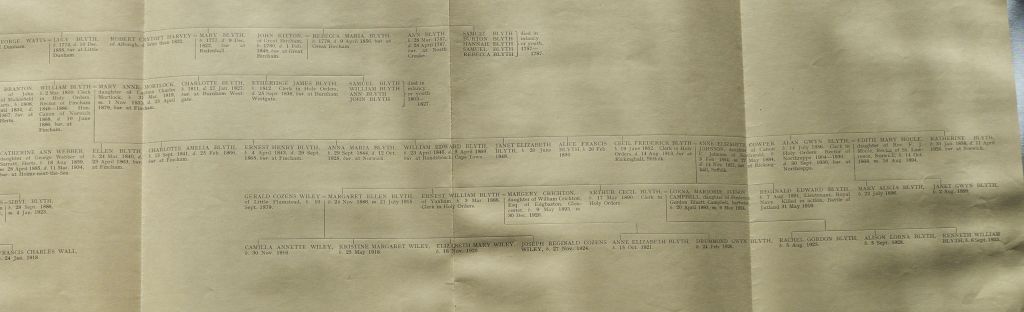
Blyth Children

Ellen Blyth 1840-1863
She died in the diphtheria epidemic of 1863


Died and buried in South Africa
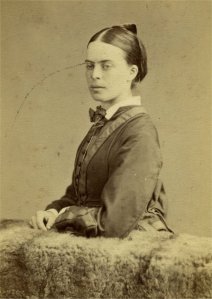
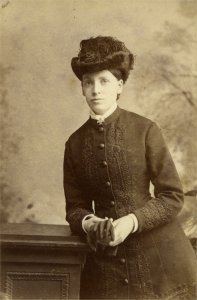

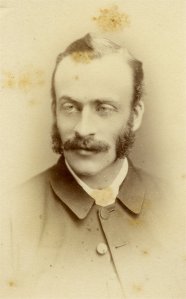

Finally after Blyth’s death-
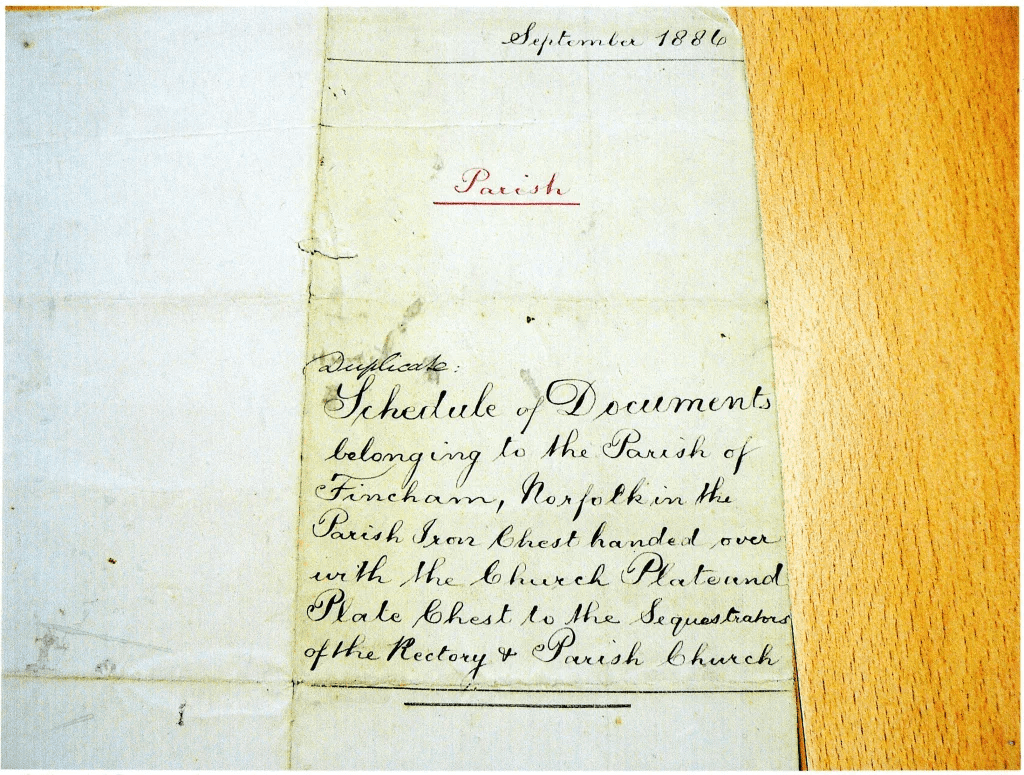
In the methodical way of William here is the confirmation of the handing over of the parish documents and plate in the Parish Iron Chest to his successor. The documents are a treasure trove of information, the most notable being the first item – 1541-1884 Thirteen Parish Register Books for this Parish. The chest referred to is still in the church but the contents referred to are safely elsewhere.
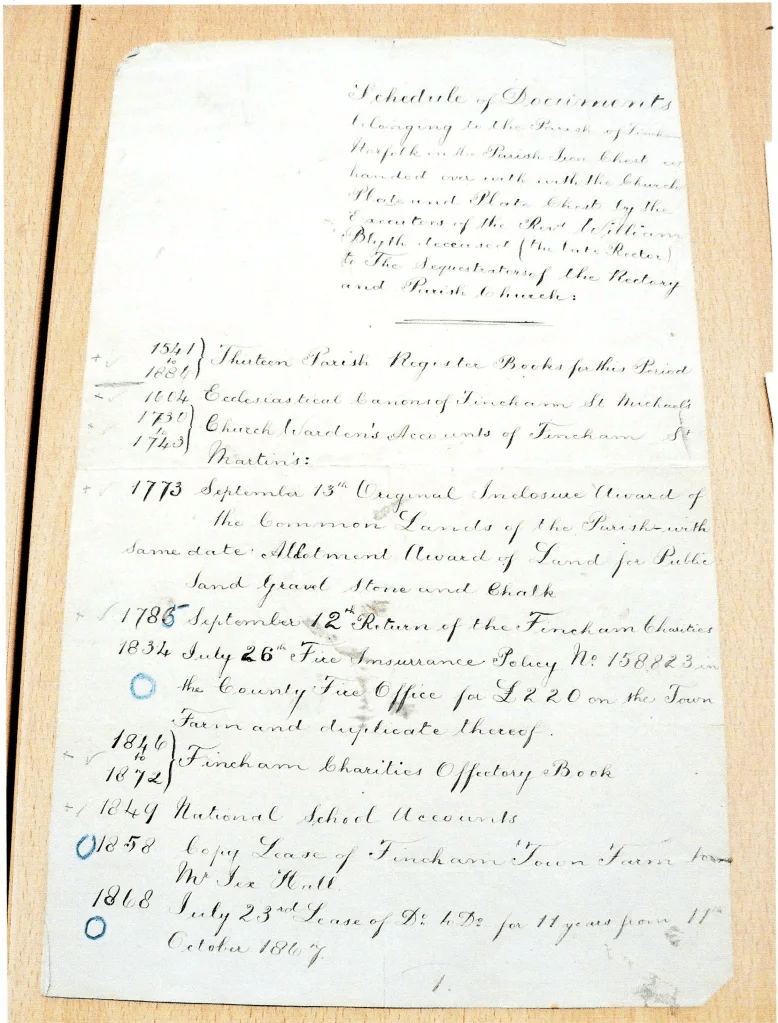
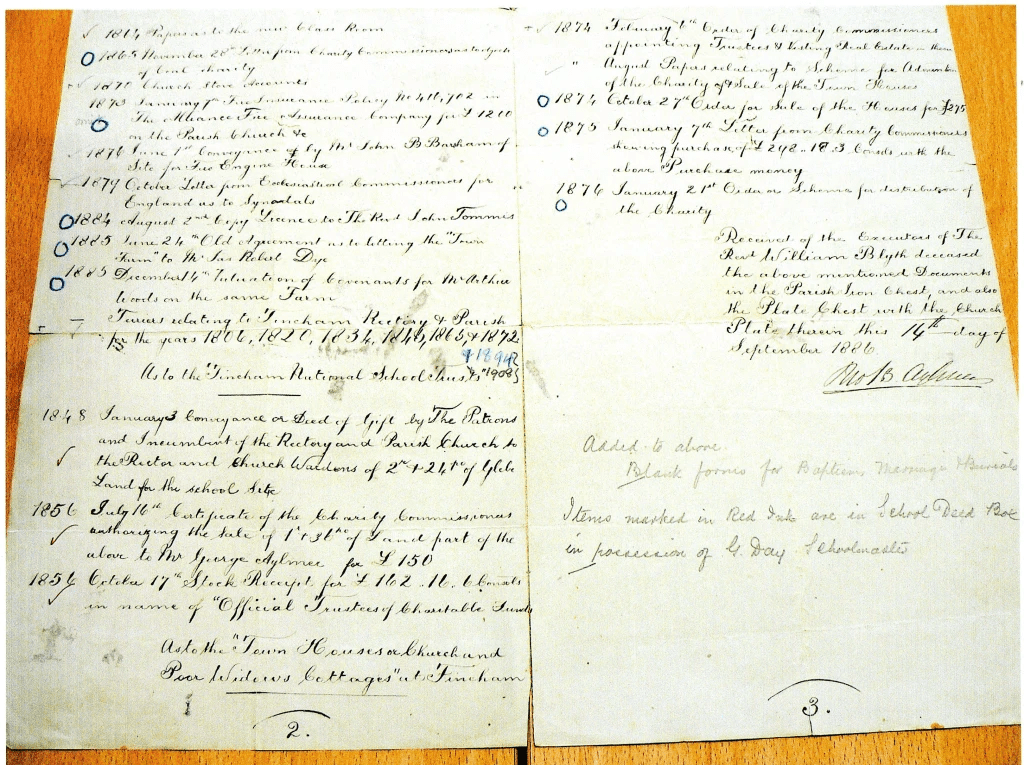
His final resting place
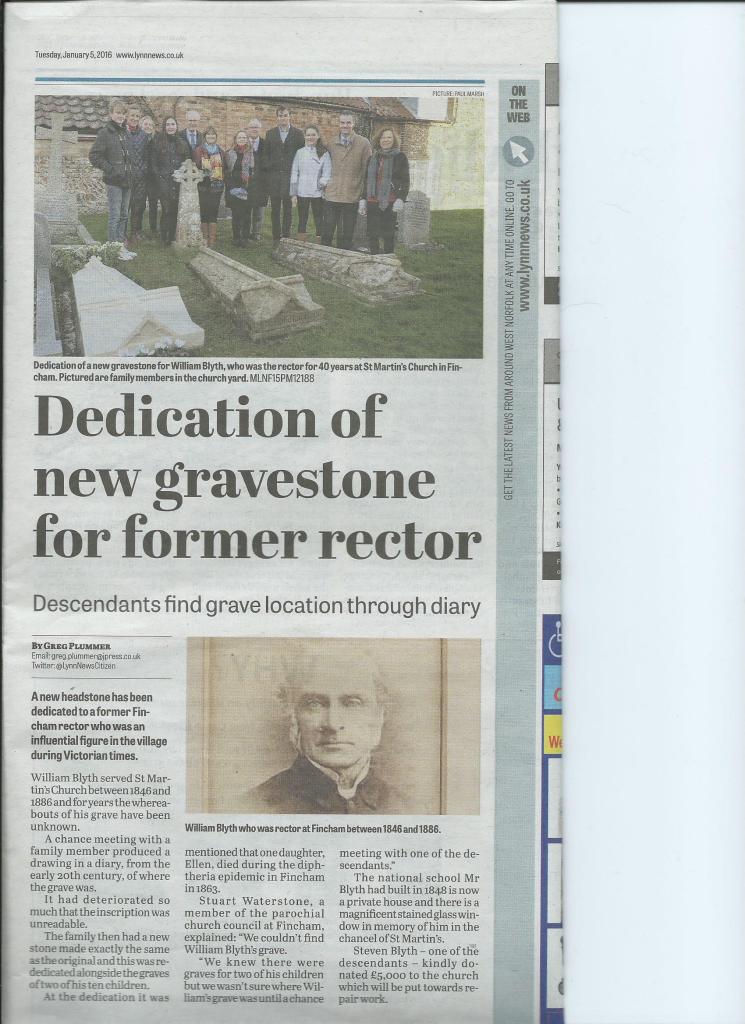
Mary Alicia Blyth and a diary entry
William Blyth had two sons who had children. Kenneth Blyth from whom we have got so much information and archive material is descended from Rev Cecil Frederick Blyth (1852-1913) and Mary Blyth, born in 1896, was the daughter of Rev Alan Gwyn Blyth (1856-1930). This writing done by Mary in 1910 is a delightful insight into Edwardian Fincham. Aunt Alice is William’s daughter who died in Norwich in 1942 aged 92 and Aunt Janet is another daughter who died in Norwich in 1950 aged 101. These sister’s lived in Norwich together probably from when William died in 1886 until Alice’s death in 1942. The new roof on the church was done in the major restoration project led by Admiral of the Fleet, Sir Gerard Noel, who lived at the Moat House. Reggie and Arthur are cousins, sons of Rev Cecil Frederick who, with his wife Anne, are the Uncle and Aunt referred to.
This is the service that occasioned the visit to Fincham
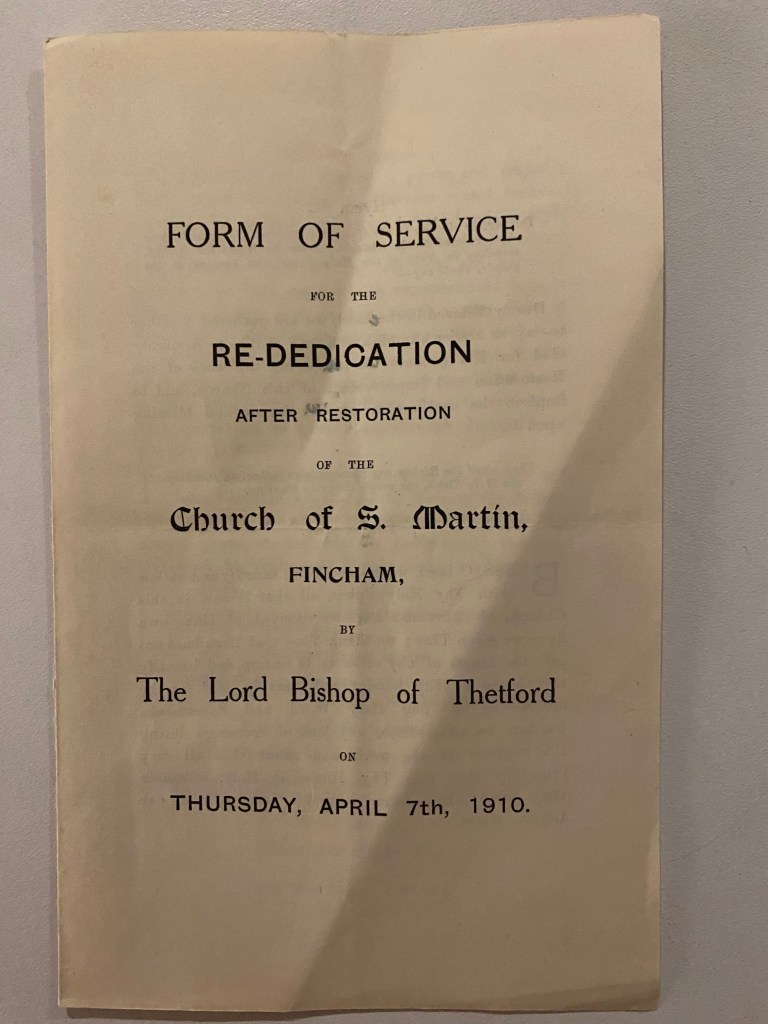
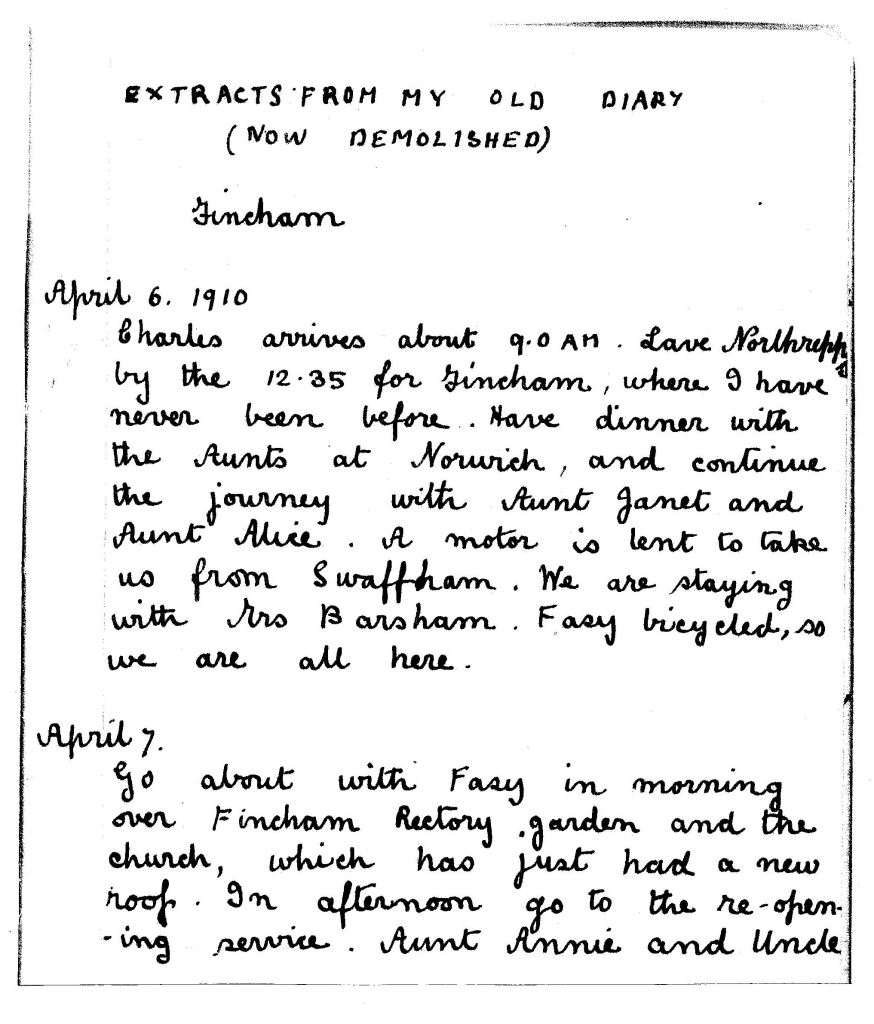
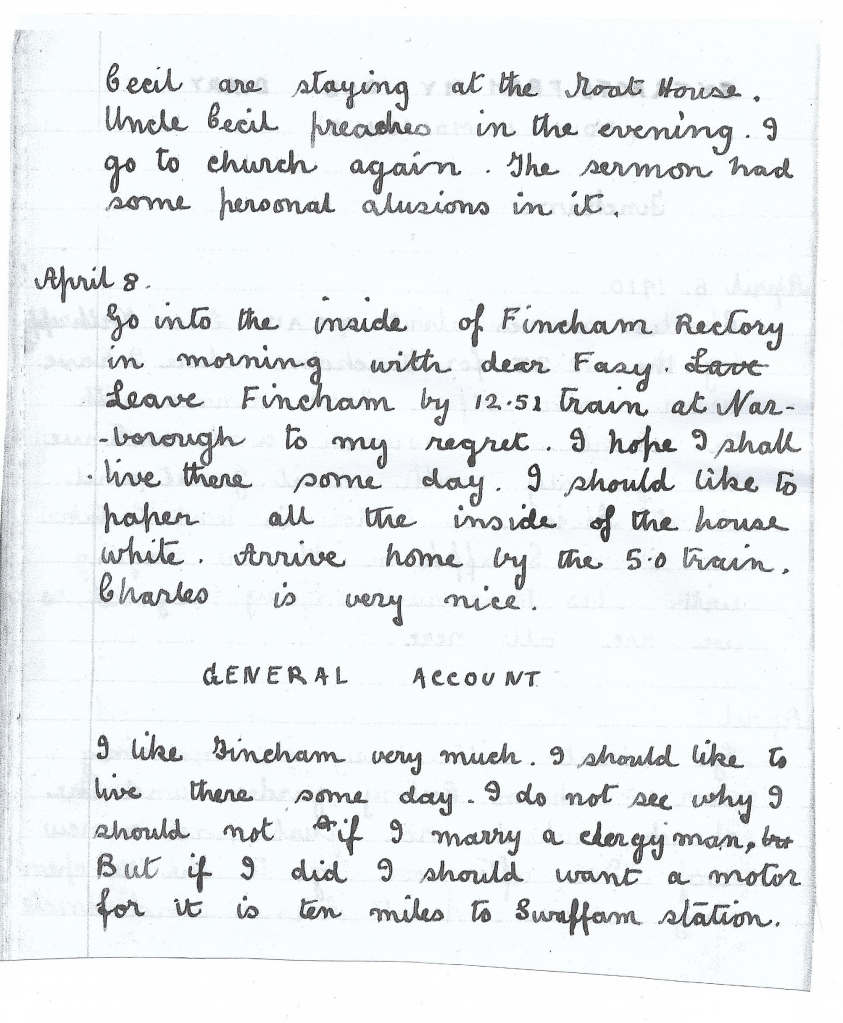
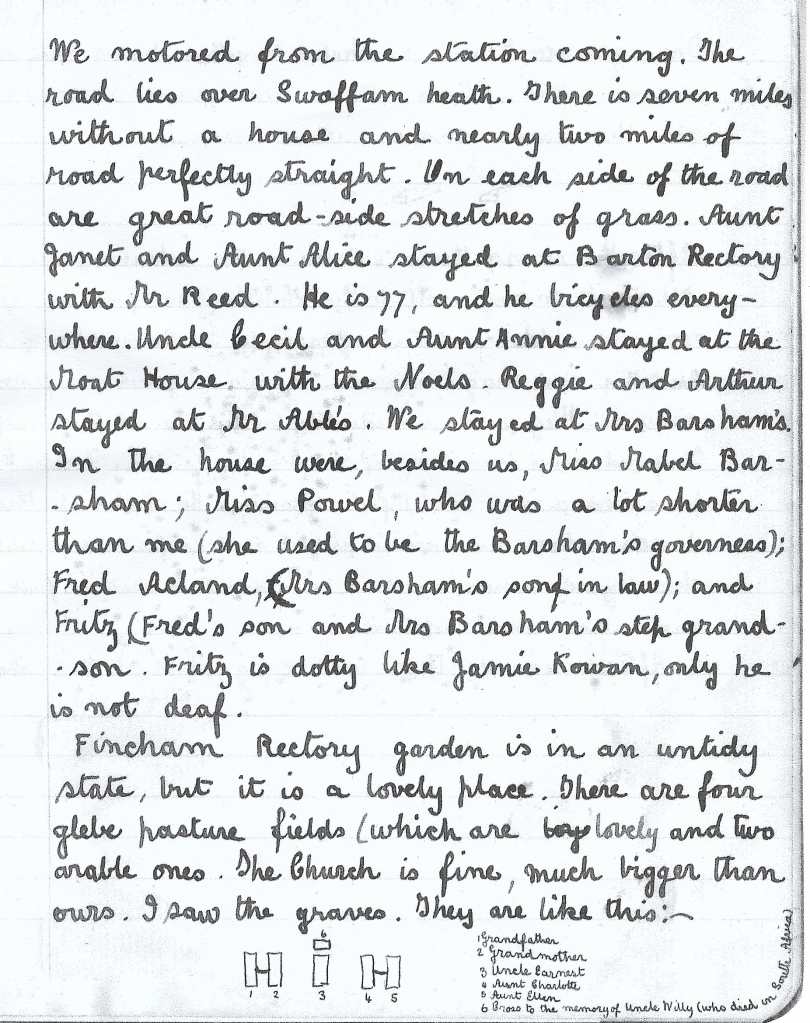
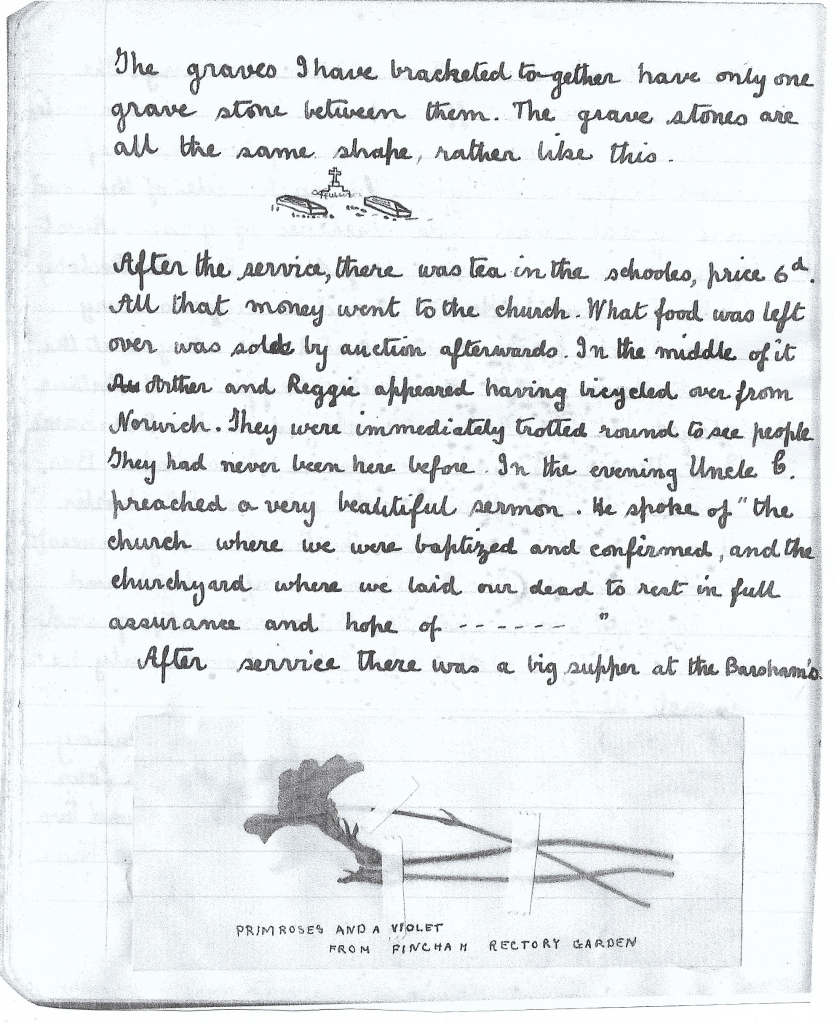
Mary never married and lived until 1975 and is buried at Sidestrand near Cromer.
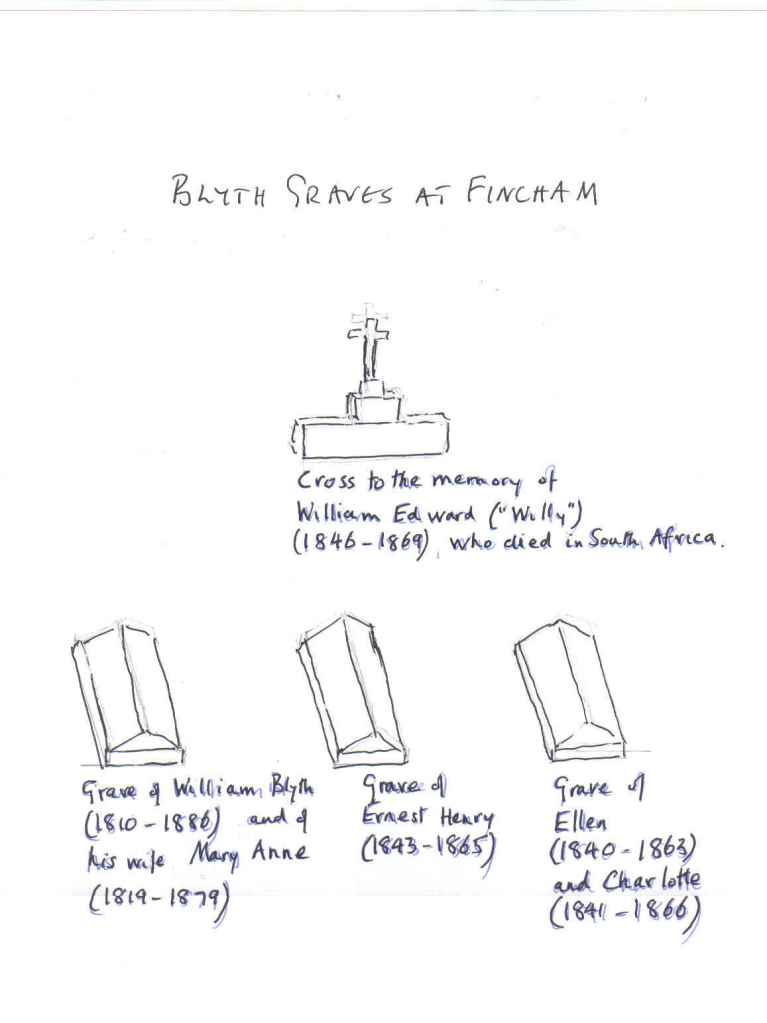
This is a drawing given by Kenneth Blyth to the Society showing the graves of William Blyth and some of his family. It may have been done by Mary or someone using her diary drawing. The grave of William and Mary Anne was found using this image
William Blyth’s Diary
Rev William Blyth was Rector of Fincham from 1846 to 1886 and during that time he kept a diary. His father Henry, who ran Sussex Farm near Burnham Market and was a close associate of Thomas Coke, had bought the advowson of Fincham St. Michael’s for £3000, a huge sum in the early 19th century. William had a difficult task at Fincham as he followed the Rev Arthur Loftus whose scandalous behaviour is well documented. However he soon asserted himself and was responsible for many improvements to the church fabric and contents and had built a new National School within a couple of years. He was meticulous in his record keeping. The school accounts books, the charity meetings records, vestry meetings, rates and rent books and church registers contain detailed records as well as many anecdotes. About ten years ago the Fincham Local History Group made contact with a direct descendant of William who one day offered the information that he had William’s diaries but didn’t think they would be of interest as they mainly ‘concerned weather and family gossip and nothing of general interest’. However they turned out to be quite a ‘treasure trove’ of interest to Fincham historians and also had much to say about early to mid-Victorian times in general. The descendant kindly had the diary copied on to a hard drive and he donated one to the Norfolk Archive Centre where it can be viewed.
William Blyth was born on 2nd March 1810 the son of Henry Blyth and Sarah (nee Etheridge) who married in 1798. William entered Christ’s College Cambridge in 1829. He graduated in 1833 and was ordained deacon in the same year, and priest in 1834. His diary begins on November 1st 1837 with his marriage at Christ Church, St Mary-le-bone, to Mary Anne Mortlock, born in 1819. She was the daughter of Capt Charles Mortlock,a captain in the East India Company Maritime Navy and and grand-daughter of John Mortlock who founded Mortlock’s Bank in Cambridge. Two of William’s brothers were clergymen. Gwyn was Rector of Burnham Deepdale and Etheridge was Vicar of Red Hill Hampshire. His eldest brother, Henry, farmed the family’s Sussex Farm near Burnham Market and his sister Elizabeth’s husband, Horatio Bolton, was Rector of Oby, in east Norfolk, and Vicar of Docking,in West Norfolk. A further brother Anthony, was a solicitor. William was the first captain of the Christ’s College Boat Club in 1830, and stroked the College men’s VIII to be Head of the River, on 18 May 1833. The recently restored college Boathouse has been named the Blyth-McGregor Boathouse in honour of him and a more recent rower. William was also a contemporary at Christ’s of Charles Darwin, and, according to the College magazine, “with whom he often went on botanizing expeditions” and was “fond of recalling Darwin as he had known him, a `boisterous youth’, whose life was yet free from vice.” At the time his diary begins, William was curate in the parishes of Burnham Westgate and Burnham Norton. He moved around in the next few years as curate of Sedgeford, Docking, Hackford and Banningham.
The diary is written almost daily and every three or so years there is a neatly written contents page with the corresponding page number by every entry. Each Sunday that he preached a sermon there is the biblical text he used. He had ten children and there are many details about them. The eldest four died in their twenties in the 1860’s but the youngest six all lived well into the twentieth century. Janet lived until 1950 when she died in Norwich aged 102. Some of the most poignant entries concerns the deaths of his children. Ellen was the first to die. In 1863 a diptheria epidemic was ravishing Fincham. 21st April: Dear Ellen, after 2 or 3 days indisposition, seriously ill with a throat affection. 22nd April : This morning taken much worse, and after struggling for breath the whole day gradually sank and died at 2.30am. Thursday! A dear good child who will be an irreparable loss both to ourselves and the parish generally. Many kind letters of Christian sympathy from our friends. Gods will be done. 30th April : Buried our dearest child, aged 23 in sure and certain hope of the Res”.
We can assume that she accompanied her father in his rounds to comfort the afflicted families and succumbed to the disease that way. It was a very severe epidemic. A gravestone still exists in the churchyard that records the death of five siblings of the Lemmon family who died during the epidemic. They were aged between four and eleven and died within just fifteen days. Blyth’s eldest son Ernest was a gifted scholar. He went to Uppingham School and won prizes for academic work and gained a scholarship to Christ’s Church College, Cambridge where he continued to prosper academically. Whilst there he became ill and had to come home. His condition deteriorated. 29/9/65 Our dear Ernest growing weaker every hour today, and breathing with great difficulty and distress, at length gave up his life and soul to God, in meek submission to his will having expressed himself happy in the love of Church in whom and on whose great work for our Redemption he trusted. Oh what an awful curse and dreadful thing is death when we thus see the young, the vigorous and most promising of our children cut down like a flower and withering away. Yet is the curse and sting removed by looking unto Jesus, and then what a blessing is that stroke by which God calls to himself a dear departed son. A few months later is this entry. 25/2/66 Evening. About 6 o’clock poor dear Charlotte breathed her last-and went to her eternal home after 10 years epileptic suffering. Her epilepsy probably explains why he often recorded giving a private communion to Charlotte. His second son and fourth child. William, went to South Africa and died there in 1869.
Some entries are of general local interest. 28/2/60: A most fearful Gale occurred today. Wind due West. Its effects were that none living remember. At the Church the lead on the porch roof was all carried away, and crumpled up like paper. Its weight was nearly a ton and a half. At the Rectory the fine old elm trees, for a century the pride of the village were, two of them, blown down and the other two shattered. The height of the tallest was 82 feet. The chimney over the dining room fell upon the roof and the pots went over on the leads. Considerable damage was caused all over the Village. In the neighbourhood the fall of trees was such as was never before heard of. 2000 down at Beachamwell, 4000 on the Stow estate,some hundreds at Stradsett. Several churches greatly injured.
He was a very keen observer of the weather -and hence the sky. 31/12/57: The last day of the year, the most splendid weather since Midsummer ever known. No snow yet and scarcely two nights of frosty temperature. 12/1/66 Returned the total rainfall (27.72) for 1865 to Mr Simons at 136 Camden Road London. He kept rainfall records for many years and was responding to a request from a Mr Simons for any records of rainfall in England to be sent to him, which he did for many years. ?/9/68 Saw this evening at 11.45 a very beautiful and wonderful meteor which appeared to explode over the garden, of immense size, red and blue and which must have been seen all over England. 1/1/71 Church Stove does well but the cold is so intense that the thermometer in church will only rise to 40 or 42 degrees. 25/9/79 Saw moon, Jupiter and Saturn through Beechey’s Telescope. Struck with awe and delight and wonder. Lord, what is man? In the annals of nineteenth century weather the year 1879 stands out as being particularly bad and Blyth records much of the turmoil that ensued. 22 July Weather grievously disastrous. Floods etc Hay greatly damaged 31st July Very little sun and very much rain for 6 months. 2nd August Wells Ch. Destroyed. 3 cows struck dead at Beachamwell. Long continued thunderstorm at night, from 11 to 6. 19th August Heavy rain and floods again. Harvest prospects seriously gloomy. On the 26th of August he recalls that his father wrote ‘in 1816 cut wheat August 26th. Finished Harvest October 16th.’ 1816 is sometimes referred to as ‘The Year without a Summer’. 29th August (1879) A little barley cut. 30th August A little wheat cut. The latest beginning of harvest ever remembered 1st September Harvest really commenced in the village with fine weather but short days and cold nights. 6th September Splendid week of harvest weather after a most critical summer. The farm workers must have worked particularly hard that year. Did they have the reward they wanted? 24th September gave 40 packets of tea to Harvestmen instead of Beer. 1st October Distributed as largesse to about 90 Harvestmen about 17lbs of tea from 4 shops in the Village costing 42/6, an expense I hope worthwhile, on Temperance Principles. 30th November An exceedingly cold and wintry month !st December Very severe frost this morning Therm 8 degrees. 5th December Heavy fall of snow and therm. Very low. He records that that the year closed with milder weather.
His own ill-health was a constant theme. Many entries concern one or both knees. Clearly he suffered much pain and was affluent enough to try several treatments and consult some quite eminent people. In his forties he went several times to Malvern where a Dr Gully had made its reputation for the healing properties of the waters. 12-14th Dec 1852 Saw Dr Gully, first interview, and commenced the Water cure treatment. Hot fomentations at bed time. 15thCold towel, tepid bath at 65 degrees, violent friction. Bath at 60 degrees at 12 and 5 and fomentations at 9.30. Low Dish at 9,2, and 7. 16th Malvern Wells. Treatment as yesterday 17th Saw Dr Gully. Treatment as yesterday. For the next twenty years he seems to have had less trouble but by 1873 he definitely had serious problems with his knee. 23th June Resolved to go to Mason at Wisbeach for advice and help respecting my knee. He immediately declared it practically dislocated and after fomentations throughout the night proceeded to reduce the joint to its proper position by force. Stayed at Wisbeach 4 nights and returned home just in time to witness the termination of the school treat which went off well etc. etc. On the 30th June there is a praise for Mary Anne. M.A. at hand “when pain and anguish wring the brow, a ministering angel thou” ( quote from a Walter Scott poem) 1/7/73: Party from Hilgay to Church, very fine day. Myself in bed. Mason from Wisbeach came and examined my leg. Confirmation candidates in my bedroom singly. He lists by name the 31 candidates from Fincham and is told that ‘the service was impressive and passed off well for which I feel greatly thankful and pray god to bless the youthful confirmees’ 2nd July Mason came to examine my leg. helpless. Five weeks later 11th August Went Cambridge to consult Dr Humphrey. Interview encouraging as to my knee. This is almost certainly to have been Dr George Humphrey who was Professor of Anatomy at Addenbrooke’s Hospital. He was knighted in 1891. There are accounts in journals of surgery he undertook for knee conditions. 26th August Wrote to Dr Humphrey suggesting different treatment of my knee, getting weaker. 2nd September Dr Humphrey and Mr Cater here splinting up my unhappy knee. 16th October Resumed parochial duties on crutches. He tried other treatments for the rest of 1873 and the entries reflect a growing desperation to ease the pain. 28th Oct Henry and Fanny came for one night , the former to show me the use and application of electricity to my leg. 29th Oct Commenced the application of Galvanism to my weak knees, with Henry’s machine. 5th Nov Galvanism too exciting to the nerves. Go to Malvern. 13th Nov Saw Sir James Paget who advised Double Baths and Shampooing for a Rheumatic effect. 17th Nov At Malvern, began treatment, brandy and hot water. 19th Nov Treatment changed by discontinuing the brandy. 27th Nov Treatment changed to Oil and Eau de Cologne rubbings 29th Nov Treatment includes a trial of oil and spirit rubbed in. 1st Dec Dr Marsden called, ordered the use of acid on the spine 8th Dec First Turkish Bath, certainly useful 17th Dec Commenced electro-magnetism under Dr Marsden 31st December Commenced treatment by Giggs Electric Machine to be continued twice daily. Very full of hope from it. He always ended the year’s entries with a summary of the year. This is what he said about 1873. So ends the present year which seems to have passed very quickly. Thanks be to God for his continuance of so many blessings to us, my own personal affliction being no doubt intended also for my good. Lord, what is man, that thou so regardeth him! The Electric Machine gave him more hope. 4/3/74: Left home with MA for Plymouth to consult Mr Gigg the Electrician on my own account and slept at 71 Euston Square 5/3/74 Arrived at Hoe Park House Plymouth and saw Mr Gigg next day and arranged for Treatment. 9-19/3/74 Remained at Plymouth taking Electric Treatment twice a day under Gigg’s supervision.
He was always anxious about childhood illnesses. 1/3/59: Charlotte and Anna safely through the scarlett fever. Deo gratis. 29/3/63 A fatal disease prevalent in the village & neighbourhood -putrid sore throat. Buried 8 children this month 12/9/63 5 funerals this week-diptheria has become a decided scourge amongst us-May it please God soon to take it away 3/12/69: Kate ill with hooping(sic) cough (2nd time) 4/3/59 The measles rapidly spreading in the Parish. 30 children absent from school.
The pressures from other denominations on the Church of England were many. The Aylmer family were prosperous landowners in Fincham and contributed much to the church financially. 28/3/59 Called on G. Aylmer who admitted that he had promised the Methodists a piece of ground to build upon. A prominent inhabitant of the village was Martha Hutchison who was the daughter of William Corston a Moravian, Weslyan Methodist and prominent supporter of the educationalist Joseph Lancaster. 10/3/59 Called on Mrs Hutchison to know to what extent she intends supporting the Methodist’s new move. Answer, only to patronise an evening service and, and not to encourage any service when the Church is open. She emphatically promised this. A Norfolk evangelist was a Miss Jary who preached in many villages. 16/12/69: Miss Jary preached in Mr Aylmer’s barn. 17/12/69 Miss Jary at Church and preached in the Evening to a crowded congregation in Mr A’s barn. I don’t think I have any reason to object to her course of action on the whole, as regards the highest spiritual interests of my flock. They will, I hope, be stedfast and profit. Clearly concerned about the impact of Methodism he more than once tabulated the attendances in Fincham.
9/12/66: The following table shows how many persons were at any place of worship today
Church Wesleyan Chapel Primitive
M. A. E. M. A. E. M. A. E.
Children 66 80 0 45 50 40 50 35 20
Adults 83 107 0 8 56 58 12 60 67
Ch: Total 149 187 0
Wes.Total 53 106 98
Prim. Total 62 95 87 —————————————————————————————————————————————————————–
264 388 185
Mrs Hutchison died in 1868. 23/3/68: With Mr William Hutchison, arranging for his mother’s funeral, which she requested should be a very quiet one, but to which he is inviting nearly 100 persons! 26/3/68: Mrs Hutchison was buried today by the side of her father. Her son Wm, grandson, and nephew were chief mourners. Canon Longman came. There were 12 bearers. 60 hatbands were sent out, and 112 pairs of gloves. 300 cakes for the town children, 60lbs of tea and sugar and 60 loaves distributed to the poor of the parish-not by the orders of the deceased but by Wm Hutchnson. But- 3/4/68: Informed that Mrs Hutchison left £5 to our school. Canon Stephen Longman was the Catholic Priest from Oxborough, the home of the Bedingfelds. Mrs Hutchison had two sons, both very high church. One, William Hutchison, turned to Catholicism and tried to bring it to Fincham, 30/3/69 Discovered Popery insidiously creeping into the parish and must now oppose it in ernest. 21/4/69 Dropped Mr Hutchison’s acquaintance. 28/2/71 Mr Hutchison is now making a determined aggression upon the church for getting Proselytes. Chapel opened in Coach House. Mass every day. People tempted in all possible ways. 16/5/71 Romish efforts for the perversion of the religion of the Village carried on most unscrupulously by the Hutchisons. An Italian priest is now with them.
There was conflict at times with various other people. Following an advertisement that a ‘good country practice now presents itself without purchase to a well-qualified medical man in a large central village in Norfolk’ for a ‘gentleman of good habits and religious principles’, there were 42 applications. Dr John Burns-Gibson was appointed and Rev Blyth made him welcome. 1/11/77 Dr Burns-Gibson came to reside at Fincham (wife and 2 ch.) to practice medically here and in neighbourhood, a service very much needed. I pray that he may be a blessing to the village. His degrees of qualifications are Edinburgh MRCS and Glasgow MD and MA. 2/11/77 Assisted Dr and Mrs Gibson to get into Church House. 9/11/77 Dr Burns-Gibson put up his “plate” and started himself. He introduced the doctor to various people but something seems to have gone wrong quite quickly. 17/12/77 Called on Dr Gibson and thought him cold and discontented. In 1878 a strange entry ensued: 13th Feb Sent Dr Gibson his agreement to hire. A few days later: 19th Feb Heard from Mr Skene complaining of Dr Gibson’s failure in his practice and suggesting a Guarantee from me. I replied No. Mr Skene was the father of Burns-Gibson’s wife, Charlotte. Burns-Gibson had been a surgeon in the Army before he came to Fincham. Things soon got worse. 13th March Gibson threatens me with legal proceedings. 8th April At Marham a defendant in a Private Reference Case with Dr Gibson in which he showed himself very maliciously. 9th April 8 At Marham again to witness burning of letters and papers. I have found no definitive explanation for ‘Private Reference Case’. The most likely one is that it is an arbitration procedure for private individuals who agree to put their dispute before a lawyer to save the cost of a formal hearing in a court. The cause of the falling out is not mentioned in the diary but Dr Burns-Gibson appears in the early 1880’s as a very early, and active, member of the Fabian Society. He was also a member of a society called the Freedom Group which issued the first number of Freedom which was ‘a Journal of Anarchist Socialism’. Annie Besant and William Morris assisted in the publication. With such socialist views perhaps a quarrel with a stalwart of the establishment was to be expected.
The last public execution in Norwich was on Monday August 26th 1867. Hubbard Lingley, a 22 years old Fincham man with two young children was convicted of the murder of his uncle, Benjamin Black in nearby Barton Leys wood. Black was the gamekeeper for the Berney family of Barton Bendish. He caught Hubbard and some others poaching and the young man shot him dead. The facts are not disputed but the diary gives an account of what the Rector did. May 20th At Downham Courthouse hearing the charge against Lingley. May 26th E.service at Barton. Great crowd (Black murder). May 27th Hubbard Lingley Examination and Committal. June 15th Visited (with Mr James Browne) Hubbard Lingley in the Castle at Norwich, charged with murder. August 12th Walked with Mr Thomas through Barton Wood and called on Wid. Black whose husband was lately murdered. August 19th Received a “Memorial to Secretary of State” on behalf of Hubbard Lingley. Could not sign it, nor did anyone in the Parish. Aug 22nd Saw Hubbard Lingley at the Castle and heard his confession of the murder of B.Black which was not premeditated but done under violent excitement, as I suspected at the first. He named two confederates. August 25th (Sunday) Intercessions at church for Hubbard Lingley. Aug 26th Hubbard Lingley executed at 8 this morning. Col Black immediately writes to me for the names of persons alluded to in Lingley’s confession. Correspondence ensues on my refusal, except to a magistrate. And finally – Sept 12th Circulated in the village Hubbard Lingley’s dying advice to the young men of Fincham. This advice was a quote from Matthew 5 v 21 which basically says don’t murder anyone! It seems William did his pastoral duty and the visits to prison were no doubt harrowing even though Lingley seems to have got no sympathy.
The Blyth family in general were quite wealthy, much of it derived from William’s landowning father, Henry. The Fincham living was a very profitable one but some financial events could still cause alarm. 23/8/69 Albert Life Company bankrupt. Heavy loss to me. Corresponding with Anthony (his brother who was a solicitor) on this matter. 7/9/69 ‘I have paid to that company the sum of £2184:15:10’ 9/1/70 Accepted by the ‘Clergy Mutual Society’ for a fresh insurance, losing more than £1000 by the Albert. The Albert, according to an online account, failed because it paid out too much in ‘bonuses’ for a few years and spent too much on acquiring small life insurance companies!
He often comments on international affairs, mainly news of battles 28/4/68 News of the storming of Magdala, in Abyssinia, the liberation of European captives (60) and the death of Theodore, admirably accomplished. Thank God for this. 6/9/70 News of the Revolution in Paris a Republic proclaimed. Napoleon 3rd has been taken prisoner by the Prussians last Friday Sept 20th at Sedan, with 80,000 French!! After 4 days terrible fighting. The Prussians go on to Paris. 24/12/70 Frost very severe. Two degrees below zero this morning-at the Moat it was -5. Think of the Prussian Army now before Paris. (Horrida bella!) 6/2/84 News of Baker’s defeat in Egypt, lost 2250 men (Egyptians)
Some entries are on national events 18/11/52 Funeral of the Duke of Wellington at which I attended with Ellen and Charlotte in St. James’ St, Piccadilly
Just before 7am on October 1st 1864 a barge of gunpowder barrels was being unloaded at Belvedere near Woolwich. Something triggered an explosion which in turn caused two gunpowder mills to explode. No trace was apparently ever found of the barge or the men unloading it! A report at the time said the explosion was felt at Cambridge and Newmarket. However it was felt thirty or so miles further north. The straight line distance to Fincham is exactly 80miles! 8/10/64 Full account of the great explosion of Gunpowder at Belvedere near Woolwich, last Saturday. Heard distinctly in this house, or rather felt by the servants in the shaking of the windows in two different rooms. Ann running upstairs instantly to see if anything had fallen. Time 7 o’clock AM
He does comment quite often on harvests and other country matters .1/10/58 Carted carrots 3 days 8 Tons. Two of them weighed 7 and a half pounds. Partridges scarcely ever before so abundant. 11/4/50 Cut Asparagus plentifully earlier than I can remember to have done. 17/1/65 The Prince of Wales shooting at Stradsett 26/2/59 A calamitous fire in the village early this morning at Mr Kemp’s stable. Three horses burnt to death. 27/2/66 Cattle plague commenced in Fincham at the Broadwater field barn. Already 12 dead out of a herd of 18 5/1/58 A flock of sheep for 2 days in the Churchyard to eat down the long grass previous to repairing the graves. 14/5/70 A wheat stack of Mr Aylmer’s burnt down (and ploughing engine)
The ancient rite of beating the bounds was carried out dutifully. It was still a necessary task so parish boundaries could be checked and ownership established. 11/4/71 Walked the bounds of half the Parish beginning at the summit of the hill at Shouldham crossroads and going eastwards by the Mill, round by Barton boundary to the Poor House Farm on Stoke road. Walked 9831 yards or 5 and half miles, rather more. He names about ten people who accompanied him and the day ended with a tea party. 25/4/71 Finished our perambulation of the Parish, Stradsett side, walking 8970 yards or 5 miles. My notes must be written out fully. He mentions some of the more unpleasant incidents of village life. 20/6/74 Inquest on the child of Agatha Drake, servant to Miss Hebgin.-not sufficient proof of murder. 15/2/72 A skeleton (woman supposed) dug up in the Besnell pasture in making plantation. Buried in the churchyard. Jane Parker (aged 79) remembers the sudden disappearance of Ann Complin who lived near this spot with the Sergeant family about 70 years ago. She had been to Lynn Mart with one William Towler, and was never seen again afterward .11/4/63 Inquest here on the body of an infant found drowned in the Pond, next Weatherell’s Garden. Born alive but no evidence of cause of death, 11/6/61 John Gamer found drowned in a ditch 20/12/59 Coroners inquest into the death of Rd Collins aged 72 who died suddenly in Mr Aylmers barn.
Soon after he came to Fincham he was made Rural Dean and in this role he was very busy meeting neighbouring priests, churchwardens and other village officials in arranging for churches to be restored or even rebuilt as well as the building of new vicarages and rectories. His diary is useful for giving the actual dates when these were done. The Bishop of Norwich often came to stay with Blyth to sort out local issues. A few more entries show Blyth’s involvement with home life, village life and the neighbourhood 21-26/10/50: During the week cleaned out the Pond. Captured about 150 eels, and 54 Prussian Carp, 42 of which were put in again and 12 into the pasture pond. Dec 25th 1866 Servants Party in the Kitchen (14) Dec 26th 1866 Singers Party in the Kitchen 26/7/82 Garden Party at the Rectory . He names 35 clergy who attended and 30 laity but also 9 clergy and 23 laity who did not attend! Dec 28th 1866 Erected last Friday in the Rectory Garden the base of the old village cross, which stood near Talbot’s Manor House where the road branches off for Lynn. It is a very handsome stone 2ft 2ins square below and 2ft 2ins high, the upper part being octagonal, from a circular fillet at the junction. 7/3/70 Parish meeting to discuss the order from the Education Department for increased pupil +accommodation. Enlargement proposed and not union with Stradsett. 4/12/66 Clerical meeting at Bexwell (11 present) Discussed the new Union Chargeability Act. It appears that Fincham Rates are diminished under the operation of that act in the half year ending Michs 66 by £27.1 6.7.58 Six of my parishioners left Fincham for America viz :G Collins, Wm Simmons, Walter Winearls, John Bywater, G Sporne and Thomas Caney, all bound for Chicago Illinois U.S. 10/8/77 Attended Sanitary Board at Downham 12/10/70 Meeting at the School Room to found a Village Institute . 23/2/74 Meeting of Town House Trustees. Proposed £325 to W Barsham. 25/2/74 At Wereham distributing Adamson Charity. 11/10/77 Sanitary Authority will send a Competent Engineer to report on the Drainage of Fincham; probably very desirable though vehemently opposed by Ratepayers 17/10/70 Meeting at Downham to confer on the subject of the Elementary Education Act, 48 persons present. 24/10/70 Collecting the names of all the children in the Parish between 5 and 13 for educational purposes. There being 142 (excluding well-to-do children) 25/10/70 School Committee met here (Stoke and Floyd) to consult me. My school passed as sufficient (in conjunction with the Primitives) for the parish. Shouldham and Marham Schools passed under review. 4/9/78 Miss Hebgin consented to pay me 5/- annually towards cleaning and ordering the paths and drains round the Chancel. 26/8/70 The Inspector of Churchyards visited Wereham and Wretton after my representation to the Home Secretary. 18/12/65 Made return to Government on the Agricultural Gangs of the Parish. The Public Gang contains from 20 to 42 persons according to the season. 30 under Mr JB Aylmer. Private about 12
In 1863 Rev Blyth published his book on the history of Fincham. It is considered well researched. He had access to the Hare family archives at Stow Bardolph where hundreds of years of Fincham archives were stored but he also travelled further afield.
30/12/57 At Somerset House searching Quaker Registration Books for Fincham with success. All the old Dissenters Registers are there. At British Museum, in the magnificent Reading room, consulting Harleian MSS for Fincham’s Pedigree. Returned in time to join a party at Denver. Home by 11 o’clock. Then there is this entry in 1880 1/1/80 Having been spared to complete 3 Vols of this Diary, through 42 years from my Wedding Day in 1837, and having lost my dearest life partner (see Apr.23rd 1879)-and having been permitted to see both my surviving sons, Cecil and Gwyn, in Holy Orders, for good work in our Church (the latter being ordained only last Sunday) and moreover feeling the infirmities of age beginning to take hold of me, I cease to continue these parochial and domestic notes in any regular order as heretofore. However he did continue fairly regularly to write his diary for six more years. This is his final entry
15/5/86 Fortieth Anniversary of my Institution to Fincham 1846. And with this entry I finish my Diary. I thank God most humbly and heartily for all the privileges, blessings and mercies bestowed on me during these Forty years not only in connection with my Ministerial position but personal and domestic, with so good a family of sons and daughters in every respect. The Lord Jesus Christ, my Chief Shepherd I trust will pardon all my faults, shortcomings and all my sins and confirm me in my hope of finding a place In his Kingdom with those dear ones gone before; to Him with the Father and Holy Ghost be all honour and praise and thanksgiving for evermore, Amen.
William Blyth died on June 10th 1886
****************************************************************************************
Arthur Loftus was born in 1795 into a life of privilege. His mother was Lady Elizabeth Townshend –daughter of George, the first Marquis Townshend, who lived in Raynham Hall. She married General William Loftus. He fought at the battle of Bunker Hill in the American War of Independence in 1775. Later he commanded a garrison at the Tower of London.

When Arthur became Rector of St. Martin’s at Fincham he had the front of the Rectory re-modelled in quite a grand style with ha-ha’s and avenues leading away from the house into the glebe lands beyond. He employed the architect William Donthorne who designed several Norfolk houses and specialised in the Gothic style. He had income from four livings – Vicar of St. Martin’s Fincham, Rector of Fincham St Michael’s, Vicar of Helhoughton and Vicar of St Martin’s, Rainham.
This entry is copied from a Fincham Register. John Scott was a powerful national figure having served in several governments including those of Pitt and Fox. How he came into the advowson of these two livings is not yet known.
Arthur Loftus MA August 1826 was presented to the United |Livings of Fincham St. Martins and Fincham St. Michaels by the Right Hon John Scott, Earl of Eldon & Lord High Chancellor of England and on September 8th 1826 was inducted to the said livings. In 1827 he improved and altered the hall and the two sitting rooms according to the plan of Mr Donthorne, Fakenham Architect. By the date on the central chimney it appears that the Glebe House was built in the year 1624.
In 1836, aged forty, he married Mary Ann Clayton, daughter of the Rector of Great Ryburgh. They had three children, one of whom died in infancy.
Nothing is known about what was wrong in the early years of their marriage but by 1841 his wife had left him and had gone back to live with her parents. Arthur petitioned the Norwich Ecclesiastical Court, bringing a suit for the restitution of his conjugal rights and his wife’s return to him.
Mary Ann claimed that he had been guilty of cruelty towards her.
The judge was Mr Charles Evans , Chancellor of the Diocese.
There was a report of the trial in The Times of October 30th 1841
Mrs Loftus made a counter claim of cruelty by her husband and sought a divorce. The judgement is a lengthy one and Judge Evans seems to have taken great care to consider every claim made by both parties. He quotes case law which he says is clearly laid down. When there is a suit for the restoration of conjugal rights, and the wife rests her cause upon a plea of cruelty on the part of her husband, and when the charges brought by the wife consisted partly of words of abuse and reproach, and partly of acts of violence he says of the words –
‘the law requires that she must submit to the misfortune she has brought upon herself. Passionate words break no bones, and it is better that they be borne with than that domestic society should be broken up, and the husband and wife thrown loose upon the world.’
However he distinguishes between words of insult and words of ‘menace’ that threaten physical violence. He says he need not wait until harm has occurred to act on the wife’s part. Mrs Loftus makes some very serious allegations including one where she asserts the Mr Loftus puts himself into violent passions, leading to ‘premature confinements,’ The main witness is Mary Ann’s mother, Mrs Clayton, and the Judge says she is ‘apparently prejudiced against her son-in-law.’ (!) The servants, nurse and medical men who attended all three births did not back up allegations of violent manners or behaviour. It was told that she slipped on the steps to a mill when frightened by horses which led to the first premature birth, the second was not premature and by the third birth she had left her husband.
Many people including the curate, the Rev Ball, and Mr Gent, ‘a medical man’ who had been on attendance to the couple since their marriage, and various servants, all said they saw Mr Loftus treat his wife with respect. Furthermore seven relations of Mrs Loftus described his conduct to his wife as ‘kind and affectionate.’ Lord James Townsend did give evidence that Rev Loftus had used unkind language about his mother-in-law to his wife and that he had reprimanded him about this, and in particular that he ,Arthur , boasted of his own descent being far superior to that of his wife.
In the end the Judge concluded that ‘though Mr Loftus may at times have, in words, abused the parents of his wife, nothing on her (Mrs Loftus’) part could justify such a step as leaving her husband. I am bound, therefore, to declare that the marriage being well proved, Mr Loftus is fully entitled to the judgement for which he prays, and that Mrs Loftus do return to her husband.’
Although ordered to do so there is no record of Mary Ann returning to her husband. This trial was not exceptional and although criticisms had been made of some of the Rector’s behaviour he came out of it with, one supposes, his reputation fairly intact. Within four years he was in another trial, this time as the accused. After that trial his reputation was most decidedly not intact.
The next trial takes place in the Court of Arches in 1845. It was held in Doctor’s Commons in St. Paul’s Churchyard and the judge was Sir Herbert Jenner-Fust, the Dean of the Arches to give him his proper title. Quotes in bold italics are taken directly from the judgement
The main charges were that about once a week Mr Loftus in the company of his footman, Henry Twiddy, went to the house of Mrs Sconce, in Birdcage Row, South Lynn, and ‘committed the crime of adultery,’ and was also in the habit of going to the house of Mrs Forman at Boston, in the County of Lincoln and ‘passing the night with a prostitute committing adultery there.
These two charges alone would have been enough, one assumes, to lead to serious consequences. There were however other serious charges. Two prostitutes called Jemima Crass and Susan Worsop were engaged to live in the service of Mr Loftus as cook and housemaid. They were ‘hired by Mrs Forman at Mr Loftus’ desire and went to Fincham in the end of December 1843.’ Further it was alleged that one of these women got pregnant and was given some medicine to procure an abortion. When she left another prostitute was hired and the adultery continued. Another charge was that he attempted to procure a certificate from Mr Arthy saying that he needed to consort with a woman for his health!
It is quite extraordinary that a Rector in a smallish village, with other servants in and out of his house, could think he would not to be found out. The judge heard from several eminent witnesses. He said ‘from the evidence of those gentlemen who have been examined, clergymen, magistrates, one of the members of the county, and other gentlemen of great respectability in the county, beyond all doubt they are of opinion that he is a person least likely to be convicted of such offences as those laid to his charge. There never was a gentleman who came before the court with such testimony in his favour, ……whose character stood so high and so free from all suspicion of such impropriety as is here imputed to him.’ High praise indeed!
The witnesses for the prosecution were decidedly less of good character. The judge says ‘it is one of those cases unfortunately in which it happens that the witnesses to be produced are persons undoubtedly not of good character…….they came to prove their own infamy, but still they are competent witnesses by law and consequently the court is not at liberty to reject the testimony of such witnesses, particularly in a case where no other description of evidence could be produced.’
There is a huge body of testimony but a few examples give a flavour of the proceedings.
The doctor, Mr Arthy, says when Mr Loftus was in the dispute with his wife he was in ‘a highly deranged state, and he was highly nervous’ and ‘highly excited and irritable.’ After the first trial Loftus’ bodily and mental symptoms did not improve and Arthy continues ‘I insinuated to him that if he were to go away for a change of air, possibly his health might improve if he were to pursue a certain course of living for a certain time……..I considered in making that suggestion I was offering an alternative to Mr Loftus instead of another, and by no means improbable alternative, namely, that of Mr Loftus becoming insane which I had much reason to apprehend.’
You could no doubt hear the proverbial pin drop during this testimony but it became even more sensational.
‘Whether or not he cohabited with a female agreeably to my insinuation Mr Loftus never informed me afterwards. When Mr Loftus was leaving home in the end of August or beginning of September 1843 to go away for a change of air as pre-deposed, he stopped at my house in his Gig as he was leaving Fincham, and got me to give him some medicine to take with him. On that occasion, in allusion to the insinuation which I had made to him as above mentioned as to cohabiting occasionally for a fortnight or three weeks with a decent female while absent from home, he said to me “Well I am going away, if I get into a scrape what shall I do?” and I in reply to him to set his mind at ease said, “Oh! I’ll give you a certificate and get you out of it.” I said that half in joke, not seriously imagining that I should ever be called upon to give him any such certificate.’
The Boston keeper of the ‘house of ill-repute’, Mrs Forman, gave strong testimony of how she dealt with Henry Twiddy and was paid to provide two women to Fincham Rectory.This is an extract from the record of Jemima Crass’ testimony. She went on to depose as to what occurred after her arrival at the Parsonage house. She said:
Emmanuel the page went to bed and the doors of the house were all fastened up. She goes on to state “I and Susan Warsop went into Henry Twiddy’s pantry where there was a fire.Henry gave us some wine and made us comfortable. We stayed in the Pantry with Henry until 12 o’clock that night or thereabouts. At about 11 o’clock that night Mr Loftus came int the Pantry. I saw him for the first time; he stayed only about a quarter of an hour in the Pantry; he did not sit down, he stood talking to us girls and Henry as well. He was going to bed; he had a flat candlestick in one hand, and his writing desk in the other. He kept talking to us about his wife saying that she had left him and how uncomfortable he was without her. He asked me and Susan Warsop how we were and which one of us was housemaid and which cook, and he kept looking at us. Before he left the room he said to Henry Twiddy “ Remember Henry, I have the housemaid, meaning myself, -you can have the cook, meaning Susan Warsop. After Mr Loftus had gone to bed, Henry talked to us, and told how we were to go on, and what we were to do. In consequence of what he said to us when we went to bed at 12.o’clock, we went upstairs to our room which was a garret, and we there undressed. Henry Twiddy then came upstairs and took Susan Warsop downstairs with him, but I remained in the said garret and slept there by myself that night. The next morning when I was doing the grate in Mr Loftus’ bedroom, he came into the room and asked me how I was and what was the reason I had not gone into his bedroom last night-meaning the previous night. I made no answer and then he asked me, whether I intended coming to him tonight-meaning on the night of that day, and I said “Yes”
There is evidence from Jemima that Arthur was aware of how things might look to outsiders. She said:
‘About 12. o’clock that day Mr Loftus sent a message to me by the said page, and I went to him in the drawing room, and he gave me a sovereign and told me to buy with it for myself some plain frocks, saying that those I wore were too gay and that people would suspect something if I continued to wear them, and I afterwards got some plain ones’.
Even more damning was this:
“Then she says “Nothing particular happened until night came, but at 10 0’clock at night Mr Balls the Curate-who lived in the house at that time- went to bed, and the page Emmanuel went to bed and the house was again shut up” She then goes on to depose that that night she slept with Mr Loftus and continued to do so for the first month during the time she was in the service of Mr Loftus. But after that time Mr Twiddy who was drunk came home, and he insisted on having this housemaid go to his bed, as she had been accustomed to do, to the bed of Mr Loftus. She declares “Mr Loftus knocked at the bedroom door,. And wanted to get me out, and to get me to come to him, but Henry Twiddy would not let me go-so Mr Loftus went upstairs to Susan Warsop and got her to come downstairs and sleep with him, and after that time I used to sleep with Henry Twiddy and Susan Warsop with Mr Loftus. The bedrooms occupied by Mr Loftus and by Henry Twiddy in the said house were on the first floor of it; they were on the opposite sides of the passage, the two doors of the two rooms being opposite to each other. After the time when Henry Twiddy took me away from Mr Loftus, and while I used to sleep with him, Mr Loftus and he used to quarrel about me. He was angry with Henry for having taken me, and Henry would not allow me to sleep with Mr Loftus.”
The Judge added this about Mr Ball the curate:
‘ But there is one circumstance in this case which cannot but strike the Court at the opening of their transactions as most extraordinary, namely that Mr Ball the Curate who was resident in the house a fortnight, who quitted it at that time, and therefore could have given the best information upon the subject if he had been examined on the Article given in by Mr Loftus as to his character; he was there at the most important period of time, if he had been called-as it is natural to suppose he would have been called- to speak of the conduct of Mr Loftus, to depose to the opinion he formed of his character; and had he been so produced, and have told the Court he was resident this fortnight in the house of Mr Loftus-that during that time he saw nothing that led him to suppose that an improper connexion subsisted between him and these individuals, it would have gone far to induce the Court not to place implicit credence on the evidence of these persons. But for some purpose or other it has not been thought necessary to produce him.’
The Judge goes on at some length about this aspect of the trial and the fact that if Mr Loftus wanted to convince the Court of his good character no-one would have been better than a gentleman in Holy Orders i.e. the Rev Ball.
So we have Jemima Crass saying she did sleep with Mr Loftus. Susan Worsop was not as forthcoming. She said she did sleep with Henry Twiddy but refused to say if she had slept with Mr Loftus. However in many other aspects of the whole proceedings, of going to the Rectory at the behest of Mrs Forman and living there as servants, she did confirm much of Jemima’s testimony. Two other prostitutes from the house run by Mrs Sconce, Paine and Goodman, gave evidence that they had entertained Rev Loftus at the Lynn house. Goodman’s testimony brought this response from the judge – ‘the tale is so disgusting that it is utterly impossible for the Court to repeat it.’ In other words it was written evidence which the Judge would not read aloud. Thus Sir Hubert concluded that because all the women’s tales broadly were the same, although of low character, they were reliable witnesses. Further issues confronted the judge. According to Mr Gent he treated Twiddy, Crass and Warsop for venereal disease. The judge could not conceive that Loftus did not know about this as all three could not do their duties in the house and he slept in the bedroom opposite to Twiddy. As a ‘gentleman in Holy Orders, a Rector in one parish and a Vicar in another,’ he should not have continued with them in his service. Then Jemima Crass either was, or conceived herself to be, pregnant. Someone gives her some medicine for the purpose of procuring a miscarriage or abortion. Mr Gent said that he had no reason to believe Mr Loftus knew about this and the judge agrees there is no direct evidence to prove otherwise.
The Judge however is scathing about the reference Loftus gave to Jemima when she left his service-
‘Jemima Crass has lived with me about four months, and is honest and understands the duties of housemaid. She left from the situation being too much for her strength.’
Not only that but Loftus hires another woman from Mrs Forman to replace Jemima!
The final quote is from Edward Arthy, surgeon of Fincham. Eventually Rev Loftus asks him for the certificate he promised if he got into a ‘scrape’! He did give him a certificate and although it had disappeared it said something like: ‘I hereby certify that the Reverend Arthur Loftus of Fincham had been under my treatment for several months, labouring under pressure of the brain, and that in spite of every variety of treatment his symptoms did not at all improve. As the last or only chance of restoring him to health, I advised him to co-habit with some decent female as he was going from home.’
The final words of Sir Herbert Jenner-Fust were uncompromising
‘ Now I have already stated that admits these facts, and nothing short of a sentence of deprivation would be adequate to the offences proved against him. I have therefore no hesitation whatever in pronouncing that Mr Loftus has incurred the pain of deprivation of that preferment of which he is possessed either in the Diocese of Norwich or elsewhere in the Province of Canterbury. There is no proof that he has any living or piece of preferment other than those referred to in the Diocese of Norwich; if he has, it is impossible with such practices proved against him, that he should be suffered to hold it in any parish, though not in that Diocese. I therefore pronounce that Mr Loftus be deprived of his preferments, more particularly those mentioned in the course of the citation, and any others he may possess in the Diocese of Norwich or elsewhere in the Province of Canterbury, and I also condemn Mr Loftus in the costs occasioned by these proceedings. The sentence in this case I direct to be pronounced on Sunday 21st– and it be published in the usual manner.’
Arthur Loftus thus lost his four livings including the high income one in Fincham and could no longer have any living anywhere else. The facts of the case are astonishing and one might surmise that Mr Arthy was correct in his diagnosis of mental illness. What else could have induced Loftus to act in such a reckless manner which by any reckoning could not end up otherwise than in him being exposed? One has to believe that Mary Ann did suffer at least some mental cruelty from him. A Hardy novel would be needed to imagine the conversations going on in Fincham in houses, lowly and grand, as the events at the Rectory unfolded.
The story has been told before and is usually presented in a scurrilous way as an amusing tale. Really it is a tragic tale in which several lives were badly affected.
This entry is copied from a Fincham Register.
Arthur Loftus MA August 1826 was presented to the United |Livings of Fincham St. Martins and Fincham St. Michaels by the Right Hon John Scott, Earl of Eldon & Lord High Chancellor of England and on September 8th 1826 was inducted to the said livings. In 1827 he improved and altered the hall and the two sitting rooms according to the plan of Mr Donthorne, Fakenham Architect. By the date on the central chimney it appears that the Glebe House was built in the year 1624.
What became of some of the people concerned?
Arthur Loftus
In the 1851 census he is living as a lodger in the home of Charles and Sarah Chamberlain in Great Massingham Norfolk.
In the 1861 census he is living in Islington and he describes his occupation as ‘clergyman’. Emmanuel Gaminara, the servant boy from the rectory during the events described above is the other member of the household and describes himself as ‘unmarried’ and ‘General Merchant’.
In the 1871 census, aged 75, he is the head of a household in Prittlewell Essex. Emanuel Gaminara is now aged 41. Neither give an occupation. There is a servant as well in the household.
In the 1881 census he is aged 85 and living in a house in Penge, Croydon, Surrey. He is down as a widower and for his occupation it says ‘formerly Rector of Fincham Norfolk.’ However the head of the household is now Emmanuel Gaminara whose occupation is now ‘merchant South America.’ Two of Emmanuel’s nieces, Beatrice and Rose Amelia aged 13 and 11 also lived there. They were born in the United States. One could endlessly speculate on the relationship between Arthur and Emmanuel. It is rather touching to think that Emmanuel decided to look after Arthur because of his circumstances. He clearly made some money as a merchant to live in some comfort with servants and able to look after two nieces and Arthur despite, it seems, not marrying. Another possibility is that Arthur took advantage of his good nature and ‘sponged’ on him for many years.
Arthur’s death in 1884 at the age of 88 is registered in Croydon so he probably still lived in Penge.However he was buried in East Raynham in Norfolk in the Townshend’s church so was clearly not cut off from the family completely for the events of forty years before. Perhaps he was allowed an income by his family as he does not appear from the census records to have had another occupation. What did he do for the last forty years!
Mary Anna Ray Loftus never went back to Arthur and from the evidence lived with her parents thereafter. She married Arthur in 1836 when he was 41 and she was 24. They had two surviving children, George William Ferrars, born 1839 and Mary Ann born 1840. She died in 1856 and her death is registered in Norwich. She lived with her parents in St.Giles, Norwich in the census of 1841 and 1851. Did the children know their father came from one of the wealthiest families in Norfolk? Did they ever go to Raynham Hall?
Emmanuel Gaminara was born in King’s Lynn in 1829 and died in Croydon -presumably Penge- in 1910. At the time of the 1841 census he was living with his parents in Helhoughton where Arthur Loftus was the vicar. Presumably this is how he came to work at the Fincham rectory. In 1851 he was once again living with his parents and described as a ‘gentleman’s servant’. As a footnote there is a gravestone in West Dereham churchyard to his father, also named Emmanuel, which describes him as being born in Genoa in 1794 and dying in Downham in 1892 and a member of Napoleon’s army who survived the terrible retreat from Moscow. The Illustrated London News of 19 Sept 1891 carried a short article on his life, accompanied by a sketch of an elderly man with flowing locks and a long beard, saying that he was ‘still hale and hearty in his daily walk through the streets of this pleasant little Norfolk town’ -and that his worship of Napoleon had survived the years!
Rev Thomas Jennings Ball was born in Plymouth in 1789. He was baptised as a Presbyterian in 1813 but ended up in St.John’s College Cambridge in 1833 as the Rev Ball. He was a Curate for Rev Loftus and when the trials were going on his name appears in the registers of births, marriages and deaths regularly. When Rev Blyth came he was eventually given notice, leaving in August 1846. He died in Runham near Great Yarmouth in 1850 but was buried in Fincham, the Rev Blyth making a comment in the register that he was ‘ late curate in this church.’
Henry Twiddy was born in 1819 so he was only about 24 when he was the ‘butler’ for Rev Loftus. He doesn’t appear to have had to give evidence at the trial and on August 12th 1844 he married a Jane Rumbolds. They appear in the 1851 census living in Hunstanton and having two children aged 1 and 3 years. He is a hosteler. A Jane Twiddy died in Hunstanton in 1851 but her age is not recorded so it may not have been Henry’s Jane. Did Jane know about the Boston, Lynn and Fincham escapades? It was current news when they married!
*****************************************************************************
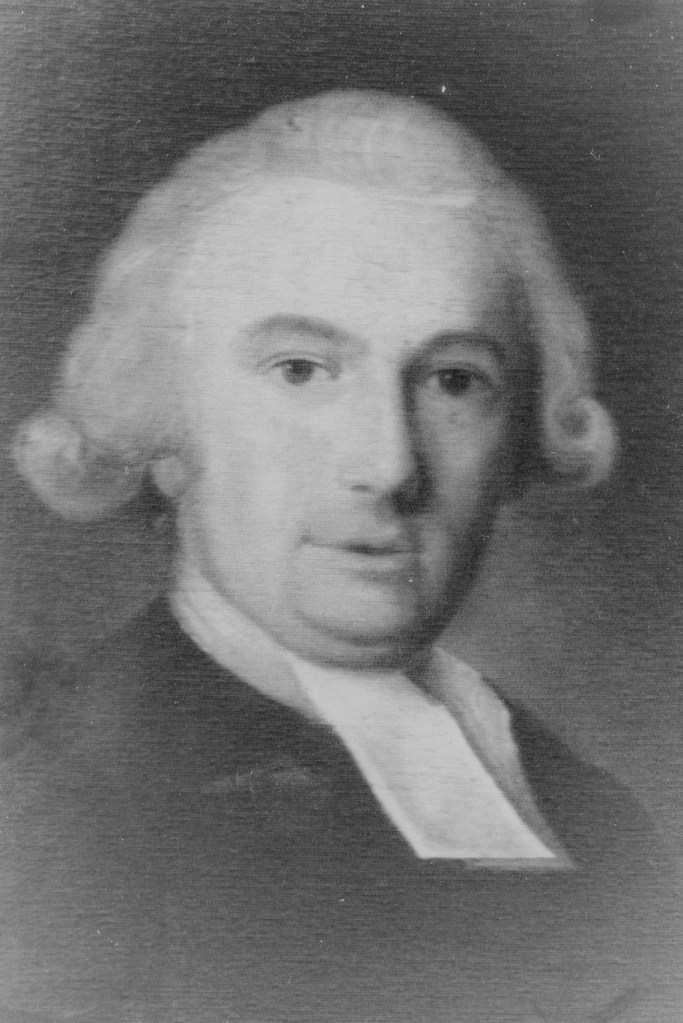
ROBERT FORBY Rector of Fincham 1799 – 1825
We know something of his life from a memoir, written by Dawson Turner, as an introduction to Forby’s book, ‘The Vocabulary of East Anglia’.
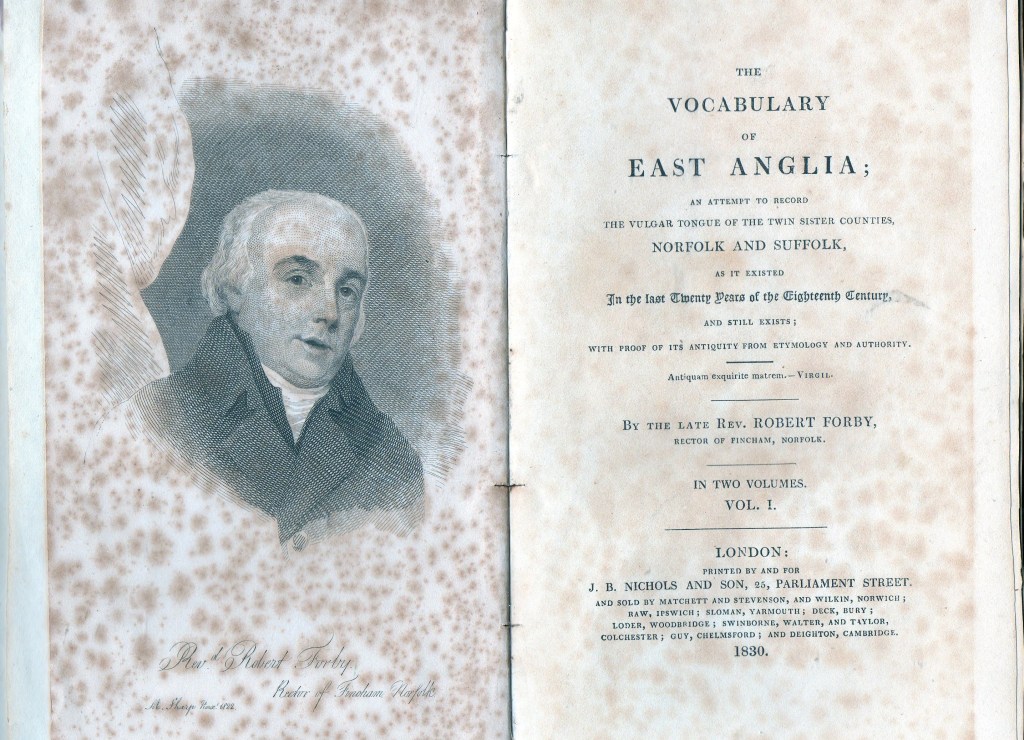
He was born in Stoke Ferry in 1759 and educated at the ‘free school’ at Lynn, under the master, a Dr Lloyd. From here he went to Caius College, Cambridge, from where he graduated in 1781. He seemed to have had a promising college career ahead of him. However his father had evidently died around this time and he had a widowed mother and three sisters to consider. In a letter years later to Dawson Turner he explains his change of direction when he writes:-
‘Among my very earliest recollections is a resolution to take charge of my mother; perhaps at as early an age as I was capable of entertaining such a thought. I availed myself at the very first opportunity, stopping short in my probably more promising career in college, and accepting a small benefice, with the curacy and little parsonage-house at Barton.’ (Barton Bendish) He did indeed ‘take charge’ of his mother who lived with him until she died at the age of ninety-three, one year before his own death. He continues in the same letter:-
‘I am persuaded that I both cheered and lengthened her life; and I am sure that she soothed and calmed many vexations and anxieties to me.’
In another letter to Turner he amply illustrates this. He is grumbling about his duty as a magistrate; a duty which he does not seem to have undertaken very willingly:
‘Indeed until you have experienced the heavy drudgery of an acting Justice, Deputy Lieutenant, and Commissioner of the Land Tax, one of two on whom the burthen of a large district lies, you will not readily conceive the fatigue they cause to the mind. Of the fatigue of my daily domestic occupations you are a competent judge: this is to be added to the other; and, when I have left home soon after breakfast, and return at 5 o’clock to a solitary dinner, which I abhor, with my head full of parish rates, surveyor’s accounts, vagrants, run-away-husbands, assaults, petty larcenies, militia lists and substitutes, tax duplicates and distress warrants, some or all of these jumbled together in a horrid confusion; and my dinner dispatched, sit down to have my aching head split by prosaic verses, bald themes or abominable lessons, tell me is it wonderful if I take up any slight amusement that lies in my way, kick off my shoes, and lounge by the fireside, or try to win sixpence off my mother at cribbage.’
Turner records that Forby received the small living of Horningtoft in Norfolk from Sir John Berney; ‘but all other expectations from that quarter were frustrated by misfortunes on the part of the Baronet. Mr. Forby, who in the full confidence that he had now found his harbour, had fixed himself at Barton Bendish, in the immediate vicinity of his intended patron, and had taken his mother and sisters there to reside with him, was obliged to have recourse to pupils for his sustenance.’
One of these pupils was Dawson Turner and so began the lifelong friendship between the two. Turner acknowledges the contribution Forby made to his lifelong love of botany.
Apart from his book on East Anglian vocabulary, Forby left a few written records. One of them, according to Turner was ‘A Sermon preached in the parish church of St. Peter at Mancroft in the city of Norwich, on Good Friday, April 14, 1797, for the benefit of the Charity Schools in that city.
(Dawson Turner was a very significant figure in Norfolk’s history. See his very interesting life)
A surviving fragment from Robert Forby’s pen is the following epigram which appeared when William Windham was standing as MP for Norfolk, having had a reputation as a politician who was not always constant in his thoughts and views.
THE POLITICAL WEATHERCOCk OR
THE WHITE COCKADE
‘When opticians a sunbeam dissect,
Pure and white as it comes from the sun,
What plain folks would never suspect,
They can shew seven tints mixed in one:
There’s red, yellow, green, orange ,and blue,
For Tories or Whigs, both or neither,
Each to choose his appropriate hue,
And then change, if they please, like the weather.
But such emblems, so stale and deceiving,
Philosophical Windham derides,
And by white, which includes all the seven,
Demonstrates that he’s on all sides
The Rev. William Blyth, writing in 1863, says that Forby was ‘especially remembered by his surviving parishioners’ and ‘was a man of letters, strong mind and brusque manners, a ‘’clergyman of the old school’’.
More evidence of Robert Forby’s life has been found recently in writing by Elizabeth Jones. Elizabeth (nee Helsham) lived from 1801 – 1860 and towards the end of her life wrote some reminiscences of her life. Robert Forby and Elizabeth’s father were cousins. Her father, Henry Helsham, died in 1806, and her mother, Katherine in 1816. After her father’s death her mother brought her children to Fincham. Elizabeth writes ‘in the Autumn of that year 1806, we took possession of our new house in Fincham. Three small dwellings had been thrown together for a straw-plaiting establishment and, as this was given up, it became our abode. It was ugly enough with a square garden in front divided into four squares….my brother Henry and I were mechanical geniuses and constructed wonderful pailings and gates for our tiny garden. The object seen from our window was the very handsome church of Fincham St. Martin.’ During these years and especially after her mother’s death when he was guardian to Elizabeth and her four siblings, Robert showed much love and devotion to his young relations. From the reminiscences we learn more of his life and character. This, for example, on his private life:-
‘Sir Michael Bedingfield was then residing at Oxburgh Hall and, notwithstanding the staunch Romanishe, Lady B. and my mother were great friends. The then Rector of Oxburgh Hall was the Rev. Joshua White whose wife and daughter were very superior people, good and clever, the elder lady rather awful and the younger very lovable, as Mr. Forby found. Indeed they were mutually attached, but their views of duty to their respective parents led them to relinquish all thoughts of marriage.’
There is some light thrown on his farming activities:-
. ‘This was a year (1816) of great commercial and agricultural distress. My sister, Catherine, and myself were under the roof of our kind friend at Fincham Rectory before the ‘wet harvest’ and the riots in the Isle of Ely and elsewhere. The harvest from Mr. Forby’s glebe had been gathered in early and well and his thanks offering was a weekly distribution of the most capital soup, the meat for which was brought every Tuesday from Lynn.’
The narrow range of people that Rectors could socialize with at the time is touchingly illustrated when Elizabeth writes ‘there were in those days no resident Rectors or their families near Fincham and our life was very secluded.’ There were however some high points in Elizabeth’s social life whilst at Fincham. This excursion for example.-
‘About the middle of July we all went to Cromer, all meaning Mr. and Mrs. Millers with Kate Alexander, Mr. Forby, Henry and myself and George joined us later. We were all in high spirits and our journey was charming. In what way our detachment reached Fakenham I cannot recall but I have the most vivid recollection of the next two stages by Thursford Hall, Holt and Felbrigg, my place being on the box from whence I could better admire the tangled wayside by the Park palings, the fine trees and finally the blue sea with its frame of healthy hills.’
This next extract is a lovely tribute to Forby’s nature: it concerns Elizabeth’s brother, George, who was studying medicine in London. This account is confirmed by Elizabeth. ‘George had, with some hesitation, asked for an invitation for a summer holiday at Fincham for his friend Hilditch. The reply was most cordial and he only regretted that he “had not been the first to think of it.”
We know from the memoirs in his book that Robert died on December 20th 1825.
According to Dawson Turner’s account:-
‘Mr. Waddington called upon our good friend, Mr. Forby, about one o’clock, while he was taking his bath, as usual. After waiting a considerable period the family became alarmed; and upon opening the door, they found he had fainted in the water, and had been suffocated, and had evidently been dead some time.
This account is confirmed by Elizabeth.
She writes movingly of her guardian at his death. She calls it her ‘tale of sorrow’ –
‘It was in the week before Christmas that I received the intelligence that our beloved parental friend had expired in his bath the previous noon, sinking beneath the water either from fainting or a fit……..Before Christmas Day we had placed him beneath that very spot whence he had, with a solemnity noticed by many, in the words of the second warning bade his parishioners to the celebration of the Holy Communion on the coming festival.
From Elizabeth’s writings Robert emerges not as a fairly isolated bachelor living alone with his ever aging mother in a large house but as a man, not only having a sister living all the time with him, but having an extended family of in-laws and young relations on whom he lavished much care and hospitality and by whom he who was remembered so fondly for his kindnesses decades later.
His book, it could be said, has passed the test of time as it was the subject of a David and Charles reprint in 1970. Robert Windham Ketton-Cremer, a descendant of William Windham, who gave Felbrigg Hall to the National Trust, has a few words about it in an essay he wrote on Forby in 1961:-
‘Modern philologists may smile at some of Forby’s derivations, and his Vocabulary certainly presents a contrast to the businesslike compilations which embody the results of their learning and research. But the amplitude of Forby’s methods, the digressions and speculations and anecdotes in which he constantly indulged, give his book a leisurely charm which is lacking in more recent and more efficient works of etymology.
Three portraits are known of Robert Forby. A painting is held in the Castle Museum, Norwich, painted in 1802, artist unknown. There is the lithograph in his book, done in 1822 and a sketch from life in Elizabeth Helsham’s book.
The presentation to the living was bequeathed by Joseph Forby to his nephew, Robert Forby (1759-1825) son of Thomas Forby and Susan Forby (née Harvey, d. of Robert Harvey of Stoke Ferry). Forby did not move into the Rectory until 1801, but remained at Wereham. This was probably until he had collected the £500 to pay off the mortgage on the presentation.
After Robert Forby’s death the right to present to the living was bequeathed to the Rev. George Millers of Ely in the notes made by Forby for a will, which were accepted as such. It is unclear what happened next as it was offered for sale on 11 January 1827.
- Cambridge Chronicle and Journal, 29 December 1826
- VALUABLE ADVOWSON
- FINCHAM NORFOLK
- To be SOLD by AUCTION
- At the Rampant Horse Inn Norwich on THURSDAY
- the 11th day of January 1827, at two o’clock in the afternoon.
The PERPETUAL ADVOWSON of, or right of Presentation and Alternate Presentation to the United RECTORY of FINCHAM Saint Michael’s with Saint Martin’s, in the County of Norfolk. the next Presentation is with the proprietors. The present incumbent is in his 32nd year ….. goes on to say the 2,800 acres of titheable land , and 46 acres of Glebe etc. etc.
Robert Forby’s name is on a slab to the right of the altar and it is likely that he was interred in the vault along with six other members of his family.
Bibliography and other sources for Joseph and Robert Forby.
Arthur Young, General View of the Agriculture of the County of Norfolk David & Charles reprint 1969.
Rev. Robert Forby, The Vocabulary of East Anglia, 1830
Rev.William Blyth, Historical Notices and Records of Fincham in the County of Norfolk. 1863
R.W.Ketton-Cremer Forty Norfolk Essays, Norwich 1961
Transactions of the Norfolk and Norwich Naturalists,’ Society Vol. IX, 1909 – 1914
Reminiscences of Elizabeth Jones (nee Helsham) published privately by her Great Great Great Grandson, J.J.Heath-Caldwell.
JOSEPH FORBY (1734-99) Rector of Fincham 1787-1799
Joseph was a grandson of Thomas Forby of Sahum Toney, Norfolk and son of the Rev. Joseph Forby, Rector of Fincham (1723-1744). One of Joseph’s brothers was Thomas Forby of StokeFerry (1735-1780), grocer, who married Susan Harvey. Thomas and Susan had four children, one of whom was Robert Forby who succeeded his uncle as Rector of Fincham in 1799.
He also had a short-lived brother, John (1738 -1745).
Joseph was only ten years old when his father died. His mother, Martha, married Rev William Harvey who became the next Rector of Fincham from 1744-1787. When his stepfather died Joseph became Rector of Fincham. To complicate family tree matters further Joseph married Constance Harvey, born 1734, daughter of William Harvey and his first wife Elizabeth (Vincent) in 1761. It is fairly certain that Joseph lived in the Rectory at Fincham from the time he was married. He became curate to William at Fincham in 1763 and almost certainly had a good share of the Fincham living, as will be seen in further details of his interests. His stepfather had an extraordinary long career in the church. He was Rector of West Winch from 1732 – 1786, Vicar of Crimplesham from 1735-1786 ( although probably only as a stipendiary curate as Rev Charles Parkin surmises in his history of the Clackclose Hundred when he was completing Blomefield’s history of Norfolk) and Rector of Fincham from 1745-1786. So he could afford to let stepson Joseph have much more than the normal curate’s stipend.
This is Joseph’s career in the church.
Deacon 22 October 1758
Curate of Threxton 23 October 1758
Rector of Merton 5 October 1761 to 4 May 1785
Rector of Beachamwell All Saints with Shingham 25 June 1763-21 April 1785
Curate of Fincham 25 June 1763
Rector of Barton Bendish All Saints 1 June 1784
Rector of Barton Bendish St Mary 22 November 1784
Rector of Fincham St Martin 22 August 1787 to 25 April 1799.
Thus at one period he was Rector of Merton and Beachamwell and then became Rector of two Barton Bendish livings. Even when many clerics had more than one living perhaps four was frowned upon so he gave up the first two, only to increase it again to three in 1787 with the Fincham living.
Joseph probably went to live in the Rectory at Fincham on his marriage, as he described himself as clerk when he signed the Archdeacon’s transcript for the year1761-2. He did not sign Merton or Beechamwell. In 1763 a curate, William Clough, was appointed for Merton. The Rev. Harvey probably moved to Downham Market as he and Joseph were respectively domiciled in Downham and Fincham but both voting for a freehold in Fincham in the Poll Book for the Norfolk Election of 1768.
Joseph Forby’s residence at Fincham is also confirmed by two letters in the Norfolk Record Office written by him to Lord Townsend thanking him respectively for gifts of half a buck in July 1768 and for game in August 1770. Joseph Forby was a keen sportsman, and took part in hare coursing meetings with members of the gentry and aristocracy, such as George Walpole, 3rd Lord Orford of Houghton Hall. His hounds, named in the reports of the competitions, were Zadoch, Zillia, and Zeno. The names of his hounds all begin with Z and this indicates that he was a member of the Swaffham Coursing society, founded in 1776 by George Walpole . It had initially twenty-six members only, and each member’s hounds were named by the same alphabet letters, one for each member.
A rather intriguing report is that in 1779 he was asked to be gamekeeper of Sir Thomas Hare’s manor at Shouldham, and this involved him in a lawsuit in the following year, 1780. He appears to have been over-zealous and with another man, John Overland, violently assaulted and removed a gun worth £20 from a certain Jonathan Morris found on the property, and two other guns, which the latter claimed they had disposed of for their own good. The jury found in favour of Morris, over the taking and disposing of the guns, and Forby and Overland had to pay over £26 5s.and costs of 40s. This case of trespass against the person (as opposed to property) is described in John Wentworth, ‘ A Complete System of Pleading: Comprehending the Most Approved Precedents and Forms of Practice; chiefly consisting of Such as have never before been Printed’ . . . vol. 2, 1799, pp. 1-4 Trespass. Jonathan Morris against Joseph Forby clerk and another (John Overland) on 1 December 1780. Why a rector should want to be a gamekeeper could be explained by a love of game shooting and plenty of time on his hands –but unusual nonetheless.
In1780 he conveyed the two turns of presentation and afterwards the alternate right of presentation with the King of the united rectory of Fincham St Michael’s with St Martin’s together with all the messuages, buildings, glebe lands, tithes or profits attached to the said rectory, to Robert Harvey of Watton, gent for £500. Dated 1 April 1780.
This did not prevent him from bequeathing this right of presentation to his nephew Robert Forby, when he made his will in 1783. Possibly he imagined he would pay it back before his death, but did not. Robert Forby paid back the £500, plus 5s.0d. and on 4 July 1801 Robert Harvey of Watton conveyed the rights of presentation, etc. to him. Robert Forby could then move into the Rectory.
Joseph must have been considered trustworthy. In 1791 a Mrs Sarah Adamson of Wereham named him as one of three trustees of a £500 gift to be invested and the interest expended on the poor of Wereham having an income of under £10 per annum and not receiving benefit from that parish or any other. You can see her monument in Wereham Church chancel.
After his death, his farm stock and shooting gear were sold. The sale was advertised in the Norfolk Chronicle, 20 July 1799, and 3 August 1799, p. 1.
Advertisement for stock to be sold on 7 August 1799.
117 stock ewes; 43 wethers; 20 fat sheep, 70 fine ewes and wether lambs, 13 fine tups of several ages, Leicester, 10 good polled cows; one springing heiffer, and a handsome cream-colour bull, 5 heiffers , 2 steers, 7 weanings, 1 yearling, Suffolk bred, a brown roan mare, cart gelding, 2 very handsome shooting ponies, brace of spanish pointers, 5 excellent double barrel guns and a brace of pistols, a whiskey and harness, old post chariot and a boxed cart, 21 acres of cinquefoil seed, also various notices about land.
The Reverend Joseph Forby made his will in 1783, before his wife’s death, and did not make another will afterwards. His wife was named as Executrix with Robert Forby as Executor, and Robert Harvey of Watton was given the task of selling Joseph’s property. The right of presentation was bequeathed to Robert Forby. His wife was to receive £200 and up to £100 worth of furniture etc. The remainder of his estate was to be sold and after payment of debts etc. all was to go to Constance. On her death Robert Harvey of Watton was to oversee the sale of his land at Saham Toney and elsewhere and this money was bequeathed half to Martha Forby, Robert Forby’s sister, and the other half divided between the other siblings, Mary and Susan.
Martha Forby made her will in Norwich later in 1826 and was to die at Cromer in 1828.
Rev Joseph Forby the farmer
In 1790 a letter dated Fincham, Sept 17 from Joseph titled ‘Crop of 1790’ was published in Annals of Agriculture and Other Useful Arts, vol. 14, no. 81, pp. 255-58. This describes the state of the present harvest of crops and tells how he had been inspired by the journal’s ‘Six Months Tour’ to introduce the cultivation of cabbages on his land nine years earlier instead of turnips, and that this had been a very successful crop on the heavy soil, but he continued to cultivate turnips on the lighter soil.
Clearly Joseph took an active part in farming his lands and Arthur Young mentions Joseph in his book ‘A General View of the Agriculture of the County of Norfolk.’ We learn under the section on cabbages that ‘The Rev. J. Forby was a most successful cultivator of this plant.’
Young continues with a detailed account of Joseph’s husbandry.
‘Two acres produced 28 tons per acre, carried off the land , a strong wet loam on clay; two adjoining acres of turnips were fed off with sheep; the whole sown after three earths with oats, to the eye perfectly equal, and the whole produce 90 coombs, or 12 quarters per acre. Seeds took well, and he cut nine tons of hay. No manure for either cabbage or turnip. Cabbages never exhausted his land, which always worked better for barley or oats than his turnip land. No cattle could do better than his cows when on cabbages and oats rather than on his turnip land. No cattle could do better than his cows when on cabbages and the cream and butter free from any disagreeable taste. The seed was always sown as early in the spring as possible, on land well sheltered, dunged and dug. The moment he perceived the fly on the young plants, he sowed the beds with wood-ashes, which instantly destroyed the fly, and so far from hurting the plants, that it was astonishing to see how they were invigorated by it. They were planted out in the third week in May. Mr. Forby always mucked the land intended for the crop soon after Michaelmas, which he found far preferable to doing it just before planting. In a very severe frost which destroyed all the turnips, Mr. Forby’s cabbages escaped and were of immense use.’
At a later date Joseph communicates to Young the claim that ‘he had never seen any piece of land at Fincham planted part with cabbages and part with turnips, where the former did not exceed the latter four-fold at least.’ He gives details of an experiment he did to see if claims that cabbages impoverished the land had any basis. He rotated cabbages, oats and wheat on a piece of ‘middling land’ and found that no person in the Parish had cleaner oats or wheat, nor any such large crop.
‘Mr.Forby’s experiments on cabbages’ are elsewhere quoted by Young in a section where he writes:
‘The universal system in Norfolk, whatever may be the soil, of sowing turnips, and cultivating them on flat, or nearly flat, lands, must, without hesitation, be condemned…..’
In the section on rotation of crops on ‘stronger land’, Joseph’s rotation is given as-
1, Cabbages,dunged for, and worth, on an average, £5 per acre;
2. Barley, 9 and a half coombs;
3. Clover mown twice, produces three tons;
4. Wheat, dibbled, 8 coombs;has had ten round;
5. Oats, fifteen coombs.
[ a coomb is a dry measure, equal to four bushels]
There is more evidence of Joseph’s initiative and innovation. The section on cabbages ends:
‘This gentleman tried the red garden cabbage, and found them very hardy, and come to 14lb, but they demand more time for growing than the green sorts; of which those streaked with red veins are best, and most durable. He hung those up for seed for two months after Christmas. He did not approve of setting the stalk only, as the side branches were apt to break off; each good plant yielding 1lb of seed: he dried it in hurdles raised on stakes: and if the ground was fine under them and dunged, it became a seed bed.’
And again, this time on the humble carrot:-
‘Mr Forby of Fincham, for some years kept carrots without suffering from the severest frosts, by forming a platform of earth, six inches above the level and two and a half feet wide: on this a sprinkling of dry straw, and then a row of carrots, with their tops all on, and turned outwards, the tails overlapping one another; so that the width covered with carrots was about two feet; the small one stopped and laid in the middle: on every two or three rows a little dry straw, and thus to a height of four feet, the tops well covered with dry straw; another row parallel, with room for a person to walk between: these alleys at last filled with straw, and the outside guarded with bundles of straw, staked down, or set fast with hurdles, to prevent the wind blowing the straw away.’
In his Presidential address to the Norfolk and Norwich Naturalists Society in 1914 the President, in recalling the friends of the naturalist, Sir James Smith, mentions the Forby family. He quotes Arthur Young:-
‘ Mr. Forby knew well the value of osier plantations for various purposes. Osiers planted in small spots, and along some of his hedges, furnished him with hurdle-stuff enough to make many dozens each year…..as well as a profusion of all sorts of baskets, especially one kind that he used for moving cabbage plants, and for which purpose they were much better than tumbling the plants loose in a cart. The common osier he cut for this purpose at three years, and that with yellow bark at four.’
There is another reference to Joseph’s cultivation of willows. He used willow baskets to carry the cabbage from trees he found on his land. The willow is named Salix Forbiana after him. The following is from James Sowerby,” English Botany; Or coloured Figures of British Plants, with their Essential Characters, Synonyms and Places of Growth, 1790-1814; vol. 20?1805, p. 1344,) ‘Salix Forbiana, Basket Osier.. . . . ‘This, which is highly valued as an Osier, for the finer kinds of basket work, and on that account greatly preferred to the foregoing, was first sent to Mr Crowe by the late Rev. Joseph Forby, from Fincham, Norfolk. It has since been observed in many places in Cambridgeshire.’ On the next page is a colour plate of the plant.”
There are quite a number of willow trees in the hedgerow on the southern boundary of the Church lands even today. (2016)
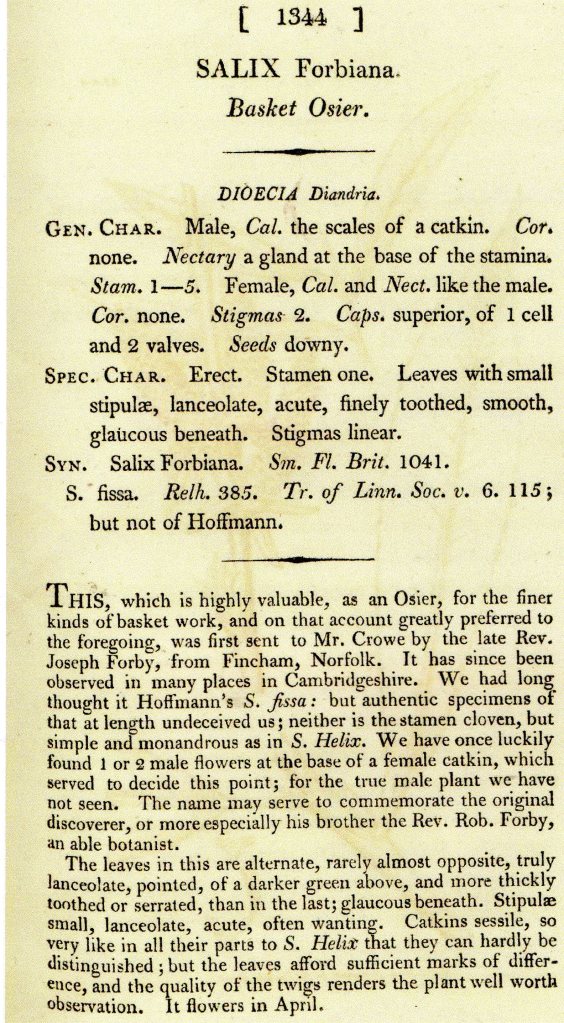
Clearly Joseph Forby was a Rector who took his farming seriously. At a time when there was a good deal of innovation and careful thought put into farming he was not content to live off his tithes alone but desired to improve the husbandry of his own land.
Joseph Forby died on April 25th 1799. His name is on a stone slab in the chancel to the left of the altar.
From Blyth’s book
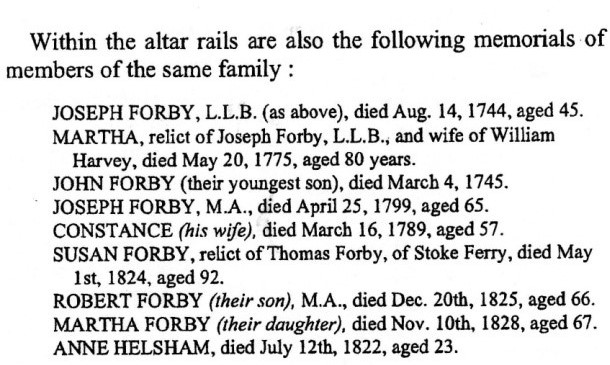
Most of these memorials are under the altar and not able to be seen. Robert Forby’s is visible on the right side of the altar.
Forby Family Tree
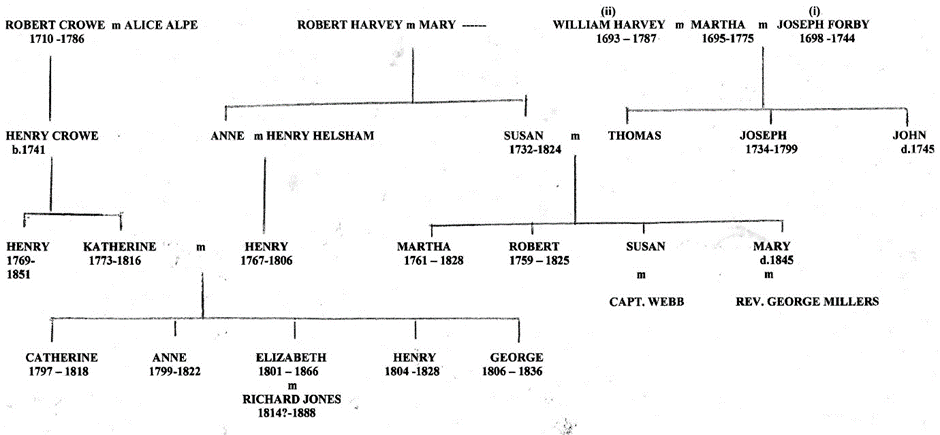
*********************************************************************************************************
Rev. Daniel Baker 1682-1723
Daniel Baker was born in Huntingdonshire, in 1654.He was baptised in Glatton on 4thMay1654.
His parents were John Baker and Mary Gardiner who were married in Godmanchester on 4thMay 1640.
His mother’s brother was Daniel Gardiner who was Rector of Fincham from 1661 to 1682. Thus Daniel Baker was Daniel Gardiner’s nephew and he succeeded him as Rector of St. Michael’s and Vicar of St. Martin’s Fincham in 1682. His first wife was Anne (possibly Anne Hebblethwaite)
Daniel was educated at Gonville & Caius College Cambridge and ordained deacon 22.09.1677 at Norwich Cathedral by Bishop Anthony Sparrow
He was firstly Curate of St Nicholas Chapel Lynn 1677 to Mr Samuel Kendall, St. Margaret’s Parish Kings Lynn
He was then ordained priest 27.02.1677 at Norwich in the Chapel of the Bishop’s Palace.
On the eleventh of January 1683 he became Rector of St. Michael’s by the advowson of ‘Sir Thomas Hare, Baronet’. A note says that a ‘Personal union was established with the Vicarage of Fincham St. Martin.’ He remained in these posts for the next forty years.
Rev. William Blyth says of Baker –‘Greatly tried in the furnace of affliction, he appears to have excelled in in faith and patience. The register tells the melancholy tale of the death of his mother, first wife, and eight children, in quick succession. These afflictive visitations directed his thoughts particularly to the book of Job, which he forthwith wrote in verse.’
In fact his suffering was indeed great but not confined to a’ quick’ period.
These are the deaths of his family as recorded in the relevant Parish Register.
Children
Lydia baptised Sept 19th 1683 – buried July 10th 1705 aged 21 yrs
Judith “ Sept 11th 1684- “ April 29th 1685 “ 7mnths
John “ Aug 7th 1685 “ Sept 14th 1694 “ 9 yrs
Daniel “ Aug 5th 1686 “ July 6th 1714 “ 27 yrs
Sarah “ June 23rd 1687 “ Dec 22nd 1716 “ 29 yrs
Anne “ March 9th 1688 “ March 12th 1688 “ -3 days
Anne “ July 23rd 1691 “ Sept 13th 1691 “ 1 mnth
Robert “ July 24th 1692 “ July 7th 1705 “ 12 yrs
Anne Baker, his wife, was buried Aug 7th 1705
A Mrs Mary Baker was buried at Fincham on May 1st 1720. This could be either his mother Mary who would have been very old or his second wife Mary. It is unusual to put ‘Mrs’ before a name so it may signify a personal touch.
Thus his family’s deaths were between 1685 and 1720. In 1705 he lost his wife, son Robert and daughter Lydia.. He doesn’t appear to have been survived by any children.
On September 16th 1718 Daniel married Mary Ingle-Bright in Great Massingham. Mary -maiden name Francklin – was the widow of Thomas Ingle-Bright of Wallington. If she was the Mrs Mary Baker, Daniel’s second wife, alluded to above, his personal grief continued.
Rev. Daniel Baker was buried on Feb 20th 1723 in Fincham.
He is remembered for his poetry. His ‘History of Job -a sacred poem’ was published soon after the deaths of his wife and two children in 1705. The poem is in five parts and tells in verse the story of Job and his sufferings. It is presently available as a print to order book.
In 1697 he published a book entitled ‘Poems upon several occasions.’ There are about thirty poems in the book. He is considered a minor Augustinian poet and his published poems can be found online. Here is one example.
The Wife
Let me but have a Wife what e’er she be
So she be Woman, ’tis enough for me:
I ask not one in whom all Graces shine,
Her Sex alone endears her to be mine.
If she be young, she is not stubborn grown,
And I may form her Manners to my own:
If old, a Wife and Mother both I have,
And either may a Kiss or Blessing crave.
If she be fair, she’s lovely as the Light:
If ugly, why? what’s matter in the Night?
If she be barren, I am free from Care:
If Fruitful, Children costly Blessings are.
If Poor, she’ll Humble, and Obedient be:
If Rich, O! who’d fear golden Slavery?
If Scold she be, she’ll teach me Patience:
If Sluttish, I may Temp’rance learn from thence.
If full of Tongue, I shan’t want Company:
If mute I’ll love her for the Rarity.
I’m Lord and Master, if she be a Fool:
If wise, I shall be so to let her rule.
Unjust are they who ‘gainst the Sex declaim,
When ’tis not they, but we deserve the blame.
They all are good enough, had we but Skill
The Good in them to take, and leave the Ill.
That Wives and Husbands Humours seldom meet,
‘Tis not ’cause they want Goodness, but these, Wit.
or this:-
Wisdom.
Be Wise d’ye say, I scorn that Word:
Love’s Politicks no such Rule afford,
For Love and Wisdom never yet,
Believe me, in one Subject met,
It cannot be, not mighty Jove
Can be at once, Wise, and in Love.
The boldest Painter never dar’d
Draw Love with either Eyes or Beard,
For these are Wisdom’s Signs; but he
Delights in plain Simplicity.
Blindness and Childhood best express
His open–hearted Heedlesness.
Let them be wise that rule the State,
And calculate the Kingdom’s Fate,
Grave Counsellers, and Judges sage,
Philosophers and Men of Age;
The Serpent’s Wisdom let them use,
We the Dove’s Innocence will chuse.
Wisdom to them perhaps may be
Of Use: but not to thee and me,
‘Twill vex our Minds and fill us full
Of Doubts, and make our Pleasures dull.
Away with’t: in the Mysteries
Of Love, ’tis Folly to be wise.
Ah! Dear, Thou dost not see the end
To which such evil Counsels tend.
Consider what it is you speak;
If this Advice Men once should take,
Your Empire’s Ruine it would prove.
No wise Man ever was in Love.
If I were Wise, I soon should find
Th’ Impertinence of Woman–kind:
Neither your Favour, nor your Frown
Would lift me up, or cast me down.
The Influence of your starry Eyes
Is over–rul’d by him that’s wise.
The deepest Mystery of State
That makes the Pope, and Women great,
Is Ignorance: If men were Wise,
Both Pope, and Women they’d despise,
And Protestants we all should prove
‘Gainst his Religion, and your Love.
 Fincham Local History Society