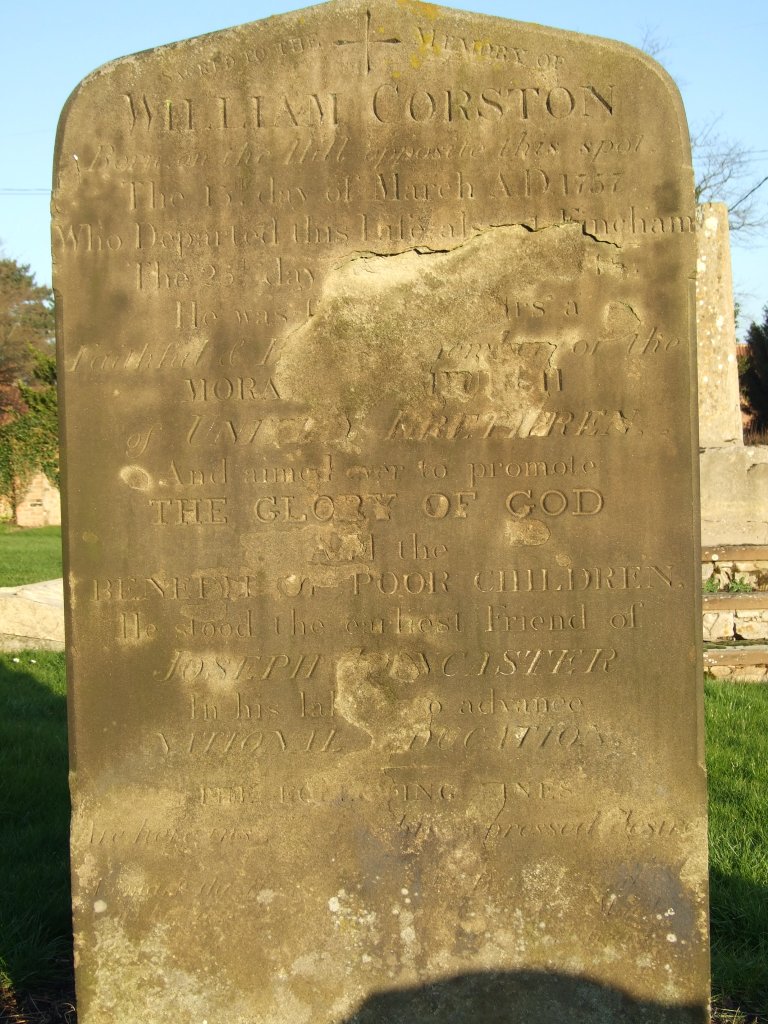
It reads
Sacred to the memory of William Corston
Born on the Hill opposite this spot on the 15th day of March A.D. 1757
Who departed this life also at Fincham the 25th day of March A.D. 1843
He was for many years a Faithful and Beloved member of the Moravian Brethren and aimed to promote the Glory of God and the Benefits of Poor children
He stood the earliest Friend of Joseph Lancaster In his labours to advance National Education.
Following is a verse written by the James Montgomery, the poet.
Norfolk Chronicle 11th May 1907 pg. 4
William Corston
William Corston was born in Fincham in 1757, the son of William Corston snr, a woolcomber, and Mary Eldred. Although not the wealthiest family in the village the Corstons owned land which they retained after the enclosure of 1772. His older brother Thomas became an exciseman in Sussex, returning to Fincham after the death of his father, his signature appearing on several Vestry documents and also as a witness at marriages. His younger sister Susannah married Patrick Sadd the village baker.
On leaving Fincham he first worked as a clerk in the silk trade and then became a straw -hat seller and manufacturer at Ludgate Hill, London. Trading difficulties during the Napoleonic war meant that Italian straw plait from Livorno “Leghorn” was in short supply and William Corston was awarded a Gold medal from the Society of Arts for inventing a method of using coarser English straw for an English version of Leghorn. This meant money and fame for Corston. He apparently presented the first Leghorn hat to King George III which was worn by Queen Charlotte thus starting a fashion for English straw-plait.
Given his obvious knowledge about straw plait, and coupled with his interest in education, he returned to Fincham in 1802 to set up one of Norfolk’s first schools of industry, a straw plaiting establishment that also educated young girls.
“In October 1802 a school was opened in Fincham for the education of the children of that, and the adjoining parishes. They are all instructed twice a day in reading and some of them in writing. The rest of their school time being seven hours of the day, is employed in the plaiting of split-straw. The school is under the care of three sisters, who have divided it into three classes, making the following payments for the time they are employed in the plait.19 children, from 7-9 years, average per week 1s 6d 27 children, from 9-12 years, average per week 3s 18 children, from 12-14 years, average per week 4s without any deduction except 3d a week for each child who learns to write. There are at present 64 children. 4 have left it to go into service and 17 have acquired a competent knowledge in the straw plait and have returned to their parents. All the children are in good health, clean and orderly. Children who live near the school, go home to dinner, from 12 to 1 o’clock, and lodge at home: of the others, some bring their dinners and return home at nights: others lodge at Fincham, and are at home only from Saturday to Monday”
Extract from the Society for Bettering the Condition of the Poor 1805
It is probable that the three sisters are his nieces from the Sadd family although his niece Elizabeth (who later married her cousin William Sadd) was in the village at the time. It is not certain where the school was situated but we can see from the Enclosure Map and the Tithe Apportionment that the Corstons owned land and houses from St Mary’s Lodge to Toll Corner and also around The Hill. An extract from the diary of Elizabeth Jones, a niece of the Rev Robert Forby, seems to suggest that the school may have been on the Hill opposite the church.
Extract from the diary of Elizabeth Jones
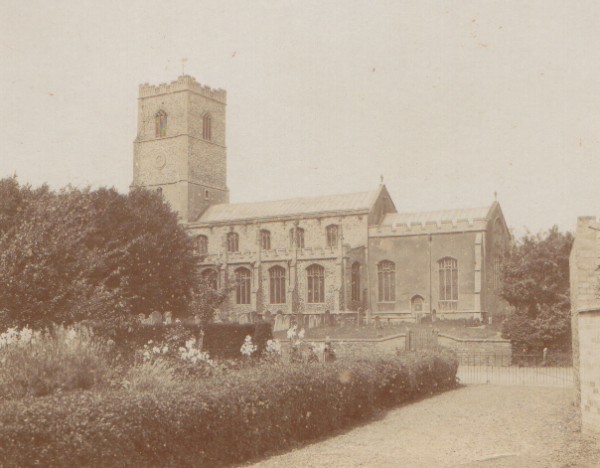
“In the autumn of that year, 1806, we took possession of our new house in Fincham. Three small dwellings had been thrown together for a straw-plaiting establishment and, as this was given up, it became our abode. It was ugly enough with a square garden in front divided into four squares, but I have some pleasant childish associations with it nevertheless. My brother Henry and I were mechanical geniuses and constructed wonderful palings and gates for our tiny garden and had many pleasures in common. The object seen from our window was the very handsome church of Fincham St. Martin.”
The straw plaiting establishment could be the cottage centre left.
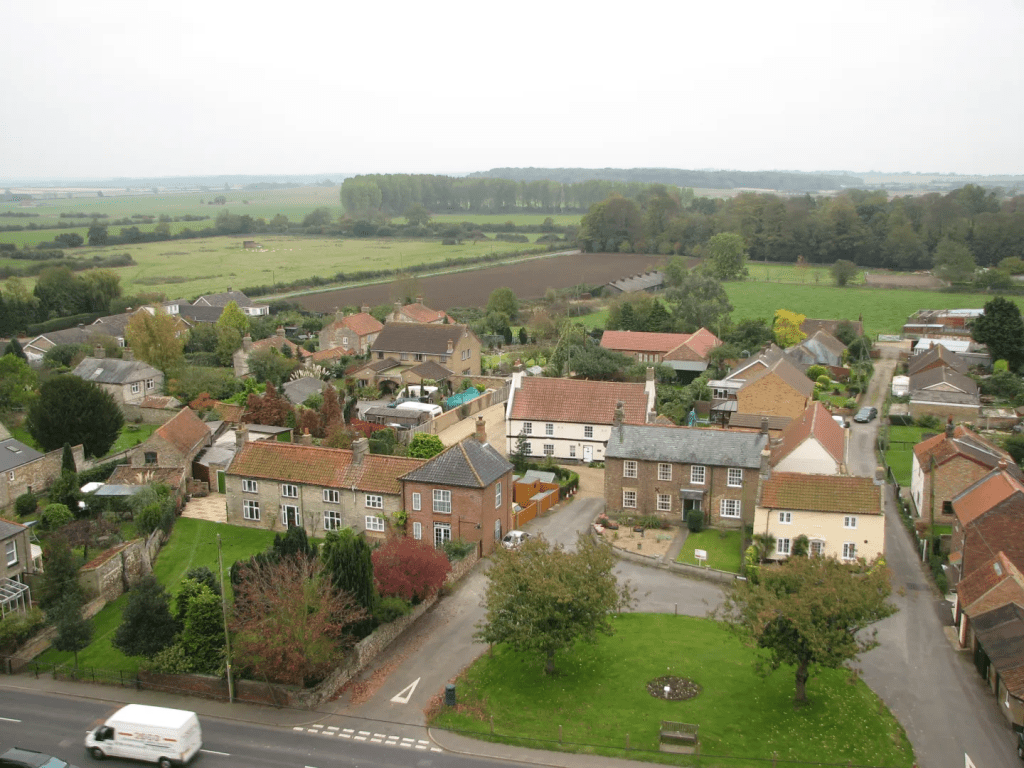
A photo from the end of 19th to early 20th of the view from the cottage(s) to the church.
Although the school closed after a few years it didn’t stop Corston trying to persuade Kings Lynn Poor Law Guardians to set up a school for girls in 1810.
1810. This year a negotiation took place, and was carried on for some months, between Mr. William Corston of Ludgate Hill London and the Lynn Court of Guardians, in consequence of a proposal from the former, to furnish employment for the female children of the Lynn poor, in plaiting of straw and knitting of hats, on certain terms and conditions: vis. To be provided with a proper house for the manufactory, and a dwelling for the superintendents, together with the loan of a large sum of money, on proper security, for seven years, without interest.—This notable treaty was opened in March, and after a number of Letters had passed between the parties, it was closed by a Letter from the Registrar to Mr. Corston, dated Sept. 15. of which the following is a copy
“Sir, I was duly favoured with your Letter of the 30th. of August inclosing answers to my questions respecting your plan for employing the female poor of this borough, which, with the sketch of the proposed building, &c. transmitted to Mr. Dixon, I laid before the Court of Guardians at their meeting, holden on Thursday last, who after having given the matter their most mature consideration, instruct me to inform you, that they entirely decline acceding to your propositions. I therefore return you the several papers, requesting you will be pleased to accept the thanks of the Court for the trouble you have had in the business I am, &c. J. Smeatham. “
So the affair ended; happily or otherwise, We take not upon us to say. From the Kings Lynn Poor records cited in ‘The history of Lynn: civil, ecclesiastical, political, commercial…’
By William Richards: The History of Lynn 1812
In 1804 William Corston met Joseph Lancaster, founder of the Royal Lancastrian method of teaching. The schools that Lancaster founded nationwide were based on the monitorial system with older boys becoming monitors and teaching the younger ones which meant that it was possible for one master to be in control of several hundred children. Because of Corston’s connection he was able to introduce Joseph Lancaster to a number of wealthy patrons. Unfortunately, in 1807 Lancaster got into financial difficulties. Arrested for debt, he was rescued by William Corston and Joseph Fox. In 1808 William Corston, Joseph Fox and William Allan, formed the Royal Lancastrian Society later the BFSS (British and Foreign Schools Society) giving both practical and financial help to Lancaster. Although the schools were non-denominational they were seen as being non-conformist (Lancaster, Fox and Allan were Quakers and Corston was a Moravian) and the Church of England, worried about competition, set up their own National Schools system (similar to the British Schools) which, as the schools of the establishment and the state, became more numerous, led eventually to our present state school system. However, our state education owes a debt to the endeavours and generosity of William Corston.
He was also a member and trustee of a number of different societies including the Society for the Promoting of Christianity amongst the Jews (of which William Wilberforce was the president).
On the death of his wife, Margarette in 1822 he returned to Fincham to his house (now called St Mary’s Lodge) next to the small Wesleyan Methodist Chapel where we think that he may have started another day school based on the Lancaster’s system of tuition. This building later became the first Wesleyan chapel in Fincham in 1822. William Corston went back to London in the late 1830s and wrote “The Life of Joseph Lancaster” returning to Fincham for the remainder of his life, dying there in 1843. He is buried in Fincham churchyard with his surviving daughter, Martha Hutchison, later buried in the grave next to his. Plaques attached to the clock frame in St Martin’s church show that in 1844 the West clock was subscribed by his daughter Martha Hutchison and grandsons Aeneas Barkly Hutchison and William Corston Hutchison in memory of William Corston
Source of information on the clock :notes taken by Henry Hodgson copy in local history society files.
The Corston Family of Fincham
William Corston, a devout and philanthropic man, was born in Fincham in 1757. He made his money and his fame as a manufacturer and seller of straw hats in Ludgate in London. Trading difficulties during the Napoleonic war meant that Italian straw plait from Livorno “Leghorn” was expensive and in short supply. William Corston invented a method of using coarser English straw for an English version of Leghorn for which he was awarded a Gold Medal by the Society of Arts. He apparently presented the first Leghorn hat to King George III and Queen Charlotte wore it starting a fashion for English straw-plait.
Given his obvious knowledge about straw plait, and coupled with his interest in education, he returned to Fincham in 1802 to set up one of Norfolk’s first schools of industry, a straw plaiting establishment that also educated young girls.
“In October 1802 a school was opened in Fincham for the education of the children of that, and the adjoining parishes. They are all instructed twice a day in reading and some of them in writing. The rest of their school time being seven hours of the day, is employed in the plaiting of split-straw
The school is under the care of three sisters, who have divided it into three classes, making the following payments for the time they are employed in the plait.
19 children, from 7-9 years, average per week 1s 6d
27 children, from 9-12 years, average per week 3s
18 children, from 12-14 years, average per week 4s
without any deduction except 3d a week for each child who learns to write. There are at present 64 children. 4 have left it to go into service and 17 have acquired a competent knowledge in the straw plait and have returned to their parents. All the children are in good health, clean and orderly. Children who live near the school, go home to dinner, from 12 to 1 o’clock, and lodge at home: of the others, some bring their dinners and return home at nights: others lodge at Fincham, and are at home only from Saturday to Monday” Extract from the Society for Bettering the Condition of the Poor 1805
It is not certain where the school was situated but we can see from the 1773 Enclosure map and the 1840 Tithe Apportionment that the Corstons owned land and houses from St Mary’s Lodge to Toll Corner and also around The Pit (now known as The Hill). An extract from the diary of Elizabeth Jones, a niece of the Rev Robert Forby, seems to suggest that the school may have been opposite the church.
“In the autumn of that year, 1806, we took possession of our new house in Fincham. Three small dwellings had been thrown together for a straw-plaiting establishment and, as this was given up, it became our abode. It was ugly enough with a square garden in front divided into four squares, but I have some pleasant childish associations with it nevertheless. My brother Henry and I were mechanical geniuses and constructed wonderful palings and gates for our tiny garden and had many pleasures in common. The object seen from our window was the very handsome church of Fincham St. Martin.”
Extract from the diary of Elizabeth Jones
Although the school closed after a few years it didn’t stop Corston trying to persuade Kings Lynn Poor Law Guardians to set up a school for girls in 1810.
1810. This year a negotiation took place, and was carried on for some months, between Mr. William Corston of Ludgate Hill, London,, and the Lynn Court of Guardians, in consequence of a proposal from the former, to furnish employment for the female children of the Lynn poor, in plaiting of straw and knitting of hats, on certain terms and conditions: vis. To be provided with a proper house for the manufactory, and a dwelling for the superintendents, together with the loan of a large sum of money, on proper security, for seven years, without interest.—This notable treaty was opened in March, and after a number of Letters had passed between the parties, it was closed by a Letter from the Registrar to Mr. Corston, dated Sept. 15. of which the following is a copy
“Sir, I was duly favoured with your Letter of the 30th. of August inclosing answers to my questions respecting your plan for employing the female poor of this borough, which, with the sketch of the proposed building, &c. transmitted to Mr. Dixon, I laid before the Court of Guardians at their meeting, holden on Thursday last; who after having given the matter their most mature consideration, instruct me to inform you, that they entirely decline acceding to your propositions. I therefore return you the several papers, requesting you will be pleased to accept the thanks of the Court for the trouble you have had in the business
I am, &c. J. Smeatham. “So the affair ended; happily or otherwise,
We take not upon us to say.
From the Kings Lynn Poor records cited in The history of Lynn: civil, ecclesiastical, political, commercial…
By William Richards
In 1804 William Corston met Joseph Lancaster, founder of the Royal Lancastrian method of teaching. The schools that Lancaster founded nationwide were based on the monitorial system,with older boys becoming monitors and teaching the younger ones, which meant that it was possible for one master to be in control of several hundred children.
Unfortunately in 1807 Lancaster got into financial difficulties. Arrested for debt, he was rescued by William Corston and Joseph Fox who in 1808 together with William Allan, formed the Royal Lancastrian Society, later the BFSS (British and Foreign Schools Society) giving both practical and financial help to Lancaster. Although the schools were non-denominational they were seen as being non-conformist (Lancaster, Fox and Allan were Quakers and Corston was a Moravian) and the Church of England , worried about competition, set up their own National Schools system (similar to the British Schools) which, as the schools of the establishment and the state, became more numerous and led eventually to our present state school system. However our state education owes a debt to the endeavours and generosity of William Corston
He was also a member and trustee of a number of different societies including the Society for the Promoting of Christianity amongst the Jews (of which William Wilberforce was the president).
On the death of his wife in 1822 he returned to St Mary’s Lodge Fincham, next to the small Wesleyan Methodist Chapel where,we think, he may have started another day school based on the Lancaster’s system of tuition.
Corston again returned to London in the late 1830s and at the aged of 84 wrote “The Life of Joseph Lancaster” a book that was well received by his contemporaries, including Thomas Carlyle the essayist. William Corston returned to Fincham for the remainder of his life, dying in 1843. He is buried in Fincham churchyard
William Corston’s Grandson
William Corston’s daughter Martha Hutchison, wife of a West Indies merchant Robert Hutchison came to live in St Mary’s Lodge on the death of her father in 1843. She and her sons, Aeneas Barkly Hutchison and William Corston Hutchison paid for the clock in the west face of Fincham church tower as a memorial to her father William Corston.
Both of William Corston’s grandsons were Church of England clergymen but William Corston Hutchison is of particular interest to us as he was born in Fincham.
He was curate of St Endellion in Cornwall but in 1851, as part of the Oxford movement, he converted to Catholicism. He was obviously quite an important and devout convert as he became private chamberlain to Popes Leo IX and Benedict XIII and was also tutor to Louis Napoleon. After the death of his mother Martha in 1868 he left the Papal States and returned to Fincham with his wife, youngest son and Italian nurse to live in St Mary’s Lodge.
He left Fincham for good in the late 1870s. Oral history of the village has it that St Mary’s Lodge, and what was originally, the Wesleyan chapel were once a Roman Catholic chapel, school and nunnery.
We think it probable that William Corston Hutchison let the nuns live at St Mary’s Lodge until 1879 when the house was sold to Frances Ward and family and we are hoping that there may be further records at Oxburgh Hall that will give us more information about the nuns.
 Fincham Local History Society