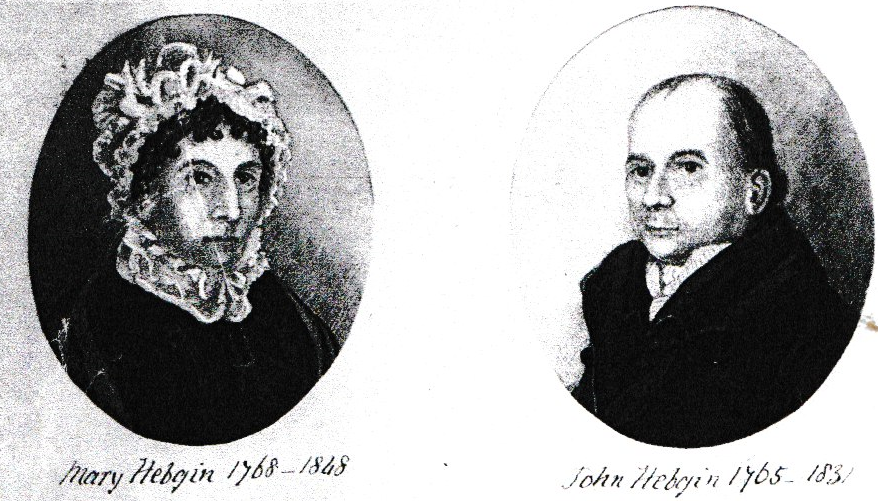
The Fincham Hebgins were from a Stoke Ferry family who owned land and property there. William and Ann Hebgin moved to Playters Hall, Fincham in 1791 as a tenant. The house and farm were owned by Ann’s father, John Raby, who had purchased it from Rev. John Peele in the same year, 1791. The lease was made out to William and his son John who carried on farming when William died in 1793. John had an elder brother William who lived at Stoke Ferry and a younger sister Ann who married James Blomfield at Stoke Ferry in 1791.
John married Mary Newton, daughter of John Newton of Methwold. In 1813 John’s aunt Elizabeth, who by this time had inherited the Playters Estate died and left it to John. The estate consisted of 393 acres with the residence and two cottages and ‘ the moiety of the Rectory and Impropriation of Fincham and of Tithes and dues to the same Rectory or Impropriation.’ Further the will said that on the failure of the male line the estate was to go to his daughters.
So to the next generation. The eldest child and only son of John and Mary was William. He was the one who gave the extra land to enlarge the churchyard. The history of Impropriation can be found elsewhere but the effect was that William was the Lay Rector who could collect tithes but was responsible for the upkeep of the chancel. The chancel tax issue has been well debated in recent years. Elsewhere on this site is recorded the improvements and repairs to the church paid for by William, mainly during the incumbency of Rev Blyth. His donation of land for the churchyard was the subject of a newspaper article in 1864. It said:
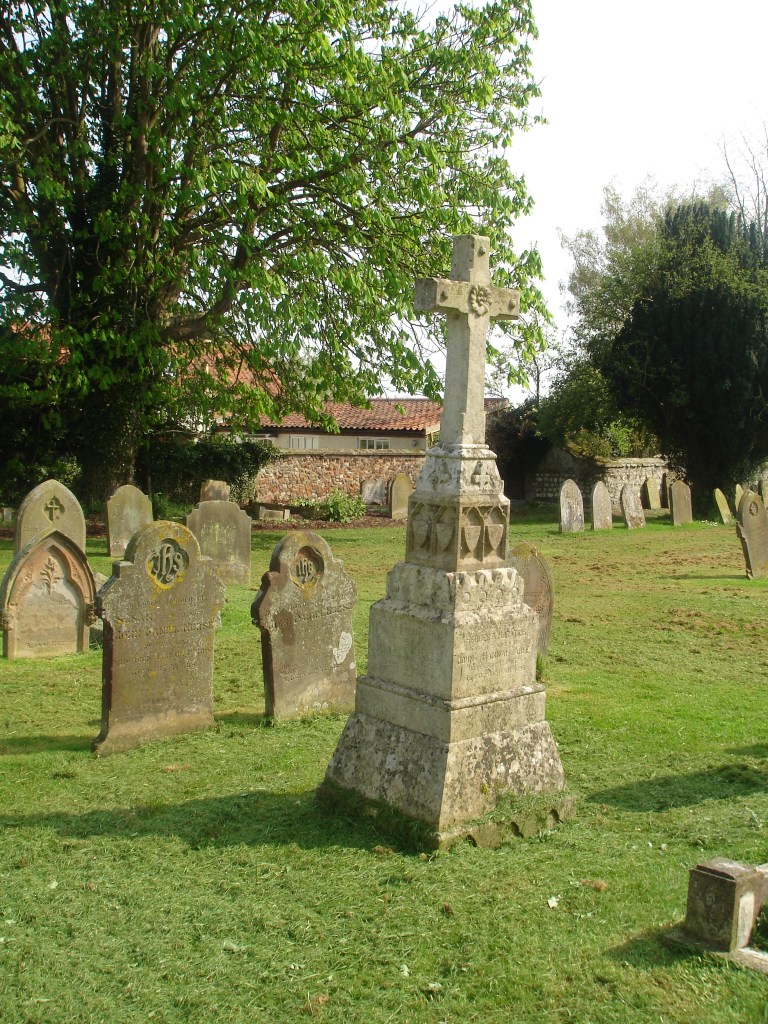
‘Of the present church we need say but little but only remark that the churchyard was very small when compared with the population, and at last it was found absolutely necessary to procure a fresh piece of land. We do not know whether any effort was made to obtain possession of the ancient churchyard of St. Michael,(supposing of course that its position is ascertainable ), but if it could have been procured a re-consecration would not have been necessary. But be this as it may, the most obvious scheme was to add a piece to the present churchyard. As it happened, Mr Hebgin, the lay impropriator, had a field abutting on the churchyard on the north, and when applied to he very handsomely presented the parish with about two roods of land. As some of our readers may remember, Mr Hebgin died on 3rd January, and the last piece of business he transacted was signing the deed of conveyance, and we think it would only be right that some memorial should be erected to his memory in the new churchyard, and we would suggest something in the style of a an Eleanor cross.’
After the consecration by the Bishop of Norwich and the naming of clergy and churchwardens, the report concludes:
‘There were several entertainments in the parish. The visitors sat down to a substantial lunch in the school, provided by Mr John Aylmer of the Manor House. The old women were taken care of by Mrs Cator, and the school children had a tea given to them by the Misses Hebgin. In the evening the bell-ringers rang a merry peal, and the choir and ringers afterwards had supper together at the Rectory. The Misses Hebgin also gave their labourers a good breakfast before the service.’
William had four sisters. The eldest, Mary, married Thomas Carneys Wales a surgeon of the Wales family who practised as doctors for several generations in Downham Market. This Thomas Wales was the second Thomas but the first with the distinctive second name. The wedding was in Stoke Ferry in 1821. The second eldest, Sarah, married John Etheridge at Stoke Ferry in 1828.
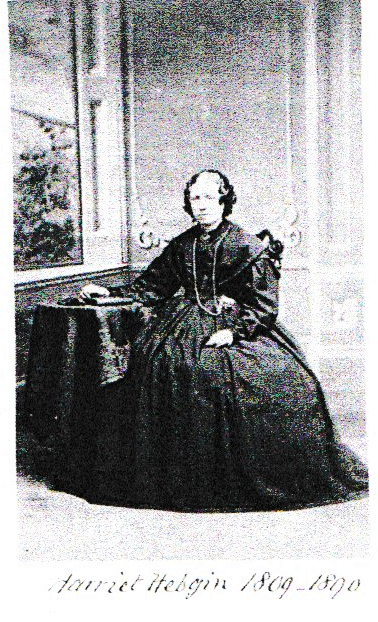
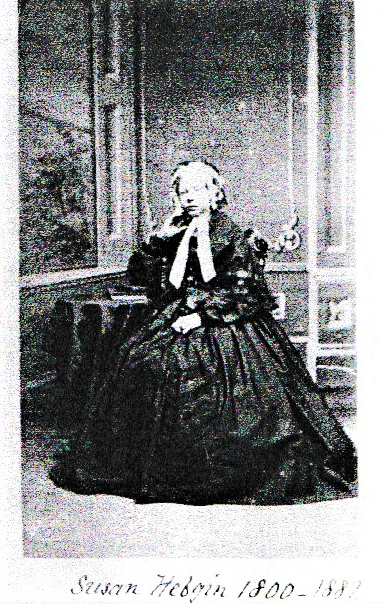
His two other sisters were Susan 1800-1882 and Harriet 1809-1890. At the death of William the estate passed to his four sisters. Mary Wales sold her one fourth share to Susan and Harriet who now owned the Playters Estate and continued to live in Playters Hall until their deaths. They continued to fulfil their duties as Lay Rectors to the chancel. When Harriet died in 1890 the following appeared in a newspaper:
‘PROPERTY SALES-On Tuesday Mr C. Hawkins offered for sale by auction, at the Glode hotel, the residential estate of the late Miss Hebgin, known as Playters Hall , and situated in the parishes of Fincham, Stradsett and Shouldham Thorpe, consisting of a brick built and tiled farm house, gardens, orchard, farm buildings, three cottages, and 385acres 2 rood and 3 perches of arable and pasture land. The bidding commenced at £10,000, and at £10,400 it was withdrawn, the auctioneer stating the reserve price was £11,100.
An addition states ‘There was no bid for the impropriate rent charge of the parish of Fincham, commuted at £325.’ The estate had been left to the Wales family who presumably had put it up for sale.
A descendant of the Hegbins wrote:
‘I was in the family vault in 1890 when it was opened for the interment of Harriet Hegbin. There are five (or six) stone steps ranged on one side of the Vault, with the coffins of members of the family. The coffin of Henry Young stands upon the floor.The Vault was then bricked up forever.’
Henry Young was a distant kinsman of the Hebgins and was a Churchwarden for sixteen years.He is remembered by a tablet over the vestry door which says ‘interred in the vault beneath/lie the mortal remains of Henry YOUNG gent/(sixteen years churchwarden of this parish)/ he departed this life Jan 12 1848 aged 56 years. A white tablet on the south wall of the chancel says ‘Sacred to the memory of William HEBGIN who died Jan 3rd 1864 aged 72 years, also Susan HEBGIN who died February 24th 1882 aged 81 years, also Harriett HEBGIN who died February 8th 1890 aged 80 years.’ There is another white tablet in the chancel to John (1765-1831) and Mary Hebgin (1768-1848) which -says’ they are interred in the family vault beneath.’
A brass plate in the chancel says ‘this window is erected to the Glory of God and in loving memory of Susan and Harriet HEBGIN last survivors of the HEBGIN family resident for 99 years at Playters Hall in this parish-their remains rest in the family vault in this chancel.’
 Fincham Local History Society