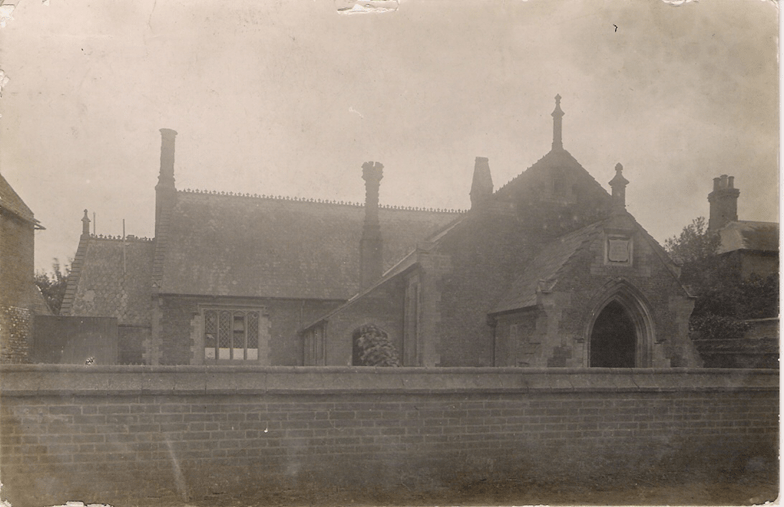
In 1846 the Rev Loftus was stripped of the living of Fincham so when his replacement ,the Rev William Blyth arrived he was determined to be as unlike the Rev.Loftus as possible. It is to William Blyth that we owe the additional graveyard, the pews in the church and the only published book on the history of Fincham. He soon set to work on building a school but, as he wrote in his diary, it was intended only to be there until a better one was built.
The school met with approval by the Bishop, and probable relief after the Loftus period, as William Blythe quotes in his book on Fincham
When Bishop Stanley first saw the plans for a National School and the restoration of St Martin’s Church in this place, he exclaimed “I am amply repaid by these for all my ‘anxieties about your parish”
It was not until 1848 that work actually commenced, on glebe land given by William Blyth himself. Blyth also contributed £748 7s 1d to the costs and a donation of £100 towards the upkeep and equipment of the school.
June 1848. First Stone of new School room laid by Ernest (Wm Blyth’s son)
July 1848. School walls up to roof
Finally the school was opened to pupils. William Blyth celebrated in style
September 1848. New school room opened – a happy day for all, for which humble thanks be given to God. 120 children to tea at 4o’clock, 25 widows &c at 5, 25 visitors at Rectory, tea at 6 , Speeches at the school at 7, by myself, Mr C. Rolfe, Mr Edwards & Mr Chapman. 25 workmen, police & ringers at 9
William Blyth kept a note of all the materials used in building the school and the master’s house, including
May 1848 Sir Thomas Hare Baronet presented to the Trustees of Fincham School about 4/5 loads of old materials as his contribution towards building the said school, through his agent Mr Wiggins. The said materials are worth £5.
Running the school was not without its problems. One of William Blyth’s biggest headaches seems to have been the teachers. At this time there were very few qualified teachers and some of the teaching would have been done by pupil teachers chosen from the older pupils. Blyth appointed 7 different head teachers in the first 14 years of the school.
October 1848 School business commenced by Mr Thomas Smith and his wife as master and mistress of the same.
Mr Smith was not the first master to live in School House as it wasn’t to be ready until Christmas but by that time William Blyth was very dissatisfied with him
December 1848 Advertised for new schoolmaster. Gave Schoolmaster (Smith) notice to quit. The conduct of the master has been bad, his treatment of the children most unjustifiable. He has been found incapable of keeping order as he is unwilling to attend at Sunday school and is violent in his treatment of the children. He is quite unfit for such a situation.
January 1849. The new schoolmaster (Joseph Richards) arrived from Bridgnorth. He commenced duties, the late master refusing to leave the room until paid a quarter’s salary. In May 1849 Mr Hubbard was paid half a year’s rent of a cottage for Thomas Smith the previous schoolmaster at a cost of £1.19s
February 1849. The school greatly improved
However this state of affairs did not last for long. The Rev Blyth seemed satisfied with the Richards but was unable to afford them.
September 1852 Dismissed Richards and appointed a cheaper person (there was insufficient funding to pay for a full master’s salary of £50.pa)
January 1853 Miss Musgrove started
August 1853 The school mistress Ann Musgrove after due notice left Fincham. She had fallen into a melancholy mood and very eccentric habits quite unfitting for her duties. Advertised immediately for a replacement
September 1853 The new mistress Miss Stone from Lincolnshire entered upon her duties with excellent testimonials, salary £30 pa but she was found to be inefficient and after notice agreed to stay until her replacement should be appointed. She was well disposed, obliging and sensible person but unequal to the management of 30 small children. Testimonials much too high.
March 1854 Miss Stone left for London
March 1854 Mrs McNess arrived with her two daughters
April 1854 Mrs McNess refused to leave the house and was ejected by the constable. She may have been as unhappy with Fincham as the Rev Blyth was with her.
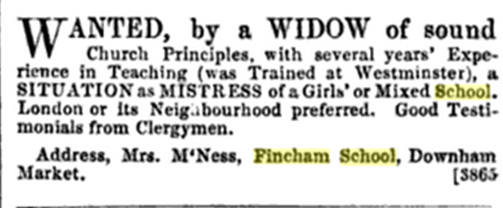
William Blyth obviously hoped that it would be third time lucky and made a new appointment
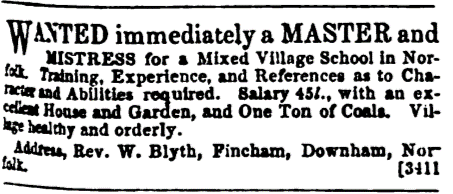
April 1854 The new master and mistress Mr and Mrs Howard from Redgrave in Suffolk £50pa
Finance remained a problem and in 1857 the school trustees sold the farmyard to the west of the school to George Aylmer who had owned the grocer and draper’s shop on the other side of the school. The land was sold for £150.00 which was invested in 3% consoles which provided an annual income of £4 17s 7d for the school (previously the farmland had provided an annual income of £6 pa.
April 1858 Gave the master and mistress notice to leave, the school has been falling off very much for several months and parents making heavy complaints.
September 1858 Mr and Mrs Phillips from Laythorpe in Lincolnshire commenced duties.
1858 Resolved to take in fewer young children as they are a great hindrance to the progress of others
July 1861 the master Phillips has been much in debt to the parish. I acceded to his request to stay until the end of the year. He promised to do his very best
December 1861 Mr. and Mrs Phillips left the school house and took lodgings at The Swan.
January1862 The new master Charles Triggs commenced his duties. His age 20 years, apprenticed at Lowestoft and trained at Highbury in 1861 passed 2nd class of 3rd division. His wife Eleanor to be mistress and attend in the afternoon.
June 1874 School somewhat crowded. Seventeen children from Barton have been admitted within the month their school been closed while the building of another is in progress
November 1875 Trigg’s salary to be increased if he would get himself out of debt, deny himself a little more and recover the tone of the school.
Charles Triggs’ wife Eleanor had died of consumption in 1872 leaving him with 3 small children
November 1875 Gave the master Triggs notice to leave on December 29th and give us possession of the house.
Engaged master and mistress George Day and wife from Stowe school £60 salary and ½ (school pence) guaranteeing him £90 at least
There had been 8 head teachers in the 29 years since the school opened. George and Jane Day were to stay at the school until Mr Brocklebank took over in 1918, The Days had been there a total of 42 years.
November 1877 Report received as follows. The school is in excellent order and has made decided progress since the last inspection. Mr Day must have worked with the most praiseworthy diligence
Wm Blyth died in 1886 having presided over two further building additions
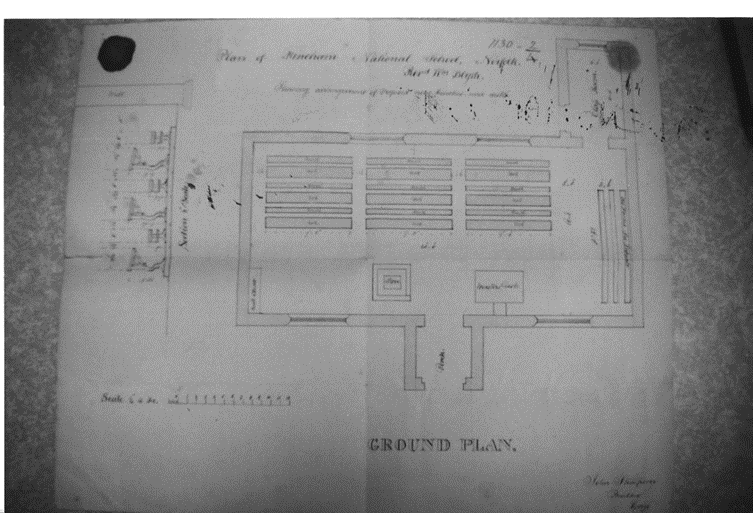
The 1848 building consisted of a large classroom running west-east with the infants and gallery to the east. There was a very small classroom to the southwest. Centrally on the north side was a porch. The schoolhouse to the southeast was built at the same time. In 1864 the small classroom was doubled in size by being extended eastward. In 1875 a further classroom was built to the north at the west end, with a boy’s cloakroom and a front porch northward to the street and a girls/infants cloakroom to the east. At some stage the small classroom became a boys’ porch and at a different time a storeroom. In the 1950’s the east half of the small classroom was demolished to improve light in the main classroom and the remaining space became an office. A curtain, later a wooden partition, was used to divide the main classroom. Initially the main classroom ran east-west the infants section partitioned off and a wall to the north between the main classroom and the 1875 classroom. A later plan show this wall removed so that the main classroom runs north-south. No records have been found relating to the 1882 date on the datestone in the east wall of the schoolyard.
Norfolk Rural Schools Survey 2010
In 1905 there was an apparent outbreak of spotted Fever in Fincham Spotted fever or cerebrospinal meningitis was a generally fatal disease. Several of the school children were affected and the school manager T H Barker a local shopkeeper and manager of the school, died
Like several of the previous head teachers in Fincham George Day oversaw the collecting the census. He was not above enlisting the help of the pupils. As he notes in 1911 in an entry in the school logbook
March 1911 Special lesson on the Census this week. The first class can now fill up the census schedules correctly
Several boys received certificates from NEC allowing them to work during the period of the war
1915 Leslie Gamble
1915 William Thompson and Stanley Hall
1915 William Wilding
1916 Thomas Parker
1916 Leslie Gamble
1916 Alfred Bingham
1916 William Wilding
1916 Harry Thompson and Alfred Bingham
1917 Percy Gamble
1917 Harry Thompson and Alfred Bingham
1917 Alfred Bingham returned
1917 Bertie Mann
1917 Walter Watson
1917 Horace Addison
1918 Bertie Kerry
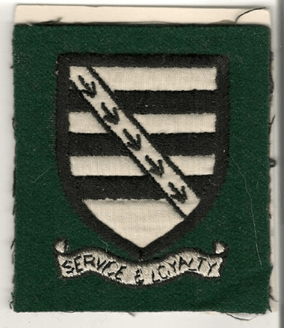
In 2001 Marina Waring bought the school and opened Puddleducks nursery. In 2003 there were 44 children on roll .The School and School House (the school teacher’s house) are now privately owned residences.
Quotes are from Wm Blyth’s book…., Wm Blyth’s diaries (unpublished) and the school Accounts and log books in the Norfolk Records Office
 Fincham Local History Society